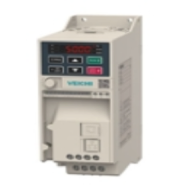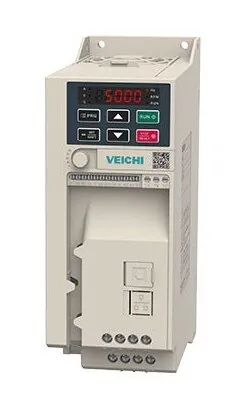
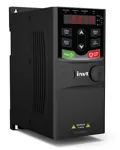
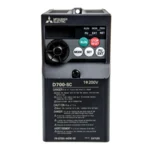
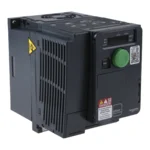
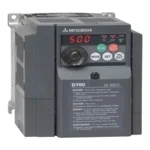
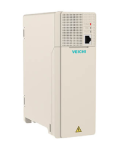
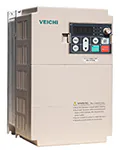
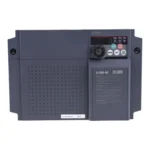
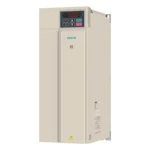
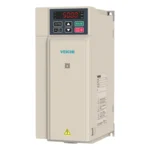
What we ship most often as the "workhorse" VFD
We carry over 1,700 VFD models in stock, but most orders close on 4-5 series. Through 2025-2026 our top runners are Veichi AC10 for tight budgets, INVT GD20 on conveyors and compressors, Delta VFD-E for machine tools, Mitsubishi FR-D when the customer already runs Japanese automation, and Schneider ATV310 on sites that need SCADA integration. Tell us the motor's rated current (off the nameplate, in amps). We will pick a model in 5 minutes and ship the same day from our Kyiv warehouse.
A variable frequency drive (VFD, AC inverter) does two jobs. First: soft start without the 5-7x inrush current. We cap it at 1.5x rated. Second: motor speed control from zero up to 600 Hz on the AC10/AC310 series. From this you get 20-60% energy savings on pumps and fans (cubic torque-vs-speed law), mechanical protection from start-up shocks, and accurate pressure or temperature hold via the built-in PID. That is the basic story.
First question we ask: single-phase or three-phase
Domestic 220 V single-phase mains at home or in a small workshop. We pick single-phase units up to 2.2 kW (Veichi AC10-S2 series, INVT GD20-S). If the motor is three-phase but your mains is single-phase, you need a 220 to 380 V converter, and the same AC10-S2 line covers that case. Industrial 380 V three-phase covers 90% of our orders: wider catalog, models from 0.4 to 630 kW. Load type: pump or fan gives variable torque M proportional to n squared (scalar V/f is enough); conveyor, extruder or hoist gives constant torque, so you need vector SVC/FOC.
What else we ask before ordering. One: do you need an EMC filter (yes for residential mains and medical sites). Two: will the drive run from a diesel generator; that needs pre-charge control and a generator sized 1.5-2x the drive load. Three: heavy-start regime (crusher, press), go one power step up. Manufacturer warranty is 12-24 months depending on the series, shipping from our Kyiv warehouse takes 1-3 days. If it is easier, send us the burnt VFD's part number by email or a photo of the motor nameplate, the rest is on us.
How to Choose a Variable Frequency Drive
VFD selection starts with four key parameters:
- Motor power and current — the most accurate selection parameter is the motor's rated current in amps. The VFD's rated current must equal or exceed the motor's rated current. Any motor with power below the VFD's rated power can be connected without restrictions. For heavy-start applications (crushers, presses), choose one power step above.
- Supply voltage — 1×220V for light-duty applications up to 2.2 kW, 3×380V for industrial installations. To run a three-phase motor from single-phase mains, use a 220V → 380V converter.
- Load type — variable torque (pumps, fans — quadratic M∝n²) or constant torque (conveyors, extruders, hoists — M=const).
- Control method — scalar (V/f) is sufficient for pumps and ventilation, vector (SVC/FOC) is required for precise positioning and full-torque operation at low frequencies.
Comparison of popular 4–5.5 kW models from different manufacturers:
| Model | Power | Rated Current | Max Frequency | Control | Application |
|---|---|---|---|---|---|
| Veichi AC10 | 4 kW | 9.5 A | 600 Hz | V/f | Pumps, fans |
| Veichi AC310 | 4 / 5.5 kW | 10 A | 600 Hz | SVC sensorless | Conveyors, extruders |
| Delta VFD-E | 5.5 kW | 13 A | 600 Hz | V/f, SVC | Pumps, machinery |
| INVT GD20 | 4 kW | 9.5 A | 400 Hz | V/f, SVC | Ventilation, compressors |
| Danfoss FC51 | 4 kW | 9 A | 400 Hz | V/f (AMA) | Pumps with PID |
Veichi AC10 is the best-selling VFD series in Ukraine for 2025–2026: compact housing, built-in Class C3 EMC filter, frequency range up to 600 Hz for high-speed spindles, and RS-485 (Modbus RTU) interface included as standard. For constant-torque applications requiring 150% torque at 0.5 Hz, choose the Veichi AC310 series with sensorless vector control.
VFD Manufacturers
We partner with manufacturers whose equipment is proven by years of operation at industrial facilities across Ukraine. Each brand serves a distinct market segment — from budget solutions for small businesses to premium systems for critical infrastructure.
- Veichi Electric — Chastotnik.ua's top seller. Series: AC10 (scalar, 0.4–280 kW), AC70E (single-phase 220V input, 220→380V conversion), AC310 (vector SVC/FOC, 0.75–630 kW). Built-in EMC filter, extended 0–600 Hz frequency range, RS-485 port, user-friendly keypad. Best price-to-performance ratio for most industrial applications.
- Schneider Electric — French industrial leader. Series: Altivar 310 (compact general-purpose), ATV320 (enhanced with built-in filter and STO), ATV630/ATV930 (heavy industrial processes). Supports Modbus TCP, CANopen, EtherNet/IP, PROFIBUS — seamless integration with SCADA and MES systems. Global service network.
- Danfoss — Danish HVAC and water supply specialist. Micro Drive FC51 features built-in PID controller, Automatic Motor Adaptation (AMA), and cascade control for up to 4 pumps. FC51 is deployed at waterworks, district heating facilities, and shopping center ventilation systems.
- Delta Electronics — Taiwanese manufacturer with a comprehensive product range. VFD-EL (economy, fans), VFD-E (universal, 0.4–22 kW), VFD-C2000 (high-performance with STO and auto-tuning). Delta drives operate reliably at up to +50°C without derating — essential for non-air-conditioned enclosures.
- INVT — Chinese manufacturer with 22 years of experience. GD20 (universal, built-in brake module up to 30 kW), GD200A (heavy industrial duty), GD350A (servo drive). Expansion cards for PG feedback, Modbus, PROFIBUS, Ethernet — flexible adaptation to any automation protocol.
- ABB — ACS150 (micro drive), ACS310 (pumps/fans with Safe Torque Off), ACS580 (general industrial with Direct Torque Control). Built-in Flying Start for power-loss recovery.
- Siemens — SINAMICS V20 (basic), G120C (modular with Safety Integrated), G120X (infrastructure-specific). Full TIA Portal integration, PROFINET support.
- Mitsubishi Electric — FR-D (compact), FR-E (enhanced), FR-A800 (premium with positioning). Japanese reliability, particularly suited for CNC machine tools.
VFDs by Specifications
Quick selection by key parameters:
By power rating: 2.2 kW · 3 kW · 5.5 kW · 7.5 kW · 11 kW · 15 kW · 22 kW
By supply voltage: single-phase 220V · three-phase 380V · 220V → 380V (single → three-phase)
By application: for pumps · for fans · for motors · for single-phase pumps · for generator starting
By control type: vector (SVC/FOC) · scalar (V/f)
Warranty and Support
All variable frequency drives come with a manufacturer warranty of 12 to 24 months. Our engineers will help you select the right VFD for your specific motor and application at no cost: calculate the required power rating for your duty cycle, recommend the optimal series, and advise on startup and protection parameter settings.
Delivery by Nova Poshta across Ukraine: Kyiv, Kharkiv, Odesa, Dnipro, Lviv, Zaporizhzhia, and all locations. Bank transfer with VAT for corporate customers. Consultation and orders: (093) 170-14-25.