Inductive sensor: which to pick for your metal, and where it will fail
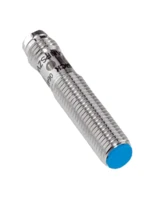
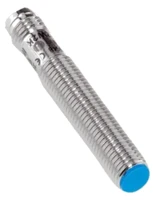
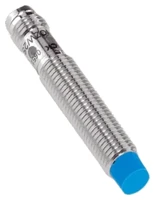
We install inductive sensors where you need to detect metal without contact: on conveyors for part counting, on machine spindles for tool position feedback, on presses for safety. Top movers from our stock: Autonics PRD18-7DN (budget, 7 mm sensing distance, target Fe steel) and Pepperl+Fuchs NBN8-12GM40-E2 (industrial standard, 8 mm, IP67). They work only on magnetic metals. Aluminum, copper, stainless steel sense worse: actual range drops by a factor of 2-3 versus the spec sheet number.
A typical customer of ours this year: a CNC shop installs 12-14 inductive sensors on the turret and feed axes plus 4-6 on safety doors. Per-unit budget runs 200-1500 UAH depending on brand and barrel size (M8, M12, M18, M30). Outputs: NPN for NPN PLC inputs (Mitsubishi, Omron) or PNP for most European PLCs (Siemens, Schneider M580).
What we ask before the order: target metal, distance, housing
One: which metal are you sensing. Fe steel: we ship the standard Sn rating (4 mm for an M12, for example). Aluminum or brass: you need a "factor 1" sensor like Pepperl+Fuchs NBB4-12GM50-E2 or Sick IMB12-04BNSVT0K, where range does not drop by material. Two: actual gap between sensor face and target in operating position. We add 30% margin because temperature and vibration shrink Sn. Three: environment (oil, washdown, coolant) sets IP67/IP69K and the temperature range.
We keep four main brands in stock: Autonics (Korea, budget, 600+ models), Pepperl+Fuchs (Germany, industrial standard), Sick (Germany, precise positioning), Omron E2A/E2B (Japan, food and pharma). Manufacturer warranty 1-2 years, delivery from our Kyiv warehouse 1-3 days. Customers often order them with a PLC or encoder as one position-feedback bundle.
| Housing Diameter | Sensing Distance Sn (Steel) | Sn for Aluminum | Typical Application |
|---|---|---|---|
| M5 | 0.8 mm | 0.3 mm | Micro-positioning, printing machines |
| M8 | 1.5–2 mm | 0.6–0.8 mm | Part counting, packaging equipment |
| M12 | 2–4 mm | 0.8–1.6 mm | Conveyor lines, CNC machines |
| M18 | 5–8 mm | 2–3.2 mm | Metalworking, automated production lines |
| M30 | 10–15 mm | 4–6 mm | Heavy industry, crane equipment |
Reduction factor for non-ferrous metals: aluminum — 0.4; brass — 0.5; copper — 0.3; stainless steel — 0.7. Choose a model with a 30–50% margin over the actual working distance to compensate for vibration, temperature drift, and mounting wear.
Output Types: NPN, PNP, Analog
The output type is determined by the controller to which the sensor connects. PNP (sourcing) is the standard for Europe and Ukraine, compatible with Siemens, Schneider, and ABB PLCs. NPN (sinking) is used with Asian controllers from Mitsubishi, Omron, and Keyence. Models with 4–20 mA analog output are also available for tasks requiring precise distance measurement (e.g., shaft runout monitoring). Switching logic: NO (normally open) — signal when object appears, NC (normally closed) — signal disappears when object appears. Universal NO+NC models allow mode selection during installation.
Inductive Sensor Manufacturers in Our Catalog
We work with manufacturers whose products comply with IEC 60947-5-2 standards and hold CE, UL certifications:
- Sick — Germany. Industry leader in industrial sensing: full range of housings from M5 to M30, switching frequency up to 5,000 Hz, IME and IMS series for harsh environments
- Siemens (SIRIUS 3RG) — full integration with SIMATIC S7, ET 200SP, IO-Link support for diagnostics and configuration via operator panels
- Pepperl+Fuchs — specialization in explosion-proof (ATEX/IECEx) and high-temperature solutions for the oil and gas industry
- IFM — Germany. Compact housings, built-in IO-Link, IF/IG series with a 5-year warranty
- Keyence — Japan. Miniature M3/M4 housings, highest switching frequency, ideal for high-speed production lines
- Autonics — South Korea. Optimal price-to-quality ratio for standard automation tasks
- Wenglor — compact sensors for food and pharmaceutical industries, hygienic V4A housings
- Baumer — Switzerland. Precision sensors for robotics and servo drive systems
Industrial Applications of Inductive Sensors
Inductive sensors address dozens of industrial automation tasks:
- Conveyor systems — counting metal parts, flow monitoring, jam detection
- CNC machines — axis limit switches, workpiece clamping verification, tool breakage detection
- Presses and stamping machines — stroke control, emergency stop on path overrun
- Packaging equipment — mechanism position detection, cap sealing verification
- Robotics — home position detection, gripper part-presence verification
- HVAC and water treatment — damper and valve position monitoring
Inductive Sensors by Application Type
Select the right category for precise matching:
- All industrial sensors — complete sensor product catalog
- Proximity sensors — capacitive, ultrasonic, magnetic types for non-metallic objects
- Optical sensors — photoelectric sensors for long distances and small parts
- Pressure sensors — for hydraulic, pneumatic, and vacuum systems
- Level sensors — liquid and bulk material level monitoring
Warranty, Delivery, Expert Selection
Every inductive sensor in our catalog carries an official manufacturer warranty of 12 months or more. Our engineers assist with selection based on your technical requirements — send your parameters (mounting diameter, sensing distance, supply voltage, output type, IP protection rating) and receive a recommendation within one business day. Delivery via Nova Poshta across Ukraine: Kyiv, Kharkiv, Odesa, Dnipro, Lviv, Zaporizhzhia. Invoice payment for businesses or cash on delivery for individuals.