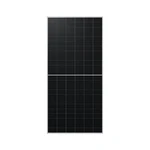
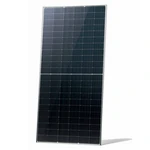
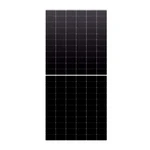
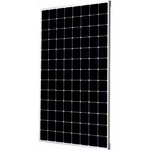
Solar panel 600 W: when it is worth taking, and when 555 is enough
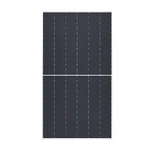
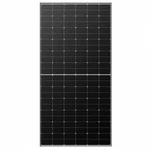
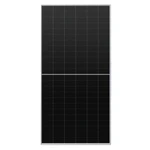
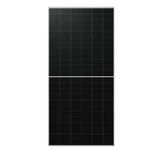
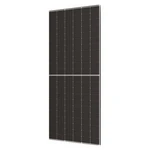
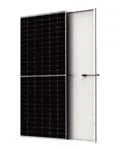
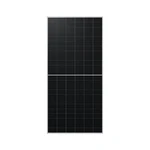
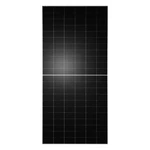
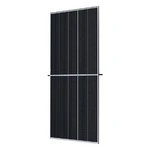
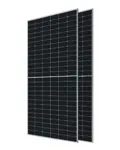
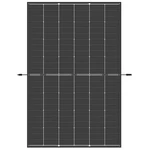
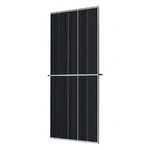
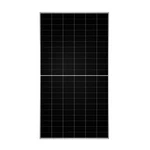
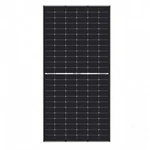
A 600 W panel (actually 580-630 W) gets ordered for two scenarios. First: a large roof or ground array where the customer wants fewer modules and less terminal hardware (fewer joints = fewer failure points). Second: limited area with a max-watts-per-square-meter requirement. Format is 156 half-cell: roughly 1.13 × 2.47 m, weight 32-34 kg. That is already at the edge of what two people can comfortably carry up a pitch; nearly 5 kg heavier than 555 W. We stock Veichi VCS-156H series.
Technically this is monocrystalline PERC+ at 22-22.5% efficiency (slightly above 500 W thanks to larger cells). Vmpp 43-44 V, Voc ~52 V: a string of 9 in series yields Voc ~468 V, still inside a 500 V MPPT. Our shipping model: VCS-156H-585-P, because it gives a clean panel count for a 10 kW inverter – 17 panels deliver 9.95 kW.
First question we ask: will the roof hold it
We always ask when a customer says "I want 600 W". Rafter and batten capacity on typical Ukrainian houses is 25-30 kg/m². A 600 W panel plus mount = ~33-36 kg over ~2.8 m² footprint, which is 12-13 kg/m². It holds. But if you have an old 1995-2005 roof with 22 mm battens, reinforce the rafter or take 555 W. A weight margin is cheaper than rebuilding the roof.
What else we always check. First: passage width to the mounting site. A 1.13 × 2.47 m panel does not fit a normal lift and barely passes narrow stairs – we ask address and floor. Second: is there a crane or at least a tripod hoist, because hauling a 33 kg panel up by hand is an injury waiting to happen. Third: MPPT window of your inverter, especially if you run an older 60-450 V model. Warranty 12/25 years per datasheet, shipping from Kyiv 1-3 days. If you want a 600 vs 555 comparison for your specific roof, call us and an engineer will walk through it.
| Model | Power | Efficiency | Type | Application |
|---|---|---|---|---|
| VCS-156H-600-P | 600W | 21.46% | Monofacial | Industrial PV, large rooftops |
| VCS-156H-605-D | 605W | 21.64% | Bifacial | Ground mount, trackers |
| VCS-156H-615-D | 615W | 22.00% | Bifacial | Commercial generation |
| VCS-156H-630-D | 630W | 22.54% | Bifacial | Industrial & commercial PV |
600W solar panel manufacturers
Veichi is a Chinese manufacturer of industrial equipment specialising in variable frequency drives, hybrid inverters, and solar panels. The VCS series includes 600W+ modules built on monocrystalline silicon Half-Cell elements with N-type TOPCon technology. Veichi panels feature 3.2mm tempered glass with anti-reflective coating, ensuring stable performance over 25+ years.
600W solar panel specifications
- Module power: from 575 to 630W — choose the optimal variant for your specific project
- Efficiency: from 20.57% to 22.54% — monocrystalline technology delivers high conversion performance
- Operating voltage: 44.20–45.30V — compatible with most MPPT controllers and inverters
- Bifacial modules: dual-sided panels generate additional energy from reflected light on the rear side
- Material: monocrystalline silicon with half-cut cells for reduced power losses
Warranty and delivery
All 600W solar panels come with the manufacturer's official warranty: 12 years for manufacturing defects and 25 years of linear performance guarantee (minimum 80% of nominal power). Our engineers will help calculate the number of panels, select a compatible inverter, and design the mounting system. Payment by bank transfer for businesses or by card. Delivery across Ukraine by freight carriers with reliable packaging.