Robot manipulator: what it does and how it differs from a gantry
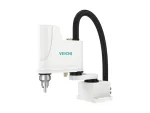
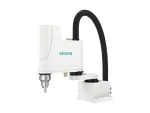
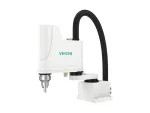
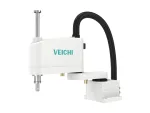
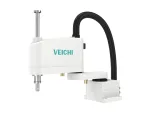
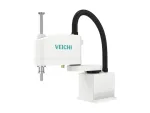
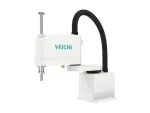
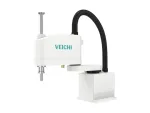
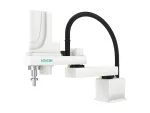
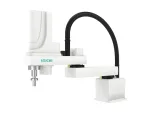
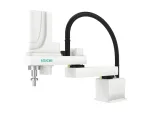
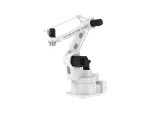
A robot manipulator is an articulated 6-axis or 4-axis SCARA arm that works where you need flexible motion and reach off a straight line. We install it for pick-and-place, CNC machine tending, part transfer between operations, and case palletizing. Top sellers from our stock: FANUC LR Mate 200iD (7 kg, 717 mm reach) for labs and small-part assembly, and MOTOMAN MH50 II-20 for heavy manipulation up to 50 kg (metallurgy, glass plant). If your trajectory is always a straight line on two axes, take a gantry instead, it is cheaper and faster.
We keep four brands: KUKA (Germany, KR series), FANUC (Japan, the widest catalog: LR Mate, M-10iA, R-2000), ABB (Switzerland, IRB plus YuMi cobots), MOTOMAN/Yaskawa (Japan, heavy MH series). Payload from 0.5 kg (lab arms) to 700 kg (auto-plant castings), reach from 350 mm to 3500 mm.
What we ask before sizing: payload, reach, cycle time
One: part weight plus gripper weight. A 5 kg part plus a 2 kg gripper means an 8-10 kg arm (20% margin). FANUC M-10iA/12 is the typical pick. Two: working envelope radius. If the cycle picks from a 1.5 m conveyor and places onto a 1.8 m machine, you need 1.5+ m of reach, that is M-20iA or KUKA KR 30. Three: line takt. Sub-second cycles run only on specialized DELTA robots like ABB IRB 360 FlexPicker; articulated arms simply do not fly that fast.
A typical customer of ours: a CNC turning shop where the operator gets tired of manual load and unload. We install a FANUC LR Mate 200iD/7L with a custom gripper, 8-12 second cycle per part. Manufacturer warranty 1-2 years, integrator commissions it in 5-15 days. Delivery from our Kyiv warehouse 7-14 days. For welding jobs see welding robots; for palletizing the heavy MOTOMAN MPL series is a separate line.
| Model | Payload | Reach | Repeatability | Axes | Application |
|---|---|---|---|---|---|
| FANUC CR-7iA | 3 kg | 1437 mm | ±0.08 mm | 6 | Assembly, small part handling |
| KUKA KR 10 R900 Sixx | 10 kg | 1101 mm | ±0.03 mm | 6 | Machine tending, adhesive bonding |
| ABB IRB 1200-7/0.7 | 5 kg | 901 mm | ±0.06 mm | 6 | Compact assembly, packaging |
| MOTOMAN GP7 | 45 kg | 1787 mm | ±0.08 mm | 6 | Palletizing, heavy part handling |
Robot Manipulator Manufacturers
The catalog features industrial robots from four leading manufacturers:
- FANUC — 263 models, leader in CNC-compatible robots with ArcMate (welding) and CR (collaborative) series.
- MOTOMAN (Yaskawa) — 247 models, wide payload range from 3 to 130+ kg, up to 15 axes for complex trajectories.
- KUKA — 100 models in the KR series with ±0.03 mm repeatability, optimal for precision operations.
- ABB — 87 models in the IRB series with flexible mounting (floor, wall, ceiling, angled).
Robot Manipulators by Specifications
Select a robot by key parameters:
- Welding Robots — specialized models for arc and spot welding.
- All Industrial Robots — full catalog with filters by payload, reach, and number of axes.
Warranty and Support
Chastotnik.ua provides a full supply cycle for industrial robot manipulators in Ukraine: official manufacturer warranty, technical consultation for selection, delivery across Ukraine (Kyiv, Kharkiv, Dnipro, Odesa, Lviv). Payment by bank transfer for legal entities or by invoice.