Proximity sensor: how inductive really differs from capacitive in practice
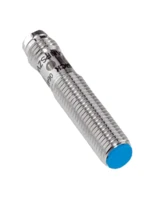
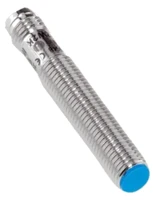
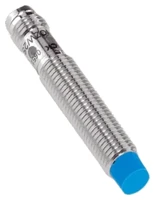
Proximity sensor is the umbrella term for two families. Inductive sees metal only, capacitive sees almost anything: water, grain, plastic, glass. A typical customer of ours this year: a CNC shop installs Pepperl+Fuchs NBN8-12GM40-E2 inductive units on safety doors and the turret, plus an Autonics CR30-15DN capacitive on a granule hopper for level-presence control. If your goal is detecting a metal shaft on a conveyor, you need inductive. If you need to track liquid level in a tank through the wall, capacitive is the only option.
We keep the full M8 to M30 range in stock for both families. Inductive: Autonics PRD18-7DN (budget, 7 mm Sn) and Pepperl+Fuchs NBB4-12GM50 (factor 1, handles aluminum plus stainless without range loss). Capacitive: Autonics CR series (10-30 mm Sn for grain, flour, plastic pellets), Pepperl+Fuchs CCN15 for liquids through walls up to 8 mm. Outputs NPN/PNP, NO/NC, analog 4-20 mA on selected models.
What we ask before the order: target material, distance, housing
One: what object are you sensing. Ferrous metal: standard inductive. Non-ferrous metal (aluminum, brass, copper): inductive with factor 1, otherwise Sn drops by a factor of 2-3. Any solid or liquid non-metal: capacitive. Two: distance plus margin. We add +30% to Sn, because temperature plus vibration shrink real range. Three: environment. Coolant shop floor: IP67 minimum. Food-grade: IP69K. Aggressive chemicals: PTFE housing or 316 stainless.
We keep four main brands in stock: Autonics (Korea, budget, 600+ models), Pepperl+Fuchs (Germany, industrial workhorse), Sick (Germany, precise positioning), Omron E2A/E2B (Japan, food). Manufacturer warranty 1-2 years, delivery from our Kyiv warehouse 1-3 days. Customers often order them with a PLC for the full position loop or with an encoder on the conveyor.
| Model | Brand | Type | Sensing range | Application |
|---|---|---|---|---|
| WL100-P4439 | Sick | Optical, retroreflective | 0.1–6 m | Conveyors, packaging, counting |
| FU6F | Keyence | Fiber optic | 110–1100 mm | Precision positioning, micro-processing |
| HD09MG-P24 | Wenglor | Optical, diffuse | 35–85 mm | Small part detection, labels |
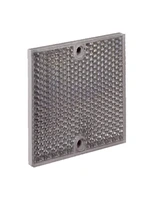
| MLV41-54-G-1371 | Pepperl Fuchs | Optical, retroreflective | 0–1300 mm | Industrial lines, object detection |
| OHDK14P5101S35A | Baumer | Optical, diffuse | 20–350 mm | Production lines, quality control |
Proximity sensor manufacturers
Our catalog features leading global brands of industrial proximity sensors:
- Sick — optical and inductive sensors for harsh industrial conditions, W and VTE series;
- Keyence — fiber optic sensors, FU series for precision positioning;
- Pepperl Fuchs — retroreflective and ultrasonic sensors for detection and measurement;
- Wenglor — compact optical sensors for packaging line automation;
- Baumer — industrial proximity sensors for precise monitoring;
- IFM — sensors with extended temperature range for demanding environments.
Proximity sensors by specifications
Choose a sensor by detection type:
- Inductive sensors — for metal objects, range 1–30 mm;
- Optical sensors — for any material, range up to 6 m;
- Level sensors — for liquid and bulk material monitoring;
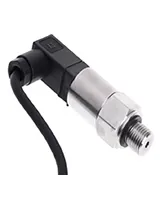
- Pressure sensors — for hydraulic and pneumatic systems.
Warranty and support
All proximity sensors come with an official manufacturer warranty of 12 to 24 months. Delivery across Ukraine via Nova Poshta, Ukrposhta, or direct shipping. Payment: bank transfer for legal entities (VAT included), bank card or wire transfer for individuals. Free technical consultation for sensor selection.