Industrial robots: the types and where each one fits
An industrial robot is not a one-size-fits-all tool. The kinematics are chosen for the task, and getting that wrong is the most expensive mistake: a SCARA won't replace an articulated arm on welding, and a 6-axis arm is overkill (and slower) where a delta is enough. A quick rundown of the types as FANUC, Yaskawa, KUKA and ABB classify them in their catalogs:
- 6-axis articulated — the all-rounder. Arc welding, assembly, machine tending, dispensing of adhesive/sealant/paint, packaging. Six axes give arbitrary tool orientation across the work envelope — for complex paths or parts the tool has to reach around. These are 6-axis industrial robots — the largest share of the catalog.
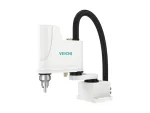
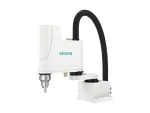
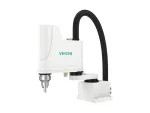
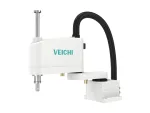
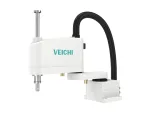
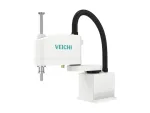
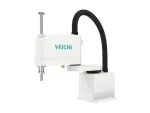
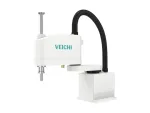
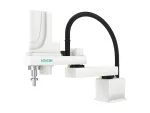
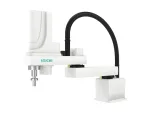
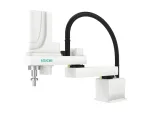
- SCARA — fast pick-and-place and assembly of small parts in a horizontal plane. Stiff vertically, mobile horizontally: press-fit, insert, transfer from tray to conveyor. Electronics, small mechanics, packing. See SCARA robots.
- Delta / parallel — ultra-fast sorting and transfer over a conveyor. Light parts, tens of cycles per second. Food, pharma, packaging of individual items. Low payload is the price of that speed.
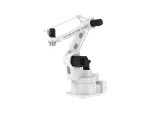
- Palletizer — stacking bags, boxes and crates onto pallets. Specialized kinematics for heavy, monotonous moves: 80–300 kg payload at the flange, large reach. See palletizing robots.
- Collaborative (cobot) — work next to a person without fencing thanks to limited speeds and loads and built-in force sensing. Suitable for small-part assembly, single-machine tending, lab tasks. Don't confuse them with industrial robots: where you need speed and payload, a cobot won't do. See collaborative robots.
We also stock general-purpose robot manipulators and welding robots in factory configuration for arc welding (torch holder on the 6th axis, interface for the welding power source).
Robot brands we offer
In stock and to order — five manufacturers. The first four are the so-called "big four", proven working standards of industrial robotics: integrators, spare parts, documentation and trained operators exist across Europe for them.
- FANUC (Japan, ~263 models) — the widest line-up in our catalog. ArcMate series for arc welding, R-2000 and M-series for machine tending and heavy handling, M-1iA/M-3iA deltas for sorting. The yellow housing is a fixture in many foundries and automotive assembly lines.
- Yaskawa Motoman (Japan, ~247 models) — strong in palletizing (MPL series, 80–300 kg) and arc welding (MA/AR series). DX/YRC controller with built-in positioner control.
- KUKA (Germany, ~100 models) — KR series for welding, assembly, machine tending; compact KR AGILUS for tight cells. The LBR iiwa cobot has torque sensors on every axis. See KUKA robots.
- ABB (Sweden/Switzerland, ~87 models) — general-purpose IRB series, the dual-arm YuMi cobot for small-part assembly, explosion-proof IRB 5500/5400 for paint booths. OmniCore/IRC5 controller. See ABB robots.
- Universal Robots (Denmark) — UR3e–UR30 collaborative robots, 3–35 kg payload, fenceless operation after a risk assessment. See Universal Robots cobots.
- TURIN (budget alternative, RRRobotica heritage) — manipulators for routine tasks without a premium-brand price. See TURIN robots.
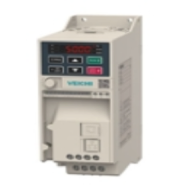
- Veichi (~52 models) — the more budget-oriented segment: VC series (6-axis, SCARA, palletizers) for routine assembly, press tending and packaging where the big four is overkill on price. See Veichi robots.
Key parameters for selecting a robot
Six numbers that filter out 90% of unsuitable models. Take them from a real spec, not a rough guess:
| Parameter | What it means | What to look at |
|---|---|---|
| Payload at the flange | Mass the robot holds on the 6th axis | Part mass + gripper/tool + cabling. Allow 15–20% headroom. Account for moment of inertia, not just mass. |
| Reach / work envelope | Radius the flange can reach | Check at the actual working angle, not the datasheet maximum — the envelope narrows near the limits. |
| Repeatability | Spread on returning to the same point | ±0.02–0.05 mm for welding/assembly; ±0.1 mm and above is acceptable for palletizing. |
| Number of axes | Degrees of freedom | 4 axes — planar tasks (palletizing, pick-and-place). 6 axes — complex paths, tool orientation. 7 axes — obstacle avoidance in a crowded cell. |
| Cycle / speed | Time per work cycle | Match it to the line takt. If the robot can't keep up with the conveyor — you need a faster type or a second robot. |
| IP rating | Resistance to dust and moisture | IP54 — ordinary shop floor; IP65/IP67 — washdown, food; special builds — paint booths (explosion-proof), foundries (heat-protected). |
For the robot's drive components and peripherals see robot drives and robot gearboxes.
Typical applications where a robot pays off fast
A robot pays off where the task is monotonous, heavy or hazardous for a person — and where there is volume. The shortest payback periods in our practice:
- Palletizing — stacking bags, boxes, crates. Monotonous heavy work plus a chronic labor shortage on that position. Yaskawa MPL or KUKA KR palletizers rated 120–180 kg cover a whole shift of loaders. See palletizing robots.
- Machine tending — loading/unloading CNC machines (lathes, mills), one robot tending several machines. The machine keeps running while the operator handles another. 6-axis FANUC M-series or KUKA KR are the usual choice.
- Welding production parts — frames, tanks, mufflers, weldments in series. A consistent bead, no fatigue. Welding robots from FANUC ArcMate or Yaskawa MA with a positioner.
- Pick-and-place on a conveyor — transfer, sorting, orienting individual items. SCARA or delta over the belt with a machine vision system. See SCARA robots.
- Dispensing adhesive / sealant / paint — where manual application gives an uneven bead and wastes material. The robot holds a steady speed and standoff — the material savings cover part of the installation.
What breaks robotization
A robot rarely "fails" on its own. What breaks robotization is the project's surroundings. The most common causes we've run into:
- No repeatability in part or container feeding. The number-one cause of failures. A robot works to coordinates — if the part lands differently each time, nothing works without machine vision or precise fixturing. Stabilize the feed first, then add the robot.
- Underestimated tooling and peripherals. Grippers, feeders, positioners, fencing and safety sensors often cost as much as the robot itself. A "robot-only" budget is a classic spec mistake.
- No one to program and maintain it. A robot needs a setter who can write programs and diagnose faults. Without an in-house specialist or an integrator contract, the cell ends up in a corner after the first breakdown.
- A cobot where an industrial robot is needed. A collaborative robot is slow and weak by definition — that's the price of fenceless safety. If the task needs speed or payload, a cobot won't cover it.
- "Bought a robot" without integrating it into the flow. A robot doesn't bring parts in, remove scrap or pass finished work down the line by itself. Without thought-through logistics in and out, the cell sits idle.
What a robotic cell includes besides the robot
Buying a "bare" robot makes no sense — what runs on the floor is a cell. Its components:
- Gripper / tool for the task — vacuum, mechanical, magnetic, welding torch, spray gun, dispenser. Chosen for the part and the operation, often engineered separately.
- Peripherals — conveyors, feeders, positioners, tables, trays. What feeds the robot on the input and takes work off the output.
- Safety — fencing, light curtains, area scanners, door interlocks. For cobots — speed-limited zones instead of fencing, but a risk assessment is still mandatory.
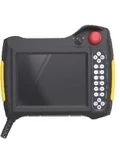
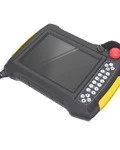
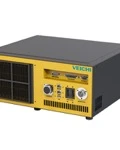
- Controller + software — control cabinet, operator interface, offline programming (RoboGuide, KUKA.Sim, RobotStudio) — critical for a changing product mix, when programs have to be prepared "on the bench" without stopping production.
- Operator training — so the line doesn't depend on a single setter.
- Service and spares — scheduled maintenance, fault response, availability of critical assemblies.
So we don't pick a robot model — we size the cell configuration to your task: kinematics type, payload with headroom, reach at the working angle, IP for the environment — plus peripherals, safety and commissioning. If the cell needs a separate axis or positioner drive — that's servo drives; if control lives outside the robot — PLCs; variable frequency drives for conveyors and auxiliary mechanisms — VFDs.
Pre-deployment checklist
- Kinematics type chosen for the task (6-axis / SCARA / delta / palletizer / cobot), not "because that's what everyone does".
- Payload at the flange — with the gripper and tool mass, with 15–20% headroom.
- Reach verified at the actual working angle, not the datasheet maximum.
- Repeatability matches the real requirement of the operation (welding/assembly — tens of microns; palletizing — tenths of a millimeter).
- IP rating chosen for the environment (ordinary shop / washdown / food / paint booth / foundry).
- Part/container feed is repeatable — or a machine vision system is planned.
- Peripherals, grippers and safety are in the budget from the start, not "later".
- It's decided who programs and maintains the cell (in-house specialist or integrator contract).
- Integration into the flow is thought through: what feeds the input and takes from the output.
Not sure about the type or brand — send us the task parameters (what the robot does, part mass with gripper, line takt, environment) and we'll size a configuration and quote it.