

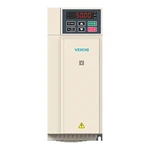

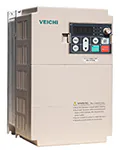


How a 220 to 380 V frequency inverter works
The job is typical: only single-phase 220 V is available on site, while the motor is three-phase (an old pump, a machine tool, a compressor). Waiting for a three-phase feed from the utility takes months and costs money. A frequency inverter with a single-phase input solves it in a day.
There are three stages inside. Rectification — the AC 220 V from the socket becomes DC of about 310 V in the DC link. Filtering — capacitors smooth the ripple. Inversion — IGBT transistors chop that DC into three phases with adjustable frequency. The motor receives proper three-phase power and a smooth ramp instead of an across-the-line jolt.
Running a 380 V motor from an ordinary 220 V socket
Yes, this works. Your three-phase 380 V motor will run from an ordinary single-phase socket at full rated power — no torque loss, no rewinding, no waiting for a three-phase feed from the utility. For motors up to roughly 3–4 kW this is the standard factory scheme, not a workaround.
Here is how. Look at the motor nameplate: it carries two ratings — 380 V in star (Y) and 220 V in delta (Δ). The windings in delta are rated for exactly the voltage a single-phase drive puts out. You move three links in the terminal box — ten minutes with a screwdriver — and the motor reaches its rated speed and torque. No power is lost: the voltage is lower but the current is proportionally higher, by √3 ≈ 1.7.
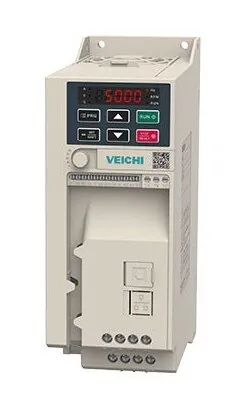
Technically the drive output is three-phase 220 V (the Veichi AC310 specification puts it as "Output voltage: three-phase, 0 V to input voltage"). For a motor in delta that is precisely its rated 220 V per winding. So when people say "a 220 to 380 inverter", this pairing is what they mean — and it delivers the result you came for.
Check the motor nameplate before ordering
One ten-second check saves you the cost and time of a return. Find the voltage pair on the motor nameplate:
- "380/220 V Y/Δ" — everything works. That is 9 out of 10 motors below 4 kW. Go ahead and order.
- "660/380 V Y/Δ" — a single-phase drive will not do. Such motors (usually from 4–5.5 kW) already run in delta on a 380 V supply and have no 220 V connection at all: the links are there, all six leads are there, but there is nothing to switch to. Here you need either a real three-phase supply or a different motor.
A rarer case is a motor potted in compound or with only three leads and no access to the links. Photograph the nameplate and send it to us — we will tell you straight away whether it will work, before you pay.
How much power your supply will carry
The second limit is your supply. The thing usually left unsaid: the input current of a single-phase drive is about twice its output current, because the same power is drawn from one phase instead of three. Real figures from the INVT GD20 manual:
- 0.75 kW — input current 9.3 A, breaker 16 A, cable 1.5 mm²
- 1.5 kW — input current 15.7 A, breaker 25 A, cable 2.5 mm²
- 2.2 kW — input current 24 A, breaker 40 A, fuse 50 A, cable 2.5 mm²
So a domestic socket on a 16 A breaker caps you at 0.75 kW, and a standard 25 A line at 1.5 kW. 2.2 kW already needs a dedicated 40 A supply. For 4 kW and above (cable per the Veichi AC310 manual — 4 mm² at 4 kW, 10 mm² at 5.5 kW, 16 mm² at 7.5–11 kW, 25 mm² at 15 kW) a dedicated power line is required, which is rarely feasible on a domestic site. The catalogue does list single-phase models up to 15 kW, but their real use case is an industrial supply, not a country house.
What we ask before selecting a drive
First: the exact motor power and rated current from the nameplate. Second: what the nameplate says — 380/220 Y/Δ or 660/380 Y/Δ. Third: the supply — breaker rating and cable cross-section. Fourth: the load type — pumps and fans are easy, a shock-load compressor needs a 1.5× margin. Delivery from our Kyiv warehouse in 1–3 days, 24-month warranty.