


VFD for Pumps (Frequency Inverters) — Pressure, Flow, and Motor Protection
A VFD for a pump is not only a soft-start device. Its job is to hold pressure or flow, ramp the motor smoothly, reduce water hammer and stop the pump when there is no water. For a borehole pump, irrigation, house booster or industrial circulation loop, selection starts with the motor. Kilowatts matter, but the rated current on the motor nameplate matters more.
This section includes frequency converters used on pumps: from small 1-phase 220 V drives for surface or borehole pumps to 3-phase 380 V models for pump stations. If you only need a soft start without pressure regulation, a soft starter may be enough. If you need PID from a pressure sensor, sleep mode, dry-run protection or savings on variable flow, use a VFD.
How to choose a VFD for a pump
Start with three checks. First: site supply, 1x220 V or 3x380 V. Second: pump motor voltage, 3x220 V or 3x380 V. Third: pressure control method, 4-20 mA sensor, 0-10 V sensor, pressure relay or manual frequency setpoint. For a borehole pump we also check cable length, minimum frequency, motor cooling by water flow and dry-run protection.
| Model | Supply / output | Key spec | Where we use it |
|---|---|---|---|
| INVT GD20-0R7G-S2 | 1x220 V → 3x220 V | 0.7 kW, sensorless vector, Modbus RTU | Small surface or borehole pump with a 220 V motor. |
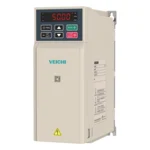
| Veichi AC10-T3-1R5G-B | 3x380 V → 3x380 V | 1.5 kW, PID, SVC, Modbus RTU | Automation cabinet, irrigation, circulation, small booster pump. |
| ABB ACS180-04S-09A4-4 | 3x380 V → 3x380 V | 4 kW, 9.4 A, industrial use | Pump station where predictable operation and brand service matter. |
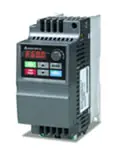
| Delta VFD055E43A | 3x380 V → 3x380 V | 5.5 kW, 13 A, VFD-E series | Booster, irrigation or circulation pump with current headroom. |
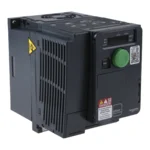
| Schneider ATV310HD11N4E | 3x380 V → 3x380 V | 11 kW, 24 A, Altivar 310 | Industrial pump that must integrate into an existing control cabinet. |
Do not size the drive by kilowatts alone. If the pump motor has high rated current or a long cable run, leave current headroom and configure motor protection. For a 1-phase 220 V input, note this point: most such VFDs output 3x220 V, so the motor must support delta connection at 220 V. If the motor is 3x380 V only, use another solution class.
Manufacturers of pump VFDs
For pump applications we most often use Veichi, INVT, Delta Electronics, Schneider Electric and ABB. Veichi and INVT fit when the project needs strong functions at a moderate budget. Delta, Schneider and ABB are common when the brand is already specified or the plant wants unified service rules.
A simple pump station needs PID, an analog input for the pressure sensor and current-based protection. For several pumps in cascade, check multi-pump logic or add an external PLC. Fan and pump control look similar, but pump systems more often need dry-run logic and minimum-frequency limits.
VFD for pump by specifications
If the site has single-phase supply, start with 1-phase 220 V VFDs. For industrial supply, open 3-phase 380 V VFDs. For borehole and booster pumps, vector control is useful because it holds torque better at low speed. If the system needs valve control, pressure sensor logic, level control or pump cascade, add a PLC, HMI panel or accessories from VFD options.
Warranty & support
Before shipping, we can check whether the VFD matches your pump by current, voltage and control method. For selection, send a photo of the motor nameplate, site supply type, target pressure and sensor wiring. Delivery works across Ukraine; for larger pump stations we can suggest base PID settings, frequency limits, sleep mode and dry-run protection.