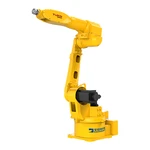
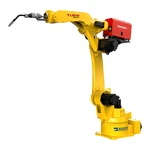
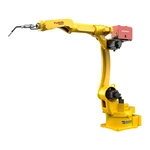

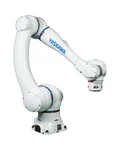
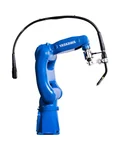
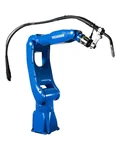
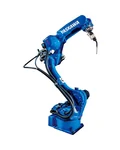
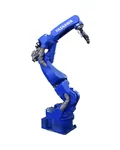
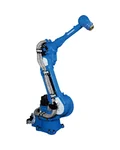
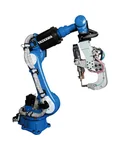
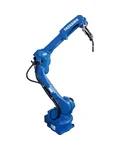

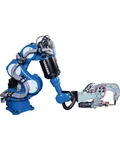
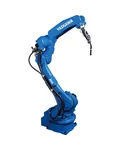
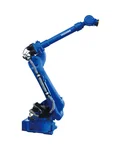
What a "welding robot" actually includes
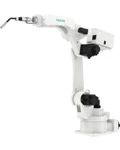
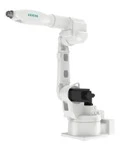
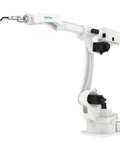
When an engineer orders a "welding robot", the spec usually lists just a 6-axis manipulator — and on its own it does not weld. An arc-welding cell is at least five subsystems, and each one affects weld quality as much as the robot's own accuracy.
- 6-axis manipulator — positions the torch in space. For arc work, pick models with repeatability around ±0.02…±0.08 mm; 3–8 kg payload covers a MIG/MAG torch with a nozzle-cleaning station, while a heavier head with a laser tracker needs 10 kg and up.
- Welding power source — a synergic MIG/MAG inverter (Fronius TPS, Lincoln Power Wave, EWM), a pulsed TIG source (Fronius MagicWave) for aluminium and thin stainless, or a plasma unit for cutting. The source must "talk" to the robot controller over a digital interface (DeviceNet, EtherNet/IP, analog setpoints) — otherwise adaptive gap control is off the table.
- Torch + service station — anti-spatter system, mechanical nozzle cleaning, wire cutting to stick-out, gas purge. Without it, the first spatter into the nozzle changes the shielding and the weld drifts after 20–30 cycles.
- Positioner / fixturing / faceplate — 1–2 extra axes rotate the part so the seam is always in the flat position. The robot will not reliably lay fillet or circumferential welds without a turntable. The fixture itself must hold the part more accurately than the robot's repeatability — otherwise the manipulator's precision is irrelevant.
- Controller + offline programming — a teach pendant plus an offline-simulation package (RoboGuide, KUKA.Sim, MotoSim). If the part mix changes, teaching "point by point" at the cell eats the robot's production time; an offline environment lets you write the program while the robot runs the previous batch.
- Seam-finding and tracking sensors — Touch Sensing (joint search by wire touch), Arc Sensing (tracking via current oscillation), laser seam scanners. This is what compensates for the part's thermal distortion during welding — without it the robot welds blind.
So the right way to phrase a purchase is not "we need a robot" but "we need a welding cell for this process and this part". We supply the cell: manipulator, a source matched to MIG/MAG or TIG, a torch service station, a positioner where needed, and commissioning.
When a welding robot pays back
A robot is worth it where several conditions hold at once — one alone is not enough.
- Volume. A repeating seam on a high-run part — frames, brackets, boiler shells, metal-furniture frames, exhaust systems. A rough threshold for robotisation to start making sense: the part repeats from a few dozen times per shift.
- Shortage of skilled welders. A certified TIG or semi-automatic welder is expensive on the market and hard to staff across two or three shifts. A robot does not "replace" the welder — it takes the monotonous high-run seams off them, leaving the complex and non-standard work to a person.
- Weld-geometry stability is critical. Where penetration and leg length drive the strength of an assembly, or where leak-tightness follows (heat exchangers, cylinders), the spread of hand welding is unacceptable.
- Harsh or hazardous conditions. Welding fume, arc UV, awkward postures — the things you want a person out of, while a robot runs with no time limits.
- Multi-shift operation. A robot holds the pace across 2–3 shifts without quality dropping by end of day — that is usually the regime where the economics close.
Honestly about payback: stating "one year" or "two" up front without a calculation is misleading. The investment horizon is measured in years and depends on four things: the cell cost (a bare robot is tens of thousands of euros; a full cell with source, fixturing and guarding is substantially more), the payroll of the welders the robot offloads, the reject rate before and after robotisation, and the number of shifts. The higher the real cell utilisation and the more expensive the manual labour it displaces, the faster the return. Only a calculation for your specific shop gives a real number — we help you build it rather than quoting a "magic" figure from an ad.
When a welding robot is NOT the right call
There are cases where robotising welding hurts more than it helps:
- Low-volume work with a constantly changing part mix and no offline programming. If there is a new part every week and the program is taught "point by point" at the cell, the robot spends more time idle in teaching than welding.
- Complex spatial seams with limited access, where a person is more flexible than a manipulator: a manual welder re-grips the torch, changes the angle, watches the pool and corrects on the fly. A robot loses here.
- No one to maintain it. TCP calibration, torch cleaning, arc-parameter tuning, controller fault diagnosis — that is a separate competence. Without it, an expensive cell turns into an idle monolith.
- No proper fixturing and part-positioning repeatability. This is reason number one why robotic welding "fails to take off": the robot lays the seam where it is told, but the part sits slightly differently in the fixture each time — and penetration wanders. Without precise, repeatable fixturing the robot is powerless, however expensive it is.
Technical pitfalls the spec sheet stays quiet about
| Model | Series | Welding type | Where it is used |
|---|---|---|---|
| FANUC ARC Mate 50iD | ARC Mate | MIG/MAG, TIG | Compact cells, small parts, tight space |
| FANUC ARC Mate 100iC | ARC Mate | MIG/MAG, TIG | Series welding of frames and structures, a universal working size |
| FANUC ARC Mate 120iC | ARC Mate | MIG/MAG, TIG | Large assemblies, extended reach, heavier torch with a tracker |
| Veichi VCR06-1410 | VCR | MIG/MAG | Budget cell, small-to-medium series, 2–8 mm steel |
| Veichi VCR10-1450 | VCR | MIG/MAG | Heavier torch, longer reach, series frames |
- Part-positioning repeatability — the main bottleneck. The robot is stable to hundredths of a millimetre, but if the fixture has play measured in millimetres, all that accuracy margin disappears. Fixturing first, robot second.
- Thermal distortion during welding. The part moves as it heats along the seam. Without seam tracking (touch/arc sensing or a laser scanner) and adaptive gap control, the robot lays the bead past the joint. For long seams and thin metal, tracking is not optional.
- Choosing the process for material and thickness. Steel 2–10 mm — MIG/MAG, synergic programs. Aluminium and thin stainless — pulsed TIG with precise arc metering. Thick metal with edge preparation — multi-pass programs with inter-pass temperature control. Getting the process wrong means reworking the whole cell.
- Welding-fume extraction and safety. Local extraction over the cell is a sanitary requirement — the site will not be accepted without it. Guarding with door interlocks, perimeter laser scanners or light curtains, emergency stops — that is part of the project, not an "extra option".
- Maintenance planned in advance. Nozzle cleaning and anti-spatter treatment — every shift/hour; wire trimming to stick-out — regularly; torch TCP calibration — on schedule and after every collision; hose package and contact tip inspection — by running hours. This goes into the regime from day one, or quality "drifts" unnoticed.
Welding robot vs. a semi-automatic welder: an honest comparison
It is not "a robot beats a human" — these are different tools for different jobs.
- A skilled welder wins where the part mix changes constantly, seams are complex and spatial with limited access, the run is small, parts are non-standard, and a fast reaction to an edge or gap defect is needed. A person sees the pool, hears the arc and corrects — still beyond a typical cell.
- A robot wins where the part is high-run, the seam is uniform, stable geometry from the first to the last unit matters, conditions are hazardous, a 2–3-shift pace without quality drop is required, and cycle time and throughput are the key metrics.
In practice most plants do not arrive at "robot instead of welder" but at a split: high-run seams to the cell, complex and non-standard work to a certified welder. We pick the robot specifically for the process (MIG/MAG, TIG or plasma), the material, the thickness and the real workload, build the cell with a source, a torch service station and a positioner, and do commissioning — i.e. we supply a working cell, not a bare manipulator. Brands in the catalog: KUKA (KR ARC / ARC HW series with a hollow wrist), Veichi VCR, FANUC ARC Mate, MOTOMAN (Yaskawa) AR/MA, ABB welding robots IRB 1520ID/1660ID. Alongside — 6-axis industrial robots for other tasks, robot manipulators and collaborative robots (cobots).
Pre-deployment checklist and summary
Before ordering a welding cell, run through these points:
- Quantify the real volume and workload — how many identical parts per shift, how many shifts, what the annual plan is. Without this, a payback calculation is impossible.
- Assess fixturing and part repeatability — is a fixture available or to be built, what play is acceptable, is a 1–2-axis positioner needed. This is the foundation of the whole project.
- Choose the process for the material and thickness — MIG/MAG for steel, pulsed TIG for aluminium and thin stainless, multi-pass for thick metal. This drives the source selection.
- Budget for offline programming if the part mix changes — otherwise the robot will idle in teaching.
- Plan extraction, guarding and safety from the start — it is mandatory, and the site will not be commissioned without it.
- Agree on operator training and service — who will maintain the cell, who will write the programs, where the spares come from.
Summary: a welding robot is not a manipulator but a cell with a source, fixturing, seam tracking and safety. It pays back with steady volume, a welder shortage, and demanding weld geometry — and it does not pay back on low-volume work without offline programming or without precise fixturing. We help you calculate what it would do in your shop and build the cell for your process. Get in touch for selection — we will point you to where to start.
Yaskawa Motoman: arc (AR, HC) and spot (SP) welding robots
We have added the current Yaskawa Motoman range alongside the existing FANUC and Veichi robots. The first question when selecting is not the brand but the process: arc and spot welding require effectively different machines.
- Arc welding (MIG/MAG, TIG) — the torch runs the seam on thin/medium metal 1–10 mm. Payload is modest (6–25 kg), repeatability ±0.02…±0.08 mm is critical. The Motoman AR series and collaborative HC models.
- Spot welding — a gun welds sheet by pressure and current with no filler (bodies, sheet assemblies). Payload decides it — guns weigh tens of kg, so the Motoman SP series covers 80–235 kg.
| Model | Process | Payload | Reach | Axes |
|---|---|---|---|---|
| AR700 / AR900 | Arc MIG/MAG, TIG | 7–8 kg | 727–927 mm | 6 |
| AR1440 / AR2010 | Arc MIG/MAG, TIG | 12 kg | 1440–2010 mm | 6 |
| AR1440E | Arc (7-axis) | 6 kg | 1440 mm | 7 |
| AR1730 / AR3120 | Arc MIG/MAG, TIG | 20–25 kg | 1730–3124 mm | 6 |
| HC10XP / HC20DTP | Arc (collaborative) | 10–20 kg | 1379–1900 mm | 6 |
| SP80 … SP235 | Spot welding | 80–235 kg | 2044–3140 mm by model | 6 |
The seventh axis (AR1440E) clears fixturing on complex seams; collaborative HC robots work next to an operator (per risk assessment, without hard guarding). The SP spot series covers loads up to 235 kg — the level of automotive body lines.
How to order
Prices are shown openly — most robot sellers hide them. These are made-to-order machines: send your joint drawing, metal and thickness — we select the model by payload and reach, build the cell (a source for MIG/MAG or TIG, a torch service station, a positioner, safety) and quote. Lead time, commissioning, operator training and warranty service in Ukraine are agreed per project. Alongside in the catalog: Veichi VCR, FANUC ARC Mate, 6-axis industrial robots and cobots.