

Mitsubishi Electric FR frequency inverters: which series to choose
Mitsubishi Electric drives are sold under the FREQROL brand, hence the FR prefix in series names. The catalogue has five series: from compact FR-D and FR-E to FR-A for demanding machinery and FR-F for pumps and fans up to 315 kW. The table below is a good starting point for selection.
| Series | Power | Supply | Typical use |
|---|---|---|---|
| FR-D | 0.75–15 kW | 1×220 V, 3×380 V | machine tools, small conveyors, simple pumps and fans |
| FR-E | 0.75–22 kW | 1×220 V, 3×380 V | packaging machines, material feed, conveyors, pumps |
| FR-A | 0.75–315 kW | 3×380 V | machine tools, winders, extruders, cranes, heavy starts |
| FR-F | 0.75–315 kW | 3×380 V | pumps, fans, HVAC |
| FR-CS80 | 11 kW | 3×380 V | compact drive for simple pumps, fans and conveyors |
Main Mitsubishi Electric series
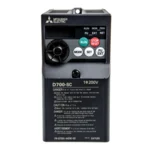
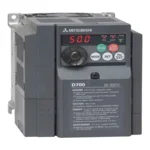
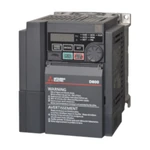
FR-D: compact series for simple tasks
Small footprint, easy installation and set-up. Single-phase 1×220 V models are available at 0.75, 1.5 and 2.2 kW; their output is three-phase 3×220 V. More: FR-D series.
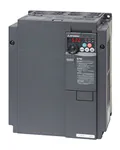
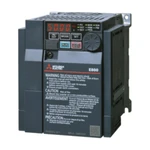
FR-E: general-purpose series for medium power
Sensorless magnetic flux vector control, Modbus RTU. Single-phase models at 0.75–2.2 kW and three-phase 380 V up to 22 kW. More: FR-E series.
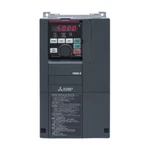
FR-A: series for demanding machinery
The series covers FR-A740 (A700 generation) and FR-A840 (A800 generation). Sensorless vector control, high overload capacity; encoder-based vector control works with an optional card. Range up to 315 kW. Suited to machine tools, winders, extruders and lifting equipment. More: FR-A series; FR-A840 models at 0.75–30 kW are also grouped separately: FR-A840.
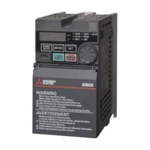
FR-F: series for pumps and fans
Optimised for pump and fan loads, with a built-in PID controller and pump control functions. Range up to 315 kW, the largest series in the catalogue. More: FR-F series.
How to choose a Mitsubishi inverter
We first check motor power and current, then load type, cable length and control method. To replace an old drive, a photo of the motor nameplate and of the old inverter's nameplate is enough for an engineer to pick a match. If Mitsubishi is more than the job needs, consider INVT, Veichi or Delta.
- FR-D700 and FR-E700 set-up: wiring and parameters
- FR-D700 and FR-E700 error codes: diagnostics
- PID and sleep mode of a Mitsubishi inverter for pumps
- FR-D720 alternative: INVT GD20 vs Veichi AC10
- FR-E700 vs INVT GD200: engineering comparison
- Replacing the FR-A800 in a Ukrainian project
Other Mitsubishi Electric equipment
For control cabinets we also supply Mitsubishi PLCs and MELSERVO servo drives. Brand overview and all product lines: Mitsubishi Electric in Ukraine.