

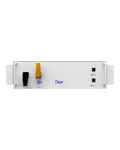
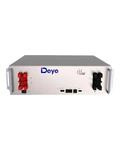
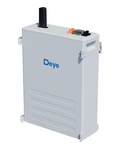
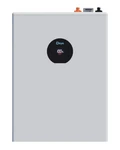
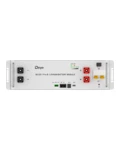
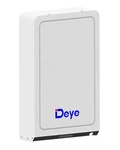
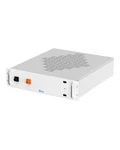
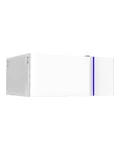
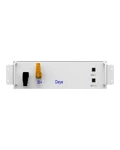
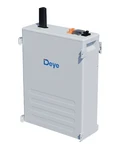
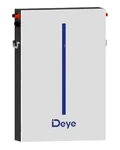
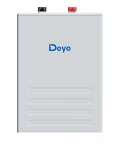
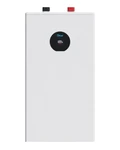
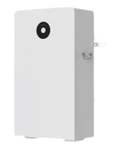
The Deye range: 51.2 V, with two exceptions
Deye keeps 15 battery modules for hybrid inverters. Thirteen of them run at 51.2 V, the usual 48 V system class, from 5.12 up to 16 kWh. Two sit apart: GB-LM4.0 at 102.4 V and BOS-A at 38.4 V. Neither of those will go onto a low-voltage inverter. Voltage is the first thing we ask about when a Deye battery enquiry comes in.
Four families rather than one even ladder
SE-G5.1-PRO and SE-F5-PRO cover 5.12 kWh. RW-M5.3 and RW-M6.1 give the odd sizes, 5.32 and 6.14: people take those when five is slightly short and 11.8 is more than they want to pay for. SE-F12 with its L version sits at 11.8 kWh. Sixteen kWh is held by two modules, RW-F16 and SE-F16-C. The BOS row sits apart because it is built differently.
BOS modules ship without a BMS of their own
Four modules are listed in the manufacturer datasheet as having no BMS: BOS-G, then BOS-G-PRO, plus BOS-A and BOS-B-PACK14.3. An external unit runs them, and that unit is not in the box. Worth pausing here. Order a BOS as if it were a standard module and the system will not come up, because nothing will hold the charge limits. The rest of the range has the board inside, with CAN and RS485 brought out, so the inverter reads pack state over the bus.
16 kWh: RW-F16 or SE-F16-C
Capacity is identical. So is charge current, 160 A on both. The difference is the enclosure: SE-F16-C weighs 109 kg at 400×708×233 mm, RW-F16 weighs 122 kg at 480×830×235 mm. So SE-F16-C is easier to carry down to a basement with two people, and it takes up less wall. RW-F16 gets asked about more often here, but that is because it shows up more often in ready-made kits with an inverter, not because of any technical edge.
Charge current from 20 to 230 A
This is the spec that actually separates modules of the same capacity. GB-LM4.0 is rated at 20 A, BOS-G at 25 A. SE-G5.1-PRO and SE-G5.1-PRO-B hold 50 A, both SE-F5-PRO versions 100 A. The larger SE-F12 and SE-F12-L are rated at 230 A. What that means on site: the higher the current, the more the module takes in during the window when the sun is up or the grid is back. On an address with short supply windows that counts for more than capacity itself.
What people order most
| Model | Capacity | Voltage | Charge current | BMS | Weight |
|---|---|---|---|---|---|
| Deye RW-F16 | 16 kWh | 51.2 V | 160 A | built-in, CAN + RS485 | 122 kg |
| Deye SE-G5.1-PRO-B | 5.12 kWh | 51.2 V | 50 A | built-in, CAN + RS485 | 45 kg |
| Deye SE-F5-PRO-L | 5.12 kWh | 51.2 V | 100 A | built-in, CAN + RS485 | 44 kg |
| Deye SE-F16-C | 16 kWh | 51.2 V | 160 A | built-in, CAN + RS485 | 109 kg |
| Deye SE-F12-L | 11.8 kWh | 51.2 V | 230 A | built-in, CAN + RS485 | 84 kg |
All five are rated at 6000 cycles. We built this table from our own shipments over the last twelve months, and we review it quarterly so it does not go stale.
Where to look next
The two most common sizes have their own pages: 5 kWh battery and 16 kWh battery. All of the chemistry sits under LiFePO4, and the full catalogue under batteries. If the inverter is not bought yet, see Deye hybrid inverters or all hybrid inverters. For an inverter you already own there is a separate page: batteries for inverters.
On the brand itself we put together a review of the Deye series with pros and cons. How to size capacity against your own load is written up in home battery capacity calculation. Wiring for several modules sits in series and parallel, and what the management board actually does is covered in BMS for LiFePO4.
Warranty and support
24-month warranty, delivery across Ukraine. The most common reason a freshly installed system does not see the pack is not a faulty module. It is an unconfigured data link to the inverter. We help with that. Send us the inverter model and we will check CAN or RS485 compatibility before you pay.