

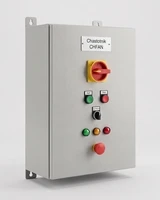
Fan control cabinets with a VFD inside: 0.75-315 kW, 380 V
A finished panel for one fan on a three-phase motor. Inside: a Veichi frequency converter, an input breaker, a painted steel IP54 enclosure, the panel's own cooling. We assemble and parameterise it, then check the circuits and do a trial run; your electrician wires it up on site. Neighbouring lines: pump control cabinets, compressor control cabinets, and the full control cabinet catalogue.
Why a fan needs a drive instead of a damper. Air flow changes roughly in proportion to shaft speed, while shaft power follows about the cube of it: the affinity laws for centrifugal machines, not our marketing. A half-closed damper burns the difference as resistance; the drive slows the wheel instead. Second reason: a fan wheel carries inertia, so direct-on-line starting hits belts and bearings. A timed ramp does not.
How to size a fan control cabinet: start at the motor nameplate
Start with rated current, not with kilowatts. Find the 380 V (or 400 V) line on the nameplate and the amps next to it. That current must stay below the drive's rated current, or the protection trips during the ramp. A 15 kW motor drawing 30 A is normal here: our 15 kW cabinet is built around 32 A.
Second parameter: motor cable length. Up to 30-50 m the cabinet goes in as it is; beyond that the cable's capacitive current heats the drive output and a motor choke joins the specification. Third: where the panel lives. Up to 75 kW wall mounted, from 90 kW floor standing, and drive height plus mandatory cooling clearances decide that, not preference.
What the line covers, and the entry price of each group:
| Motor power | Mounting | Enclosure W×H×D, mm | Example cabinet | Price from, UAH |
|---|---|---|---|---|
| 0.75-4.0 kW | wall | 500×600×300 | CH-FAN-0R75-380 | 30 604 |
| 5.5-11 kW | wall | 600×1000×300 | CH-FAN-5R5-380 | 44 311 |
| 15-22 kW | wall | 800×1000×300 | CH-FAN-015-380 | 64 443 |
| 30-45 kW | wall | 800×1200×400 | CH-FAN-030-380 | 106 281 |
| 55-75 kW | wall | 1000×1200×400 | CH-FAN-055-380 | 171 068 |
| 90-110 kW | floor | 800×1800×600 | CH-FAN-090-380 | 253 972 |
| 132-160 kW | floor | 1000×2000×600 | CH-FAN-132-380 | 417 686 |
| 185-220 kW | floor | 1000×2200×800 | CH-FAN-185-380 | 566 154 |
| 250-315 kW | floor | 1200×2200×800 | CH-FAN-250-380 | 815 857 |
Prices are for the smallest rating in each group and include VAT; exact figures sit on each product page.
Self-check before you order: six lines
We ask the same six things about the fan before we confirm an order anyway, so it is faster to run the list yourself: it catches almost every case where the specification has to be rebuilt after the price was already agreed.
- Nameplate current and the 380 V winding connection written down? We size the cabinet and set the protection by those two numbers.
- Impeller straight on the shaft, or belt driven? A belt loses part of the torque to slip, so we set a longer ramp.
- Impeller diameter and mass from the fan datasheet? High inertia means a ramp of tens of seconds, not three, or the drive trips on overload.
- Airflow or duct pressure? Pressure needs a duct sensor and a setpoint signal; the base cabinet has no sensor.
- Lowest speed you will run? A self-ventilated motor cools worse at low speed, and low airflow stalls the duct.
- Dusty or damp shop floor? IP54 handles dust and splashes, but the panel's ventilation filters need a cleaning schedule there; explosive or chemically aggressive atmospheres are not this line.
What is inside, and what wall or floor mounting gives you
The drive: Veichi frequency converters, AC10 up to 22 kW and AC310 from 30 kW. Both have PID control on board. The AI analog input takes 0-10 V or 0-20 mA (AC10 manual p. 15, terminals AI-GND: "Input current range: DC 0V~10V/0mA~20mA"); on the AC310 the mode is set by F05.41/F05.42 and a DIP switch. A 4-20 mA sensor runs on the same current input, with the zero shifted in the AI curve. Need the drive alone, without a panel? Sold separately as frequency converters for fans.
Input breaker up to 185 kW: Schneider Electric; above that, a matching frame size named in the specification. Enclosure: painted steel, IP54. Wall mounting saves floor area, floor standing gives all-round access for service. Panel cooling: thermostat-controlled forced ventilation sized against that drive's heat losses. The assembly kit: DIN rails, cable ducts, power and signal wiring, glands, start/stop buttons, door indicators.
Speed is set in two ways. One: a precision potentiometer on the door, turned by the operator. Two: a signal from an external controller into the drive's analog input, with a hand/auto selector still on the door. The fault signal comes off the drive's relay output. Input mode and terminal numbers go into the wiring diagram for your controller.
Not in the base build: a PLC, an operator panel, a mains/drive bypass, cascade control of several fans. That is the product boundary, not a cut corner: one drive, one fan. Several fans in one panel, or a BMS link, make it an engineered project: custom industrial automation.
Plainly: this is not a smoke extraction panel and not fire safety automation. Smoke control panels carry their own requirements for supply redundancy and type testing, and this line does not meet them. It does cover an induced-draft fan on a boiler, a drying chamber or an aspiration line.
Fan control cabinets by specification
Know the size already? Filters are quicker: wall mounted cabinets up to 75 kW, floor standing from 90 kW, by power 2.2 kW or 15 kW. If speed control is not needed and the only problem is starting shock on belts and bearings, look at soft starters: cheaper and simpler.
Lead time, documents and where our work ends
Built to order: 7-10 working days from order confirmation.
The price on the site is fixed and the buy button works; no quote request first. With the panel you receive a wiring diagram and a list of installed components. No separate operating manual for the series: the build changes from order to order.
Warranty: 24 months on the assembled cabinet, under the store's general warranty terms.
Our part: assembly, circuit labelling, drive parameter setup for your motor, circuit checks and a trial run. Your installer's part: mounting, cabling, connections, commissioning on site. We support remotely, without site visits. Delivery across Ukraine, payment by bank transfer or online. Send a photo of the motor nameplate. More on what we do: services.