

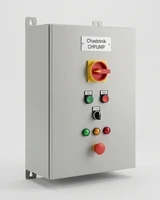
Pump control cabinets on Veichi: 25 sizes from 0.75 to 315 kW
Ready cabinets for one pump with a three-phase induction motor, 3×380 V supply. Inside: a Veichi drive, an incoming breaker matched to it, a pressure transducer and dry-run protection. Everything is panel-mounted and labelled, with base parameters set. Price is fixed, and the Buy button works as on any variable frequency drive in the catalogue.
One drive runs one pump. No cascade, standby set or automatic transfer in the base build. Two or three pumps with duty rotation and runtime balancing is a separate job: custom automation to specification.
Cabinets are built to order with a lead time of 7–10 working days.
Start from the motor nameplate, not from the kilowatts in the ad
The most common ordering mistake: "a 15 kW pump", and nothing else. Rated power says nothing about the current the drive sees. Take full load amps (FLA) from the nameplate and add 10–15 % over the maximum working current; the pump then survives a start against high static head, or a supply sag, without tripping.
Next, where it will live. Up to 75 kW it is a wall-mounted IP54 enclosure; from 90 kW, floor-standing on a plinth. The reason is geometry. A 315 kW AC310 is 1250 mm tall, and the series manual (fig. 3-3) asks for over 150 mm of free space above and below: 1550 mm for the drive alone. No wall box carries it, by size or by weight: the 315 kW drive is a heavy floor-standing unit.
| Power, kW | Veichi drive | Drive rated current, A | IP54 enclosure, W×H×D, mm | Mounting | SKU (row entry) | Price from, UAH |
|---|---|---|---|---|---|---|
| 0.75 – 4 | AC10-T3 | 3 – 9.5 | 500×600×300 | wall | CH-PUMP-0R75-380 | 33 204 |
| 5.5 – 11 | AC10-T3 | 13 – 25 | 600×1000×300 | wall | CH-PUMP-5R5-380 | 46 911 |
| 15 – 22 | AC10-T3 | 32 – 45 | 800×1000×300 | wall | CH-PUMP-015-380 | 67 043 |
| 30 – 45 | AC310-T3 | 60 – 90 | 800×1200×400 | wall | CH-PUMP-030-380 | 109 271 |
| 55 – 75 | AC310-T3 | 110 – 150 | 1000×1200×400 | wall | CH-PUMP-055-380 | 174 058 |
| 90 – 110 | AC310-T3 | 180 – 210 | 800×1800×600 | floor | CH-PUMP-090-380 | 256 962 |
| 132 – 160 | AC310-T3 (-L) | 250 – 310 | 1000×2000×600 | floor | CH-PUMP-132-380 | 420 676 |
| 185 – 220 | AC310-T3 (-L) | 340 – 415 | 1000×2200×800 | floor | CH-PUMP-185-380 | 569 144 |
| 250 – 315 | AC310-T3 (-L) | 470 – 600 | 1200×2200×800 | floor | CH-PUMP-250-380 | 818 847 |
Prices are for the lowest power in each row; at the top they run higher: 55 kW is 174 058 UAH, 75 kW already 211 629 UAH. Site prices include VAT; the exact figure sits on each product page.
What the base cabinet contains, and what it does not
The base build is the same across the range: a Veichi drive (AC10 up to 22 kW, AC310 from 30 kW), an incoming breaker for that exact drive (Schneider Electric up to 185 kW, above that a matching frame size, model fixed in the spec sheet), an IP54 enclosure sized for the drive and its clearances, ventilation from the thermal calculation, internal wiring with labelling, assembly and setup. A pump cabinet also carries a Veichi D0-10bar pressure transducer, 0-10 bar with a 4-20 mA output, plus dry-run protection, never as options: without them there is no automatic mode.
Pressure is held by the drive's own PID loop, with no PLC needed. PID parameters live in group F13 on both the AC10 and AC310 per the series manuals, with feedback on an analog input from the transducer. That input accepts 0-10 V or 0-20 mA, so the 4-20 mA D0-10bar needs it in current mode with an offset zero in the AI curve, or the drive reads voltage and sees noise. Full walkthrough: connecting and inverting a 4-20 mA pressure sensor on a Veichi VFD.
The thermal calculation runs per size, and it picks the enclosure. Airflow is sized on that drive's heat loss, with a 1.5× margin. IP54 filter mats in a pump room clog within a season, and a cabinet without headroom trips on overtemperature in a heatwave. Layout is deliberate too: drive and anything hot on top, switchgear in the middle, low-current sensor terminals at the bottom by the cool air inlet.
Not in the base build: PLC, operator panel, bypass, cascade, input or motor choke, braking resistor, remote keypad, outdoor package. Those are options, agreed in writing. There is no fire automation and no certified safety input either. An ordinary digital input is not a safety input, and a software Stop does not replace electrical isolation for maintenance.
Why a pump forgives a drive what a conveyor never will
A centrifugal pump is a quadratic load: flow follows speed, head follows speed squared, shaft power follows speed cubed. Drop the speed by 20 % and consumption falls by roughly half, which is why pressure is held with speed, not a throttled valve.
The second effect beats the energy bill: a ramped start removes water hammer. A direct contactor start pushes a shock wave into the pipework, and what breaks is usually the check valves and welded joints. The drive stretches both ramps, so the water column is never thrown. On ramping and sizing: pump drive control with a frequency converter.
Dry-run is wired as a run permit. Lose the "water present" contact and the drive stops while the cabinet raises a fault. Automatic restart is left out on purpose: a set restarting into an empty column fails quietly and expensively. Return to service needs a controlled fault reset, once the cause is fixed. How it is set in parameters: protecting a pump from dry running with a Veichi VFD.
Cabinets by power
The table links every row. Two more worth naming: 75 kW, the last wall-mounted build, and 315 kW, a two-section floor body. Other directions sit in the main cabinet catalogue. Building the panel yourself? Buy the frequency inverter alone.
Delivery, payment and where our work stops
Delivery across Ukraine, Kyiv to Lviv. Payment is by bank transfer or online. A wiring diagram and component list ship with the cabinet.
24-month warranty on the finished cabinet under the general warranty terms: warranty and service.
Boundary up front: we supply, assemble and set up the cabinet, and support you remotely on parameters and commissioning, but never travel to site. Installation, motor cable routing and earthing are your electrician's job. No electrician? Write to us and we will list the work for a contractor. Two things we ask you not to skip: a screened symmetrical motor cable with the screen clamped through 360°, never pigtailed, and at least 200 mm between power runs and the 4–20 mA signal wiring. Unsure? Send a photo of the pump nameplate and your supply details, and we will do the maths.