

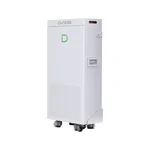
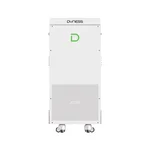
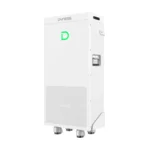
Dyness batteries: 11 LiFePO4 modules from 2.4 to 16 kWh
Dyness builds storage and nothing else: lithium iron phosphate modules for low-voltage hybrid inverters, plus the high-voltage STACK systems. Our price list currently holds 11 items. The smallest one, B4850, stores 2.4 kWh at 48 V. The ceiling of the range is 16.08 kWh in a single enclosure: PowerBrick Max and PowerBrick Plus. All 11 items are made to order, which means they are not sitting in our warehouse, and we confirm availability together with the lead time individually for the model you need. We do not print dates on this page.
Three formats, and they are not interchangeable
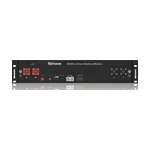
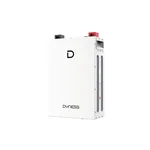
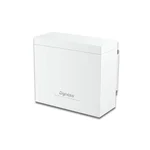
First format: compact wall or rack modules. These are B4850 at 2.4 kWh, the B4850-BOX-2 enclosure for two modules (4.8 kWh), plus BX51100, DL5.0C and DL5.0F-H at 5.12 kWh each. A sound choice when the bank grows step by step: you install one module now, add the second one a season later, and the array accepts it without rewiring provided the model stays the same.
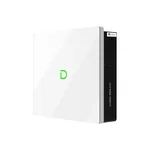
Second: high-capacity monoblocks on a single chassis. Powerbox G2 at 10.24 kWh in an IP65 enclosure, PowerBrick at 14.3 kWh, PowerBrick Max and PowerBrick Plus at 16.08 kWh. You get more energy for the same installation work, but PowerBrick weighs 114 kg, so the floor and the carry-in route are worth checking in advance.
The third format sits in its own block below. People buy it by mistake on a regular basis.
S51100 and S51280-H are STACK modules, not standalone batteries
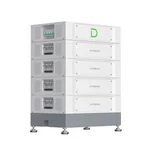
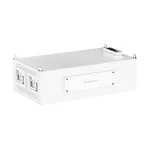
Both belong to the high-voltage Dyness STACK100 and STACK280 systems. On their own they do not operate. A tower consists of a control unit (SBDU100 for STACK100, SBDU200 for STACK280), a base, and at least three modules: the minimum works out to 15.36 kWh for STACK100 and roughly 43 kWh for STACK280. Modules are wired in series, so the system voltage adds up and leaves the familiar 48 V far behind. For a STACK100 tower the manufacturer states an operating range of 153.6 to 768 V.
We do not carry the SBDU100 and SBDU200 units. That is why we sell S51100 and S51280-H as expansion modules for an already installed tower, not as a kit for a new site. Need the first tower? Write to us. We will price its contents separately, control unit included.
Key models compared
| Model | Capacity | Charge current, rec./max | Cycles | Weight | Format |
|---|---|---|---|---|---|
| B4850 | 2.4 kWh | 25 / 50 A | from 6000 | 22 kg | wall mount, 480×360×90 mm |
| DL5.0C | 5.12 kWh | 50 / 75 A | from 6000 | 54 kg | wall mount, 558×545×150 mm |
| Powerbox G2 | 10.24 kWh | 100 / 200 A | — | 95 kg | floor standing IP65, 710×165×640 mm |
| PowerBrick Plus | 16.08 kWh | 140 / 200 A | — | — | floor standing IP65, 435×235×850 mm |
| S51280-H | 14.3 kWh | — / 200 A | — | — | STACK280 module, 770×425×363 mm |
Cycle figures appear only where the manufacturer gives a number. For PowerBrick and Powerbox G2 the datasheet says «unlimited cycles / 10 years» instead of a figure, so the dash here marks a missing rating rather than a weak one.
Which module fits your inverter
Low-voltage Dyness modules target a 48 V battery input. From our catalogue that covers Deye SG05LP1 and SG04LP3 plus Veichi VHS and VHT. LuxPower SNA and GEN belong to the same group. Data runs over CAN or RS485, and the battery protocol has to be selected by hand in the inverter menu: otherwise the inverter estimates state of charge from voltage and misses by tens of percent. We check the specific inverter and module pair against the inverter maker's compatibility list before confirming an order.
The second limit gets mentioned less often, and it matters more than kWh. Current. B4850 takes 25 A in normal operation, DL5.0C already 50 A, PowerBrick 140 A. If the inverter can push 135 A into the battery, a 25 A module simply will not take that power. So the sizing question is not only how many kWh the night needs, but whether the bank can absorb the midday generation peak, because otherwise the BMS clamps the charge current and part of the yield never reaches the cells.
Where to look next
Next to Dyness we stock Felicity batteries and the full list of LiFePO4 modules across all brands. Looking for a specific capacity? A 5 kWh battery is the most common rating, and our widest choice sits there. The inverter-oriented selection lives on the batteries for inverter page, and the full catalogue is here: battery modules.
Unsure about capacity? Start with the arithmetic: how many batteries a house needs and how to choose a battery for a hybrid inverter. We covered separately what the BMS actually does and why its protocol weighs more than the cell brand: BMS for LiFePO4.
We order the whole range, not only the popular ratings. Tell us which inverter and PV array you have, and we will say which Dyness module belongs there and where another brand comes out cheaper.