Deye Hybrid Inverter — Why the Brand Became a Leader in Ukraine
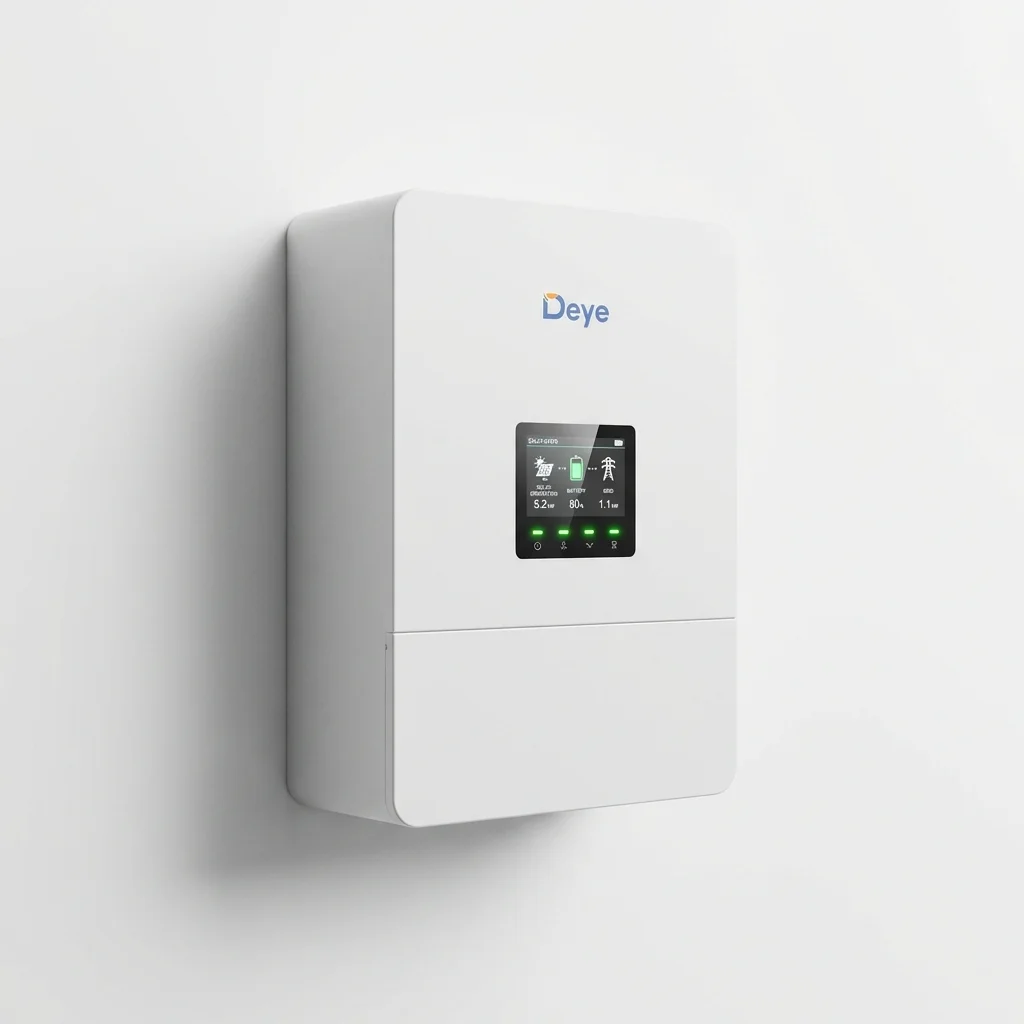
Deye (Ningbo Deye Technology Co., Ltd.) is a Chinese power electronics manufacturer founded in 2000 in Ningbo. The company ranks among the top 5 global hybrid inverter manufacturers by shipment volume. Deye's production capacity exceeds 30 GW per year, and its products are certified to IEC, CE, TUV, and VDE standards. In Ukraine, Deye became especially popular after the massive blackouts of 2022–2023, when tens of thousands of households began installing solar power systems with battery backup.
A Deye hybrid inverter differs from a standard grid-tie inverter in that it works simultaneously with solar panels, batteries, and the grid. When the power goes out, it automatically switches to battery power within 10–20 ms — household appliances don't even notice the switch. When the grid returns, the inverter resumes charging batteries from excess solar generation.
Deye Lineup: From 5 to 50 kW for Any Application
Deye offers four main series of hybrid inverters, each designed for its own market segment:
SG05LP1 — Single-Phase Residential (5–8 kW)
Series for apartments, small homes, and vacation properties with single-phase 220V connection. Compact enclosure, easy installation, 2 MPPT trackers. The most affordable models in the lineup:
- Deye SUN-5K-SG05LP1 — 5 kW, from UAH 53,400
- Deye SUN-6K-SG05LP1 — 6 kW, from UAH 52,300
- Deye SUN-8K-SG05LP1 — 8 kW, from UAH 71,200
SG04LP3 — Three-Phase Residential (5–12 kW)
Series for private homes with three-phase power. Wider MPPT range (200–850V), allowing longer strings of solar panels without additional connections:
- Deye SUN-5K-SG04LP3 — 5 kW, from UAH 104,528
- Deye SUN-6K-SG04LP3 — 6 kW, from UAH 88,300
- Deye SUN-8K-SG04LP3 — 8 kW, from UAH 84,000
- Deye SUN-10K-SG04LP3 — 10 kW, from UAH 90,700
- Deye SUN-12K-SG04LP3 — 12 kW, from UAH 100,100
SG05LP3-SM2 — Three-Phase High Power (14–20 kW)
Series for large homes, commercial properties, and small businesses. Increased maximum DC voltage up to 800V, IP65 protection, and 97.6% efficiency. Supports parallel connection of multiple inverters:
- Deye SUN-14K-SG05LP3-SM2 — 14 kW, from UAH 108,900
- Deye SUN-16K-SG05LP3-SM2 — 16 kW, from UAH 119,400
- Deye SUN-20K-SG05LP3-SM2 — 20 kW, from UAH 135,000
SG01HP3 — High-Voltage Industrial (30–50 kW)
Series for industrial facilities, farms, and large commercial installations. High battery voltage of 500V (instead of 48V), reducing currents and losses. Maximum PV voltage up to 1000V:
- Deye SUN-30K-SG01HP3 — 30 kW, from UAH 177,400
- Deye SUN-35K-SG01HP3 — 35 kW, from UAH 234,833
- Deye SUN-40K-SG01HP3 — 40 kW, from UAH 213,300
- Deye SUN-50K-SG01HP3 — 50 kW, from UAH 238,400
Deye Series Comparison Table
| Series | Power | Phases | Battery | Max DC | MPPT Range | Efficiency | Protection |
|---|---|---|---|---|---|---|---|
| SG05LP1 | 5–8 kW | 1-ph/220V | 48V | 500V | 150–425V | 97.6% | IP65 |
| SG04LP3 | 5–12 kW | 3-ph/380V | 48V | 550V | 200–850V | 97.0% | IP65 |
| SG05LP3-SM2 | 14–20 kW | 3-ph/380V | 48V | 800V | 160–650V | 97.6% | IP65 |
| SG01HP3 | 30–50 kW | 3-ph/380V | 500V | 1000V | 150–850V | 97.6% | IP65 |
Advantages of Deye Hybrid Inverters
Over years of sales in Ukraine, Deye has earned a reputation as a reliable brand in the residential and commercial solar power segment. Here are the key advantages:
1. Comprehensive Product Range
From 5 kW for an apartment to 50 kW for industrial use — Deye has a solution for any application. No other brand offers such a complete power range in a single hybrid inverter lineup. This is convenient for installers: one brand, one monitoring ecosystem, a unified approach to service.
2. Competitive Pricing
The Deye SUN-5K-SG05LP1 at UAH 53,400 is one of the most affordable 5 kW hybrid inverters on the market. Yet its 97.6% efficiency matches European counterparts from Fronius or SMA that cost 2–3 times more. For Ukrainian consumers, often constrained by budgets since the full-scale invasion, this is a critically important factor.
3. Automatic Switchover (UPS Function)
All Deye models support automatic transfer to battery power within 10–20 ms when the grid fails. This means computers, routers, refrigerators, and even gas boilers with electronic controls continue operating without interruption.
4. Cloud Monitoring
Through the SolarMan or Solarman Smart app (iOS/Android), you can monitor generation, consumption, battery status in real time, and set up charging time schedules. A Wi-Fi module is included with every unit.
5. Battery Compatibility
Low-voltage series (48V) work with most LiFePO4 batteries from various manufacturers via CAN or RS485 protocol. This allows choosing batteries based on budget without being locked into proprietary Deye batteries.
Disadvantages and Weak Points of Deye
No manufacturer is perfect, and Deye has its weaknesses worth knowing before purchase:
1. "Made in China" Brand Perception
Despite the fact that 90% of the world's inverters are manufactured in China (including "European" brands), some buyers remain cautious about an openly Chinese brand. Deye compensates with European certifications and a five-year warranty.
2. Firmware Updates
Some users report the need for firmware updates for proper operation with certain battery models. This requires a service engineer visit or self-update via USB, which is not always convenient.
3. After-Sales Service
Although Deye's service center network in Ukraine is expanding, it still falls behind brands like Huawei or GoodWe in coverage. In smaller cities, finding qualified service may take time.
4. Fan Noise
Models from 10 kW and above have active cooling that can produce noticeable noise (35–45 dB) at maximum load. This should be considered for indoor residential installations.
5. Cloud Service Dependency
Monitoring through SolarMan works via Chinese servers. Under conditions of unstable internet or geopolitical risks, this can be a concern. The alternative is local monitoring via Modbus and third-party systems like Home Assistant.
Which Deye to Choose: Usage Scenarios
For an Apartment (Backup Power)
The optimal choice is the Deye SUN-5K-SG05LP1 (single-phase, 5 kW, UAH 53,400). Sufficient for a refrigerator, lighting, router, and device charging. Paired with a 5 kWh LiFePO4 battery, it provides 4–6 hours of autonomous operation for basic loads.
For a Private Home Up to 150 m²
With single-phase power — Deye SUN-8K-SG05LP1 (8 kW, UAH 71,200). With three-phase — Deye SUN-8K-SG04LP3 (8 kW, UAH 84,000). These models cover basic household loads including a heating pump and small air conditioner.
For a Large Home Over 200 m²
We recommend the Deye SUN-12K-SG04LP3 (12 kW, UAH 100,100) or the SM2 series from 14 kW. These models handle simultaneous operation of an air conditioner, electric stove, water heater, and other high-power appliances.
For Commercial Properties
The SG01HP3 series from 30 kW is designed for retail stores, office buildings, production facilities, and farms. The high-voltage 500V battery ensures minimal losses at high power levels.
Deye in the Ukrainian Market: What Changed Since 2022
Before the full-scale invasion, hybrid inverters were a niche product for "green" energy enthusiasts. The massive blackouts of late 2022 — early 2023 fundamentally changed the situation. According to the State Statistics Service, in 2023–2024, the number of residential solar power systems in Ukraine grew by 40%.
Deye became one of the main beneficiaries of this trend thanks to three factors:
- Affordable pricing — 1.5–2 times cheaper than European alternatives with comparable specifications
- Stock availability — fast logistics from China and large warehouse stocks at distributors
- Installation simplicity — clear documentation and standard connection interfaces
As of 2026, Deye holds one of the leading positions in the Ukrainian hybrid inverter market, competing with Huawei, GoodWe, and Growatt.
Frequently Asked Questions (FAQ)
Is Deye suitable for the green tariff in Ukraine?
Yes, Deye hybrid inverters in the SG04LP3 and SG05LP3 series support feeding excess energy back to the grid, which is required for the green tariff. However, official connection requires technical documentation and approval from the regional power distribution company. Single-phase SG05LP1 models also support grid export.
How many solar panels are needed for the Deye SUN-5K?
For the Deye SUN-5K-SG05LP1, we recommend 8–10 solar panels rated at 550W each (total capacity 4.4–5.5 kW). This ensures full inverter utilization on sunny days and sufficient generation for battery charging.
What is the warranty on Deye inverters in Ukraine?
Deye's standard warranty is 5 years from the date of manufacture. Some distributors offer extended warranties up to 10 years. It is important to keep the receipt and installation certificate for warranty claims.
Can Deye be connected without solar panels?
Yes, all Deye hybrid inverters can operate in "battery + grid only" mode without solar panels. In this case, the inverter functions as a powerful UPS: it charges batteries from the grid and provides uninterrupted power when electricity goes out.
How does Deye compare to Huawei and GoodWe?
Deye wins on price (20–40% cheaper than Huawei) and product range width. Huawei offers better integration with proprietary batteries and a more developed service network. GoodWe is a mid-range option with a good reliability reputation. For most residential applications in Ukraine, Deye offers the best price-to-quality ratio.