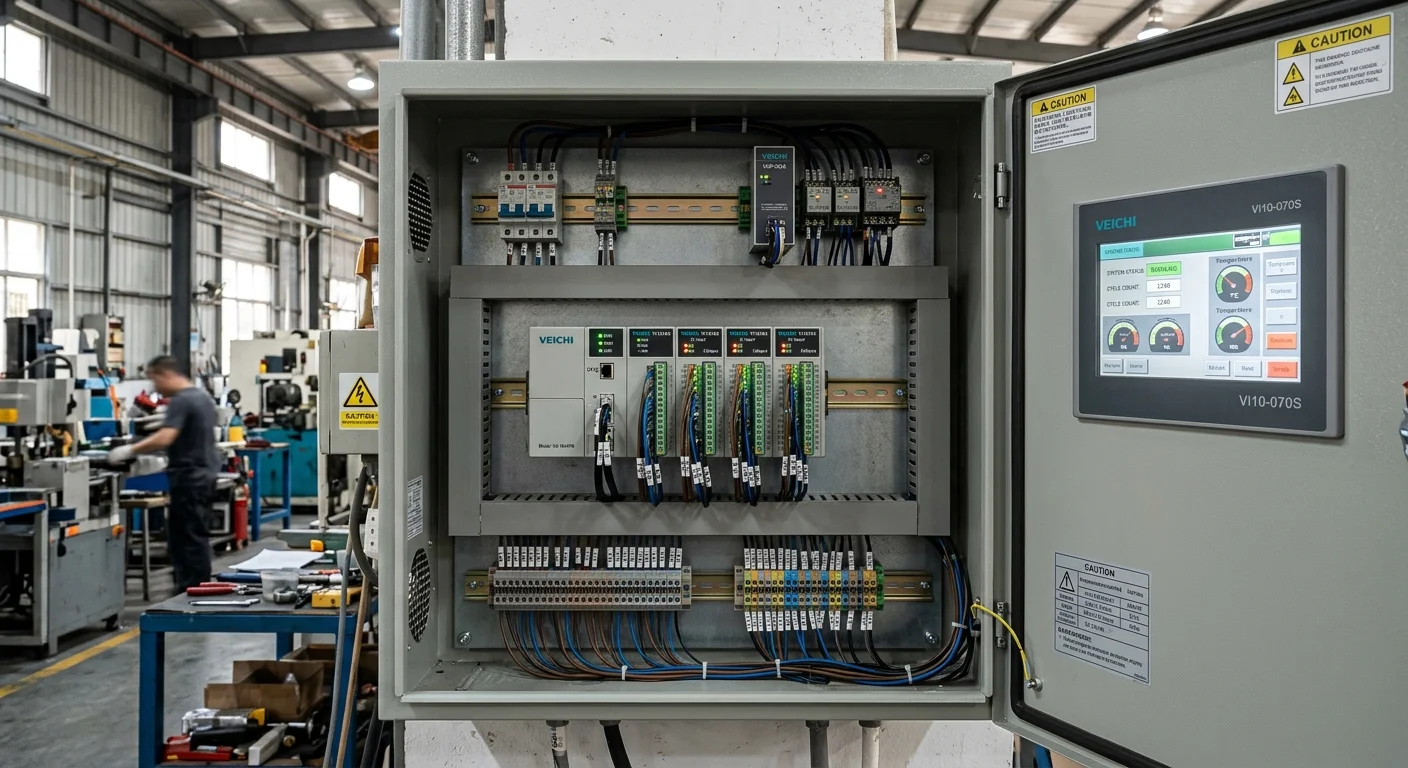
Veichi PLC: which series exist and how to choose for the job
Veichi PLCs are programmable controllers for control cabinets, from simple relay-output VC1 units to models with EtherCAT and axis control. The Veichi PLC section currently holds about 160 items, and about a third of them are expansion modules rather than controllers. Below we sort out what is what, so you can reach the right series in five minutes.
What this covers. The manufacturer's range is wider than ours: Veichi makes the VC2 (CANopen) and VH200 series, but we do not stock them, so they are not in this article. Parameters come from the official VC Series PLC catalog (version 2024.10, https://chastotnik.ua/en/manuals-veichi-plc-catalog), from the VH600 manual for VH600, and from the VH compact PLC catalog for the other VH series. Page numbers below follow the catalog's printed numbering. This is an assortment guide, not a performance test: where a source gives no number, we do not invent one.
In short: which series to take
- A simple machine, up to 36 inputs and 24 outputs, no network: VC1 or VC1S.
- You need CANopen and Ethernet, up to eight 200 kHz fast outputs: VC3 (or VC3M if you need axis interpolation).
- Many axes, EtherCAT bus: VC5, VH500 or VH600.
- A thin 24 V controller for the cabinet: VH100 (8 inputs, 8 outputs) or VH300.
- Not enough I/O, or you need analog and temperature: VC, VH-R, VH-L, VM modules. These are separate series, not PLC variants.
- The job is one or two timed speeds or simple logic on a drive: you may not need a PLC at all, see "When you do not need a PLC".
First filter: supply voltage
Cabinet supply cuts down the choice faster than anything else. VC1, VC3 and VC3M exist in both 220 V AC and 24 V DC. VC1S is 220 V AC only according to the catalog. VC5 in the catalog (p.18) is also 220 V AC only, all eight models. So in a cabinet with a single 24 V supply both series drop out. One caveat on VC5: our database holds two more items, VC5-1616MDT-8 and VC5-1616MDT-16, whose cards list 24 V DC, while the v2024.10 catalog does not contain them. If you need a 24 V VC5, write to us and we will confirm the model before you order. VH100, VH300, VH500 and VH600 run on 24 V DC.
All Veichi PLC series in one table
Each row links to the filtered series listing in the catalog. Parameters come from the sources named above; where a product card disagreed with the source, the table uses the source value.
| Series | Type | What the manufacturer's catalog says |
|---|---|---|
| VC1 | Compact PLC | 8-36 inputs, 6-24 outputs; 220 V AC or 24 V DC; relay or transistor; RS232 + RS485; 3 transistor pulse outputs of 100 kHz; program memory up to 16k steps; basic instruction 0.2 us; up to 15 expansion modules (max. 8 functional), up to 128 I/O points (p.09) |
| VC1S | Compact PLC | 8-36 inputs, 8-24 outputs; 220 V AC only; relay or transistor; RS232 + RS485; 3 transistor outputs of 20 kHz (Y0-Y2); 16k steps; 0.2 us; no expansion modules, stand-alone (p.06-07) |
| VC3 | Networked PLC | 16/16 or 32/32; 220 V AC or 24 V DC; 2 serial ports, CANopen, Ethernet (Modbus TCP); up to 8 transistor outputs of 200 kHz; 64k steps; 0.065 us; up to 15 modules (max. 8 functional), up to 512 I/O points (p.13) |
| VC3M | Networked PLC | 16/16 and 32/32, 8 x 200 kHz transistor outputs; built on VC3, linear and circular interpolation of two axes (interpolation p.12, models p.14) |
| VC5 | Motion PLC | 16/16 and 32/32; 220 V AC only per the catalog; USB, RS232/485, CANopen, Ethernet, EtherCAT; up to 32 real and 32-64 virtual axes, up to 72 EtherCAT slaves; 200K steps; 0.065 us; up to 15 modules, up to 512 I/O points (p.17-18) |
| VH100 | Thin PLC | 8 inputs, 8 outputs NPN or PNP; 24 V DC; 3 pulse outputs of 100 kHz (per the VH100 page on veichi.com); no expansion modules (VH catalog, p.05) |
| VH300 | Networked PLC | 8/8; 24 V DC; 200K-step program; RS-485 is Modbus/FreePort/N:N (up to 31 Modbus RTU slaves); up to 16 right modules + 1 left board; SD for firmware, Type-C. Only VH311 has a CANopen master (31 slaves) and Modbus TCP master/slave; VH301 has neither CAN nor Ethernet (VH catalog, p.10) |
| VH500 | Motion PLC | 8 DI / 8 DO; 24 V DC; 8 high-speed inputs at 200 kHz and 8 pulse outputs at 100 kHz; 72 EtherCAT slaves, up to 48 real and virtual axes in total; up to 16 right modules + 1 left board; RS485 (1 onboard + 2 on the left board) Modbus/FreePort/N:N. VH511 has 8 axes, 1 Ethernet, no CAN; VH522/523/524 have 16/32/48 axes, 2 Ethernet (shared network board and IP), CANopen master up to 31 slaves (VH catalog, p.14) |
| VH600 | Stand-alone medium PLC | VH601 is 8 axes, VH602 16, VH603 32 (VH catalog, p.19); per the series manual (1.3.1) the limit is 32 axes (real and virtual together) and 125 EtherCAT slaves; programmed in CODESYS; 24 V DC; 8 DI / 8 DO NPN; 2 x Ethernet (Modbus TCP, EtherNet/IP, OPC-UA), 1 x EtherCAT, RS485 (1 on board + 2 via the left board), CANopen master; 10 MByte program memory; no USB, firmware from a TF card |
| VC | Expansion modules | digital, analog, temperature, communication; for VC controllers |
| VH-R / VH-L | Expansion modules | right-side (I/O, analog, temperature) and left-side (RTC, RS485) |
| VM / VH-RTU | Expansion and communication modules | digital/analog/temperature; EtherCAT and Profinet modules |
PLC and drive: what to match in one project
In most projects the controller runs a drive, so two questions are better settled at series selection. First, NPN/PNP matching: the PLC transistor output (VH100-0808TN is NPN, VH100-0808TP is PNP) must match the drive's input type, or the start and stop commands will not pass. The details are in our article on the PLC jumper on Veichi. Second, the control method: discrete signals from terminals are covered in the article on remote start of Veichi drives; if you need setpoints and feedback over a network, a PLC with RS485 (Modbus RTU) talks to a Veichi drive on the same port. The RS485 on VC1 works as Modbus RTU master and slave (p.08), so it can run several drives on one line.
Compact PLCs: VC1 and VC1S
For a mixer, press, conveyor or a simple pump station, start with VC1. It has the widest range, from 8 inputs and 6 outputs up to 36 inputs and 24 outputs, plus versions with a detachable terminal (a 2 at the end of the part number).
- Supply: VC1 is 220 V AC or 24 V DC; VC1S is 220 V AC only.
- Interfaces: RS232 and RS485 in both series. No Ethernet or CANopen here; that starts at VC3. VC1S is stand-alone and does not support expansion modules (VC catalog, p.07). Ethernet through a left-side board ("under development") is mentioned only for VC1 (p.08).
- Pulse outputs (transistor models only): VC1 has three 100 kHz outputs, VC1S three 20 kHz (Y0-Y2). For positioning with a servo drive that difference matters.
- Expansion: VC1 takes up to 15 modules (max. 8 functional) and up to 128 I/O points; VC1S does not support I/O expansion.
- Analog and temperature: VC1-0808MAR1 and VC1-0808MAT1 carry 2 analog inputs and 2 outputs on board. Models with a -T index have 2 RTD (Pt) inputs, and VC1-2424MAR-4TC has 4 thermocouple inputs.
The difference is simple: VC1 offers more choice (24 V, analog, temperature, detachable terminal, expansion), VC1S is a shorter range for 220 V AC with no expansion. Unless supply voltage ties you down, we suggest VC1, since it leaves room when requirements change.
VC3 and VC3M: when you need a network
Take VC3 when the controller has to talk over CANopen or Ethernet. All models have 2 serial ports, 1 CANopen and 1 Ethernet, in 16/16 or 32/32 configurations.
- In transistor (T) models the suffix shows the number of fast outputs: no suffix means eight 200 kHz outputs, -4 means four, -6 means six. Relay VC3 models have no pulse outputs (p.14), so the suffix rule does not apply to them.
- Relays (R) for contactors and solenoids, transistors (T) for fast, frequent switching.
- VC3M is four models with 8 x 200 kHz transistor outputs; it supports linear and circular interpolation of two axes (p.12; models p.14).
Axis control: VC5, VH500, VH600
For multi-axis machines there are three lines, and what separates them is mainly axis count and format.
- VC5 is 16/16 or 32/32 with USB, CANopen, Ethernet and EtherCAT. The number at the end of the model (-8, -16, -32, -48) is the bus axis count by model name; the series specification, however, states up to 32 real and 32-64 virtual axes (p.17-18), so confirm the final axis count with the manufacturer.
- VH500 is 8/8, 24 V DC, Common to the series: 8 DI / 8 DO, 8 high-speed inputs at 200 kHz and 8 pulse outputs at 100 kHz, 72 EtherCAT slaves, up to 48 real and virtual axes in total, up to 16 right modules + 1 left board, RS485 (1 onboard + 2 on the left board) Modbus/FreePort/N:N. VH511 has 8 axes, 1 Ethernet and no CAN; VH522, VH523 and VH524 have 16, 32 and 48 axes, 2 Ethernet (shared network board and IP) and a CANopen master up to 31 slaves (VH catalog, p.14).
- VH600 is a stand-alone medium PLC, not a "main module". VH601, VH602 and VH603 are 8, 16 and 32 axes. The sources disagree: the VH600 manual (1.3.1) gives 32 axes (real and virtual together) and 125 EtherCAT slaves, while the VH compact catalog (p.19) gives 128 axes and 128 slaves for the base VH600-0808TN/P. We follow the series manual. VH600 is programmed in CODESYS (LD, FBD, IL, ST, SFC, CFC). Interfaces: 2 x Ethernet (Modbus TCP, EtherNet/IP, OPC-UA), EtherCAT, RS485, CANopen master.
Which one? For a compact controller on 220 V AC, VC5. For a 24 V cabinet that needs industrial Ethernet protocols (EtherNet/IP, OPC-UA), VH600. Do not take more axes than you need today, but one or two spare axes is reasonable: adding axes later to the program and the cabinet is harder than buying one model size up.
Thin controllers VH100 and VH300
VH100 is the simplest: 8 inputs, 8 outputs, NPN (VH100-0808TN) or PNP (VH100-0808TP), 24 V DC, three 100 kHz pulse outputs. VH300 is a 24 V DC PLC: 200K-step program, RS-485 (Modbus/FreePort/N:N, up to 31 Modbus RTU slaves), Type-C, SD for firmware, up to 16 right modules + 1 left board. The CANopen master (31 slaves) and Modbus TCP master/slave exist only on VH311; VH301 has neither CAN nor Ethernet (VH catalog, p.10). VH100 does not support expansion. All outputs are transistor, so contactors need interposing relays.
Expansion modules: do not mix up the series
Roughly a third of the section's items are modules. They are not PLCs and do not work on their own, and this is where an order is easiest to get wrong.
- VC: digital I/O (VC-0808ENR, VC-0016ENT), analog (VC-4AD, VC-4DA, VC-4AM with 2 inputs + 2 outputs, VC-8AD-I/V), temperature (VC-4PT, VC-4PT2 for RTD PT1000/NTC, VC-4TC, VC-8TC), network (VC-ENet, VC-RS485) and the VC-24V5POW power module.
- VH-R: right-side modules: digital, analog, temperature, plus the VH-2WT weighing module.
- VH-L: left-side: 4 inputs or 4 outputs, analog, RS485, and a real-time clock (RTC) in the models marked -RTC.
- VM: I/O, analog, temperature. Communication modules are VH-RTU: VH-RTU-ECT (EtherCAT) and VH-RTU-PN (Profinet).
The catalog assigns the VC modules to VC controllers (up to 15 per controller, max. 8 functional; VC1S has no expansion). VH300, VH500 and VH600 take up to 16 right modules and 1 left board; VH100 does not support expansion (VH catalog, p.05).
How to read the part number
- VC1-1614MDT: series VC1, 16 inputs, 14 outputs.
- M is the main unit; the next letter is the supply: A is 220 V AC, D is 24 V DC, N is no power input (modules).
- The last letter is the output type: R is relay, T is transistor, M is a hybrid output (VC1-2424MAM-4TC), N is no outputs.
- A digit after the letters: 1 is integrated analog (VC1-0808MAR1), 2 is a detachable terminal.
- VH controllers: TN is NPN transistor, TP is PNP transistor (VH301-0808TN).
Example: VC1-1614MAR is 220 V AC, 16 inputs, 14 relay outputs; VC1-1614MDT has the same inputs but a 24 V DC supply and transistor outputs.
When you do not need a PLC
For simple cycles you can skip the PLC. Veichi drives have a built-in simple PLC (Simple PLC), several speeds changing on a timer, for example for a hydraulic press or cyclic mixing, and Virtual DI/DO logic blocks for internal conditions without an external controller. Availability and setup depend on the series: the AC310 manual, for example, lists a built-in simple PLC, and we do not quote exact parameters here because they differ between series. Look at Veichi frequency converters and the manual of your model. If you need analog control, a network, positioning or dozens of signals, move to a PLC.
Programming and documentation
VC PLCs are programmed in AutoStudio: LD, IL and SFC languages with mutual conversion, function blocks and an oscilloscope for debugging (catalog, p.21-22). VC1 and VC1S are programmed over USB Type-C. The Veichi PLC catalog page has the catalog (in English) and a programming manual, including a Ukrainian version. VH100, VH200, VH300 and VH500 are also programmed in AutoStudio, while VH600 uses CODESYS (LD, FBD, IL, ST, SFC, CFC).
What to check before ordering
- Cabinet supply voltage: 24 V DC or 220 V AC. It decides whether VC1S and VC5 are options.
- Output load type: contactors and solenoids need relays, fast and frequent switching needs transistors. Transistor outputs must match the NPN/PNP of your sensors and drive.
- Network: do you need CANopen, Ethernet or EtherCAT? This is the quickest filter and tells you whether to look at VC1 or at VC3/VC5/VH.
- Axis count if there is motion, and real I/O headroom including modules.
- Sensor power: a 24 V supply, see choosing a 24 V power supply for PLCs and sensors.
What else to pair with a PLC
A PLC rarely works alone. It usually comes with an operator panel (HMI) and a drive: Veichi frequency converters or Veichi servo systems. If you are comparing controller brands, also look at all PLCs and Fatek PLCs.
Conclusion
For most simple machines VC1 is enough: a sufficient I/O range, 24 V or 220 V, relay or transistor. A network means VC3, motion means VC5, VH500 or VH600, and the minimal thin controller is VH100/VH300. Expansion modules are separate series, so do not confuse them with controllers. Send us your signal list (inputs, outputs, analog, network, axes, supply voltage) and we will pick the series and modules. The full model list is in the Veichi PLC section.