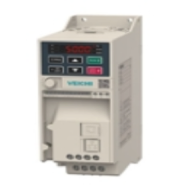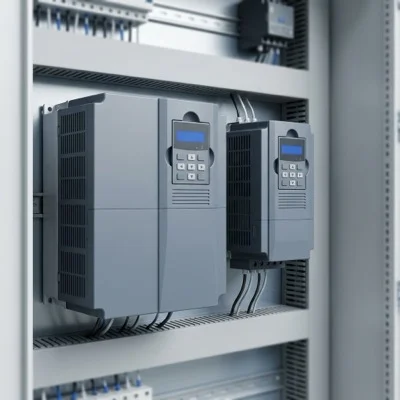
INVT GD200A or Veichi AC310: the short answer
With a three-phase 380 V supply and an ordinary load (pump, fan, conveyor, crusher), either series will do the job, and the price gap stays within one or two percent. Four things decide it: single-phase 220 V input and encoder feedback exist only on Veichi AC310; more digital inputs, two relays and built-in multi-pump control exist only on INVT GD200A.
We have stocked both series for years, so what follows is not a brochure summary but a check against the official INVT Goodrive200A and Veichi AC310 manuals, plus what actually shows up on site. For the lower segment (0.75–15 kW) we have a separate write-up: INVT GD20 and Veichi AC10 interchangeability.
GD200A vs AC310 comparison table
Figures come from the manufacturers' manuals. Where a parameter depends on the variant, that is stated.
| Parameter | INVT GD200A | Veichi AC310 |
|---|---|---|
| Supply | 3×380 V only | 1×220 V and 3×380 V |
| Ratings in stock | 0.75–500 kW (27 models) | 0.75–400 kW (35 models), single-phase up to 15 kW |
| Max output frequency | 400 Hz | 600 Hz |
| Control modes | V/F, sensorless vector (SVC), speed range 1:100 | V/F, SVC 1:200, closed-loop FVC 1:1000, PM motor modes |
| Starting torque | 150% at 0.5 Hz | 150% at 0.25 Hz (SVC), 200% at 0 Hz (FVC) |
| Encoder / PG card | none | AC300PG01 (incremental), AC300RT1 (resolver), EX-B slot |
| Overload, G duty | 150% for 60 s, 180% for 10 s, 200% for 1 s | 150% for 89 s, 180% for 10 s, 200% for 3 s |
| Digital inputs | 8 standard + 1 high-speed HDI (50 kHz) | 5 (X1–X5) + pulse input PUL |
| Analog inputs | 2: 0–10 V / 0–20 mA and bipolar −10…+10 V | 2, voltage/current selected by jumper |
| Relay outputs | 2 (RO1, RO2) | 1 (TA/TB/TC) |
| Analog outputs | 2 | 1 |
| I/O expansion | none | AC300IO1 card (X6–X8, X10, Y2, second relay, AO2) |
| Communication | Modbus RTU over RS485, standard | Modbus RTU over RS485, standard, master and slave modes; optional CAN (AC300CAN1) and Profibus-DP (AC300DP01) |
| Built-in braking unit | up to 30 kW inclusive, external above that | in -B variant: 3×380 V up to 22 kW, 1×220 V up to 11 kW |
| EMC filter | built in, class C3 per IEC 61800-3 (380 V) | no built-in filter stated in the manual, filters listed as external peripherals |
| Simple PLC program | 16 steps, group P10 | 15 stages, group F14 |
| PID controller | yes, group P09 | yes, group F13 |
| Sleep mode | yes, P01.19 / P01.20 and group P24 | yes, F13.29–F13.33 |
| Multi-pump control | yes: group P24, up to 2 auxiliary motors | not in the standard manual |
| Enclosure rating | IP20 | IP20 |
Three differences that actually decide it
The rest of the specification either matches or differs so little that you will never notice it on site. These three you notice immediately.
Single-phase 220 V exists only on AC310
This is the most common reason the choice lands on Veichi. GD200A comes in 3×380 V only — the series has no single-phase model at all. The AC310 T/S2 variant takes 1×220 V and covers 0.75–15 kW from our stock.
In practice: a rural borehole, a service station, a workshop, a small packing line — anywhere without three-phase power, GD200A drops out at the sizing stage. It is either a single-phase AC310 or a drive from our 220 V VFD selection. Watch the current: a single-phase AC310 at 7.5 kW draws 30 A on the input, so size the breaker and cable to that figure, not to the three-phase one.
Closed-loop encoder feedback is also AC310 only
GD200A runs sensorless. In the manual, parameter P00.00 offers only two control modes, SVC and V/F, and the series options list contains no PG card at all. So anything that needs tight speed holding or torque at zero speed is out of reach for GD200A.
AC310 has an FVC mode with the incremental AC300PG01 or the resolver-based AC300RT1 (both fit the EX-B slot only). The numbers:
- Speed range: GD200A 1:100, AC310 1:200 in SVC, 1:1000 in FVC
- Starting torque: GD200A 150% at 0.5 Hz, AC310 200% at zero speed in FVC
- Where it matters: hoists, winders, dosing systems, lines that synchronise several drives
On a pump or a fan an encoder is money thrown away. On a winch or a winder, do not start without one.
Inputs, relays and pump groups — GD200A wins here
GD200A gives you 8 digital inputs plus a 50 kHz high-speed HDI, two relay outputs and two analog outputs. AC310 offers 5 inputs plus the PUL pulse input, one relay and one analog output in the base version. The two-relay gap looks trivial right up to the moment you need a separate fault contact and a separate ready contact.
AC310 makes it up with the AC300IO1 card, which adds X6–X8, X10, a second transistor output, a second relay and AO2. The problem is solvable, but that is one more line item in the bill and one more slot used.
Pumps deserve their own note. GD200A has a full P24 Water supply group: pressure PID with selectable feedback source, sleep mode, and cascade control of two auxiliary motors with start and stop delays. The standard AC310 manual has no multi-pump control — only a single pump with PID and sleep. That is the opposite of what most people expect from this INVT/Veichi pairing.
One more point for INVT: the bipolar −10…+10 V analog input. You need it when a controller sends a signed reference, so direction is set by polarity. Both AC310 inputs are unipolar.
Dimensions and currents: will it fit the same cabinet
Currents are nearly identical between the two series. Enclosures are not. If you are replacing a drive in an existing cabinet, look at the width first.
Rated currents, 3×380 V
| Rating | GD200A, A | AC310, A |
|---|---|---|
| 5.5 kW | 14 | 13 |
| 7.5 kW | 18.5 | 17 |
| 11 kW | 25 | 25 |
| 15 kW | 32 | 32 |
| 22 kW | 45 | 45 |
| 30 kW | 60 | 60 |
| 45 kW | 92 | 90 |
| 55 kW | 115 | 110 |
| 75 kW | 150 | 150 |
The difference is within tolerance. Sizing by motor current works equally well on either series — and as always, go by the nameplate current, not by kilowatts.
Size and weight
| Rating | GD200A, W×H×D mm (kg) | AC310, W×H×D mm (kg) |
|---|---|---|
| 5.5 kW | 146×256×171 (3.2) | 100×242×155 (1.9) |
| 11 kW | 170×320×200 (5.9) | 116×320×175 (3.5) |
| 22 kW | 255×407×246 (13) | 142×383×225 (6.0) |
| 30 kW | 255×407×246 (13) | 172×430×225 (10.6) |
| 45 kW | 270×555×333 (30) | 240×560×310 (25) |
| 75 kW | 325×680×374 (47) | 240×560×310 (25) |
At 22 kW the GD200A is nearly twice as wide, 255 mm against 142 mm, and twice as heavy. In a tight cabinet that settles the argument. On the other hand, the 380 V GD200A carries a class C3 EMC filter inside, so you do not spend another 80–100 mm of width on an external filter, which is what AC310 would require where the site demands 61800-3 compliance.
Power terminals serve the same purpose on both: R/S/T in, U/V/W to the motor, P+/PB for the braking resistor. The control terminal layout differs, though, so you cannot move the loom across one to one — it has to be rewired. We covered the INVT procedure in INVT GD10, GD20 and GD200A setup, and the Veichi one in the AC10/AC310/AC01 step-by-step guide.
Which one for which load
The rule is short: supply and encoder point to AC310, I/O count and pump cascading point to GD200A. Below is the same thing broken down by machine.
Pump station
A single pump: take either, PID and sleep are on both (P09 and P01.19 on INVT, F13 and F13.29 on Veichi). Two or three pumps with rotation: GD200A only, through group P24, because AC310 cannot cascade in standard firmware. A borehole on single-phase power works the other way round, AC310 only.
Conveyor, extruder, mixer
Constant torque at low speed. Overload headroom decides here, and on paper AC310 looks better: it holds 150% for 89 seconds against 60 on GD200A, and 200% for three seconds against one. In practice the gap only matters on jams and stalls. Crushers and screws with unstable loading, in other words.
If several drives in the line need synchronising, again AC310 with an encoder card.
Fan and flue extractor
Quadratic load, P duty, both series are equal here. Look at the digital inputs: if the scheme includes fire mode, emergency ventilation, damper feedback and several preset speeds, the eight inputs on GD200A save you an expansion card.
Spindle and high speed
AC310 reaches 600 Hz, GD200A stops at 400 Hz. For a 24,000 rpm spindle that is not a matter of preference.
Above 400 kW
Our AC310 stock ends at 400 kW, GD200A runs to 500 kW. Above that the question is no longer about these two series.
What is NOT a difference
A few myths we hear on the phone every week:
- Price. At matched 380 V ratings the gap stays within one or two percent. Choosing by price list makes no sense here.
- Modbus. RS485 with Modbus RTU is standard on both. An empty cell in somebody's catalogue is a data gap, not a missing feature.
- Built-in PLC. On both series this is not ladder programming but a stepped speed program: 16 steps on GD200A (P10) and 15 stages on AC310 (F14). Neither replaces controller-level logic. For that you need a separate PLC.
- Preset speeds. 16 on GD200A, 15 plus the main reference on AC310 — effectively the same thing.
- Enclosure rating. IP20 on both, so a cabinet is mandatory either way.
Frequently Asked Questions
Can GD200A be swapped for AC310 without reworking the cabinet?
Mechanically no, the mounting dimensions differ. AC310 is more compact: at 22 kW that is 142 mm wide against 255 mm for GD200A. Power terminals match in function (R/S/T, U/V/W, P+/PB), but the control terminal block has to be rewired because the layout is different.
Does AC310 really have a built-in PLC?
It does, but it is a simple 15-stage stepped program (group F14): each stage sets frequency, time and direction. There is no ladder programming. GD200A has the same kind of function with 16 steps in group P10.
Can GD200A run at 600 Hz?
No. Maximum output frequency for GD200A is 400 Hz per the manual. 600 Hz comes from AC310, and the manual makes no exception for the single-phase variant.
Up to what rating is the braking unit built in?
On GD200A up to 30 kW inclusive; from 37 kW you need an external unit. On AC310 the built-in unit comes with the -B suffix: up to 22 kW for 3×380 V and up to 11 kW for 1×220 V. The resistor itself is bought separately in both cases.
Which drive for a 22 kW pump?
For a single pump either works — rated current is the same on both, 45 A. For a station with two or three pumps on rotation, take GD200A: cascade control of two auxiliary motors is built into group P24, and AC310 has nothing equivalent in standard firmware.
What to choose
The order we run through on the phone:
- What supply the site has. Single-phase 220 V and you can stop counting, it is AC310.
- Whether an encoder is needed. Hoist, winder, synchronised drives, again AC310 — GD200A has no closed loop.
- How many inputs and relays. More than 5 inputs or two relays means GD200A without expansion cards.
- How many pumps in the station. Two or three on rotation means GD200A, group P24.
- How much cabinet width you have. At 22 kW GD200A asks for 255 mm, AC310 for 142 mm.
In short: AC310 when you need a 220 V supply, an encoder, 600 Hz or a compact footprint. GD200A when you need spare I/O, pump cascading, a built-in C3 filter or ratings above 400 kW. Otherwise take whatever is in stock and do not pay extra for a difference nobody sees on site.
Both series are on our shelves: INVT GD200A and Veichi AC310. The full range sits in variable frequency drives, with brand selections at INVT and Veichi. If the drive is already installed and throwing faults, check INVT GD20, GD10 and GD200A fault codes or the AC310 parameter walkthrough. And if you are coming at this from replacing an imported drive, we have a Mitsubishi FR-E700 vs INVT GD200 comparison and a Schneider ATV930 to AC310 replacement guide.