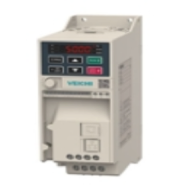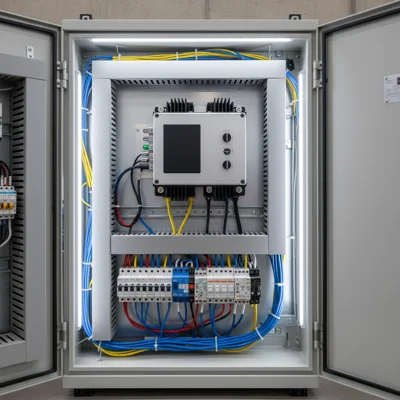
To ensure accurate vector control and reliable motor protection, it is essential to first enter the motor nameplate data into parameter group F02. Neglecting this step leads to incorrect calculation of the stator and rotor mathematical models, causing winding overheating and overcurrent faults during startup. Before the first power-up, check the motor nameplate and transfer the rated power, current, voltage, and frequency values into the corresponding memory cells of the Veichi variable frequency drive.
Veichi AC10, AC310, and AC01 variable frequency drives use this data for automatic calibration. It is recommended to perform dynamic auto-tuning if the motor is disconnected from the gearbox, or static auto-tuning if disconnection is not possible. The AC310 series is Veichi's flagship line, supporting both asynchronous motors and permanent magnet synchronous motors. For synchronous motors, parameter group F02 is supplemented with feedback parameters and specific rotor characteristics. The AC10 series is a more compact solution for simple applications where scalar control or simplified sensorless vector control is primarily used. The AC01 series is optimized for ventilation systems. Regardless of the selected series, the accuracy of filling out group F02 directly affects the sensorless vector control algorithm, which calculates the current rotor position based on phase current measurements. Below is a table of the basic parameters of group F02 that are mandatory to fill in:
After successfully entering these parameters, the system is ready for the auto-tuning procedure, which is initiated via parameter F02.07. A correctly configured motor model optimizes power consumption and ensures maximum torque at low rotation speeds.
To transfer start and stop control of the variable frequency drive to external physical buttons or controller relay contacts, set parameter F01.01 to 1 and connect the switching devices between terminals DI1 and COM. This disables control from the local keypad and activates the terminal block as the priority source for start commands, which is standard for industrial automation systems.
When working with the terminal block, it is important to consider the digital input logic type: NPN or PNP. Veichi variable frequency drives feature a hardware switch to select the logic type. If NPN logic is selected, terminal DI1 must be shorted to the COM terminal to activate it. If PNP logic is selected, activation occurs by applying an external +24V voltage to the corresponding input. This allows easy integration of the VFD into systems with PLCs from various manufacturers without using additional intermediate relays. Parameter F01.01 defines the source of start commands: a value of 0 corresponds to the keypad, 1 to the terminal block, and 2 to the RS485 serial communication port. Let's look at the connection diagram and digital input logic. For basic two-wire control, a dry contact is used. When the contact between terminal DI1 and terminal COM is closed, the VFD begins accelerating the motor. When opened, deceleration occurs according to the set deceleration time. To implement reverse rotation, parameter F01.09 and an additional digital input are used:
To configure three-wire control, you must modify the parameters in group F05, which are responsible for the digital input logic. This ensures a high level of safety, as spontaneous motor startup is prevented when the power supply drops and recovers.
To implement smooth speed control using an external analog potentiometer connected via the RJ45 interface or analog terminals, set the frequency reference source F01.02 to 2 and configure parameter F11.30 to 1. This allows using the built-in hardware interfaces of Veichi AC10/AC310 drives for precise positioning and prompt control of the process speed.
Using the RJ45 interface to connect an external potentiometer is a unique advantage of Veichi. This allows placing the speed control element on the control cabinet door using a standard Category 5e or higher UTP patch cord, avoiding the complex wiring of individual leads. Parameter F11.30 defines the operating mode of the RJ45 port: at a value of 1, it switches from RS485 data transmission mode to reading an analog signal from a remote keypad with an integrated potentiometer. This significantly simplifies commissioning and reduces the overall cost of installation materials. To activate this mode, the following sequence of actions must be strictly followed:
If you are using a classic three-wire potentiometer, connect it to the terminal block: the outer terminals to the +10V and GND terminals, and the center wiper to the AI1 terminal. Using a shielded cable to connect the potentiometer is mandatory, as analog signals are sensitive to electromagnetic interference generated by the motor power cables.
To prevent emergency drive trips with the OU fault code under unstable Ukrainian power grid conditions, it is necessary to set the overvoltage protection limit F02.05 to no more than 253 V for single-phase grids. This guarantees the preservation of the DC bus power capacitors' operability and prevents thermal breakdown of the IGBT transistors during sudden voltage spikes in the power supply grid.
Special attention should be paid to parameter F02.05 in regions with unstable supply voltage. In Ukrainian realities, the grid voltage often exceeds the nominal 220 V, reaching 250-260 V, which triggers the VFD's protection. Setting the F02.05 limit to 253 V allows adapting the device to domestic power quality standards without losing protective functions. If the voltage is consistently high, it is recommended to use voltage stabilizers or input line reactors, which additionally smooth current ripples and protect the drive's diode bridge from damage. When working with inertial loads during deceleration, the motor begins to operate in generator mode, returning energy back to the VFD. This causes a sharp increase in voltage on the internal DC bus. To effectively manage this process, several tools are provided in the Veichi AC10 and AC310:
Correct configuration of protection limits helps avoid equipment downtime and significantly extends the service life of the VFD's power electronics.
To eliminate unpleasant high-frequency whining and acoustic noise in the motor windings, it is recommended to increase the PWM carrier frequency by 2-4 kHz from the base value using parameter F01.40. This shifts the stator magnetic field oscillations into a higher frequency range that is less noticeable to the human ear, ensuring comfortable working conditions for personnel near the equipment.
However, changing the carrier frequency involves technical trade-offs that every engineer must consider. Increasing the PWM frequency leads to an increase in dynamic losses in the drive's power IGBT switches, causing them to run hotter. Therefore, when increasing the carrier frequency, it is necessary to monitor the temperature of the VFD's cooling heatsink. Below is a comparison table of the carrier frequency's impact on system operation:
If the cable length between the VFD and the motor exceeds 20 meters, a high carrier frequency can cause significant capacitive leakage currents. In such cases, it is recommended to keep the carrier frequency at no more than 4 kHz or install an output motor reactor to protect the motor winding insulation from premature aging. This maintains a balance between acoustic comfort and the reliability of the power stage.
Successful commissioning of Veichi AC10, AC310, and AC01 variable frequency drives depends on a systematic approach to configuring each component: from precise entry of motor parameters to optimizing protection limits and PWM frequency. Following these instructions will allow you to minimize emergency shutdowns and ensure maximum energy efficiency for your production.
For professional advice, selection of auxiliary equipment, or purchasing original frequency inverters, please contact our specialists. Our website features a specific category of Veichi devices with an official manufacturer's warranty and full technical support at all stages of implementation.