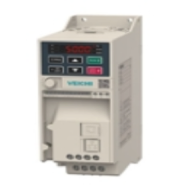
Full interchangeability of INVT GD20 and Veichi AC10 in industrial systems
A variable frequency drive is one of the most important parts of pumping stations, ventilation systems, conveyors, mixers, compressors and simple machine drives. When this unit fails or must be replaced because of stock availability, the engineer is not interested only in the price of the new device. The key questions are whether the wiring can be transferred, the control logic can be preserved, the parameters can be repeated quickly and the process can avoid several days of downtime.
INVT Goodrive20 has long been a popular solution in the budget and mid-range segment. Veichi AC10 covers the same application class and can be used as a direct functional equivalent of GD20 in most typical industrial systems. Both series belong to the same technology generation: scalar V/f control, sensorless vector control, Modbus RTU, PID regulation, 0-10 V and 4-20 mA analog inputs, 24 V digital inputs and relay outputs.
This guide shows how to check INVT GD20 and Veichi AC10 compatibility in practice: by enclosure, power terminals, control inputs, parameters, PID control and typical startup scenarios.
When replacing GD20 with AC10 makes sense
Replacement is often driven not by weakness of the old drive, but by real supply conditions. In the Ukrainian market during 2024-2026, factories increasingly keep several interchangeable brands to avoid dependence on one batch, one warehouse or one supplier. For maintenance teams, this means the new VFD must be familiar, quickly available and close enough in logic to the installed equipment.
- Equipment must be restored quickly, and GD20 is not available from stock.
- The cabinet has limited space, and the narrow AC10 body helps fit the drive without redesigning the panel.
- Control is wired through terminals: Start/Stop buttons, potentiometer, pressure sensor or PLC digital signals.
- Modbus RTU is used, and communication with an HMI or controller must be preserved.
- The application is typical: pump, fan, conveyor, exhaust fan, feeder or small asynchronous motor mechanism.
Hardware compatibility: enclosure, mounting and cooling
INVT GD20 and Veichi AC10 are designed for installation inside electrical cabinets. Both have IP20 protection, support DIN rail or panel mounting depending on frame size, use forced air cooling and follow a narrow book-style layout. For a panel builder, this means replacement usually does not require a full cabinet redesign.
| Feature | INVT GD20 | Veichi AC10 | Conclusion |
| Mounting | DIN rail or screws | DIN rail or screws | Compatible mounting logic |
| Enclosure type | Narrow book-style format | Narrow book-style format | Good for dense cabinet layouts |
| Cooling | Forced air | Forced air | Similar cabinet ventilation requirements |
| Protection class | IP20 | IP20 | Electrical cabinet required |
Veichi AC10 uses an isolated air channel that directs airflow through the heatsink and reduces dust exposure on electronic components. In dusty workshops this is a practical advantage, but it does not remove the need for cabinet filters, fan cleaning and proper temperature margin.
Power terminals
The power section of both drives follows a standard layout: mains input, motor output, protective earth and braking resistor terminals in relevant models. The marking follows common international practice, so the installer does not have to learn a new electrical concept.
| Circuit | GD20 terminal | AC10 terminal | Purpose |
| Supply | R, S, T or L, N | R, S, T or L, N | Three-phase or single-phase supply |
| Motor | U, V, W | U, V, W | Output to asynchronous motor |
| Braking | Plus, PB | P+, PB | Braking resistor connection |
| Ground | PE | PE | Protective earth |
During replacement, do not only move the wires. Check cable cross-section, terminal tightening, ferrule condition and motor cable shielding. If the old VFD failed because of motor insulation breakdown or damaged cable, the new AC10 can fail as well without insulation diagnostics.
Control terminals: direct I/O mapping
Most questions arise not from power wiring, but from control wiring. INVT GD20 digital inputs are marked S1, S2, S3, S4 and HDI. Veichi AC10 uses X1, X2, X3, X4 or PUL. Functionally these are the same multifunction inputs, assigned in parameters for start, reverse, fault reset, speed selection or pulse reference.
| Function | INVT GD20 | Veichi AC10 | Comment |
| Forward start | S1 | X1 | Direct logical match |
| Reverse start | S2 | X2 | Direct logical match |
| Multifunction input | S3 | X3 | Function assigned by parameter |
| Multifunction input | S4 | X4 | Can work as normal input |
| High-speed pulse input | HDI | PUL or X4 | For frequency reference up to 50 kHz |
| Input supply | +24V | 24V | Supply for buttons and sensors |
| Digital common | COM | COM or GND | Common point for digital signals |
| Potentiometer supply | +10V | 10V | External frequency potentiometer |
| Analog input | analog input 2 | analog input | Pressure sensor, speed signal or reference |
| Relay output | RO1A, RO1B, RO1C | TA, TB, TC | Fault, ready or run status |
| RS485 | 485+, 485- | A+, B- | Modbus RTU for PLC or HMI |
NPN, PNP and analog signals
Both drives support common digital input logic options. In GD20, this is configured with jumpers between PW, +24V and COM. AC10 follows a similar idea: the input can operate in circuits where the signal is applied by shorting to common or by applying positive voltage. Before the first startup, compare the old schematic and jumper positions.
Analog inputs support 0-10 V and 4-20 mA. In GD20, the second analog input signal type is often selected by a jumper on the control board. In Veichi AC10, DIP switch S4 is used: U means voltage input, I means current input. For a pumping station with a 4-20 mA pressure sensor, this is a critical check.
Software compatibility
If an engineer knows the INVT GD20 menu, Veichi AC10 will not feel unfamiliar. GD20 parameter groups are marked P00, P01, P02 and so on. AC10 uses the F prefix: F00, F01, F02. The group logic is very close: basic settings, command sources, motor data, V/f curve, inputs, outputs, communication and PID control.
| Task | INVT GD20 | Veichi AC10 | Explanation |
| Factory reset | P00.18 = 1 | F00.03 = 22 | Start from a clean configuration |
| Control mode | P00.00 | F01.00 | V/f or SVC |
| RUN command source | P00.01 | F01.01 | Panel, terminals or communication |
| Frequency source | P00.06 | F01.02 | Panel, analog input, Modbus or pulses |
| Maximum frequency | P00.03 | F01.10 | Upper speed limit |
| Acceleration time | P00.11 | F01.22 | Smooth ramp-up |
| Deceleration time | P00.12 | F01.23 | Smooth stopping |
| Motor power | P02.01 | F02.02 | From the motor nameplate |
| Rated current | P02.05 | F02.06 | Motor overload protection |
| Auto-tuning | P00.15 | F02.07 | Before vector control operation |
Step-by-step replacement
- Record GD20 parameters: P00, P01, P02 groups, input and output settings, PID and Modbus if used.
- Photograph the terminals: power section, control wiring, NPN/PNP jumpers and analog jumpers.
- Check the motor: insulation resistance, cable condition, grounding and current match.
- Install AC10: fix the body and leave space for cooling.
- Move the wires by the table: power terminals, X inputs, analog input, relay and RS485.
- Reset parameters: perform factory initialization before setup.
- Enter motor data: power, voltage, current, frequency and speed.
- Check rotation direction: make the first run at 5-10 Hz.
Pumps, conveyors, fans and Modbus
For pumping stations, both VFDs can maintain pressure without a separate controller. In GD20 the PID controller is in group P09, while in Veichi AC10 it is in group F13. Feedback usually comes from a 4-20 mA pressure sensor, and pressure reference is set from the panel, a potentiometer or Modbus.
For conveyors, starting torque is important. INVT GD20 and Veichi AC10 support sensorless vector control, which helps start a loaded mechanism at low frequency. Before using SVC, enter accurate motor data and run auto-tuning.
For ventilation, a square V/f curve and energy-saving mode are often used. In these tasks, AC10 behaves like a direct GD20 equivalent: soft start, maximum frequency limit, sensor or analog reference operation, and fault relay output to dispatching.
Both series support RS485 and Modbus RTU. During replacement, check device address, baud rate, parity, stop bits and register format. Physically the line moves from 485+ and 485- to A+ and B-, but command register addresses may require correction in the PLC or HMI.
Practical conclusion
INVT GD20 and Veichi AC10 are interchangeable for most standard asynchronous motor applications. They have a close hardware architecture, similar terminal logic, the same class of industrial signals and a clear parameter structure.
The correct approach is simple: record old settings, transfer terminals according to the table, check NPN/PNP and analog signal type, enter motor data, perform a test run and only then return the mechanism to normal operation. In this scenario, Veichi AC10 is not a risky alternative, but a normal engineering replacement for INVT GD20.
FAQ
- Can INVT GD20 be replaced with Veichi AC10 without changing the motor?
Yes, if AC10 power, voltage and rated current match the motor and old drive.
- Do the power terminals match?
Yes. Supply, motor output, grounding and braking resistor terminals follow standard marking logic.
- Do Start and Stop buttons need rewiring?
Usually no, but S1-S4 must be mapped to X1-X4 correctly and NPN or PNP logic must be checked.
- What should be done with a 4-20 mA sensor?
Connect it to the AC10 analog input, set the DIP switch to current mode and configure scaling.
- Will Modbus RTU work?
Yes, but address, baud rate, frame format and register map in the PLC or HMI must be checked.
- What is the main replacement mistake?
Moving the wires without recording old parameters and without checking motor nameplate data.