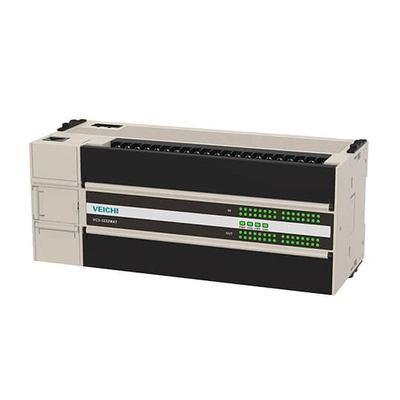
VC3M-3232MDT is the larger VC3M CPU with 32 inputs and 32 transistor outputs on a 24 V DC supply. Eight 200 kHz pulse channels (output), two serial ports, CANopen, Ethernet and the motion function with interpolation and axis synchronization. This is the choice for a big machine with a 24 V cabinet that needs coordinated pulse axis control alongside logic.
Typical applications:
- A large processing or packaging machine on DC supply with several coordinated motion axes.
- Distributed assemblies fed from a common 24 V DC source.
- Synchronization and positioning with Ethernet exchange to the supervisory level.
Note: it differs from VC3M-3232MAT only in supply (24 V DC); the I/O count and type are the same. If half the points are enough on the same DC, take VC3M-1616MDT.
Veichi VC3M — a pulse-based motion controller built on VC3
VC3M is the VC3 taken up to a full motion controller. The same dual-core CPU and 64,000 program steps, every output transistor, eight 200 kHz pulse channels (output) and a hardware motion function. We reach for it when a machine needs more than logic — pulse control of stepper or servo drives with two-axis linear and circular interpolation, electronic cam on up to four axes, electronic gear and multi-axis synchronization. All of this runs over the pulse channels, without a fieldbus. Ethernet (Modbus-TCP), CANopen, two serial ports and RS485 are on board, so it slots into an existing network easily.
The main reason to pick VC3M over the base VC3 is motion out of the box plus guaranteed transistor fast outputs for PWM and pulse. The plain VC3 also gives you 8×200 kHz and basic positioning, but VC3M is assembled specifically for coordinated motion: interpolation, e-cam, e-gear and axis synchronization are built into the firmware.
What VC3M is good for
- Two-axis interpolation: linear and circular paths for XY tables and simpler cutting or dosing stations.
- Electronic cam and gear: e-cam on up to four axes, synchronous gearing without mechanical cams — winding, flying feed, portioning.
- Multi-axis pulse synchronization: follower shafts tracking a master, coordinated motion of several servos on a packaging or textile machine.
- Replacing a "logic PLC + separate motion controller" pair: one VC3M covers both discrete logic and coordinated multi-axis motion, with Ethernet up to the HMI.
How VC3M differs from neighbouring series
| Spec | VC3 | VC3M | VC5 |
|---|
| Program | 64,000 steps | 64,000 steps | 200,000 steps |
| Pulse channels | 8 × 200 kHz | 8 × 200 kHz (output) | 8 × 200 kHz |
| Output type | model-dependent | transistor only | transistor |
| Motion | basic positioning | 2-axis interpolation, 4-axis e-cam, e-gear, sync | coordinated motion over EtherCAT, up to 32 axes |
| Motion bus | CANopen | CANopen, pulse motion | EtherCAT, axis synchronization |
Our take: VC3M already does interpolation, electronic cam and axis synchronization — but over pulses. For most coordinated jobs on 2–4 axes that is enough. The step up to VC5/VH600 is more axes, EtherCAT bus-synchronized servo, 200,000 program steps and a CODESYS environment (VH600) when you need hard deterministic synchronization across many drives.
When VC3M is not the right fit
- You need many servos synchronized over a fieldbus with microsecond determinism — go for VC5 or VH500/VH600 with EtherCAT.
- More axes than pulse control can drive, or you need 200,000 steps and CODESYS — that is VH600.
- You do not need motion, just logic and relay outputs for mixed loads — the base VC3 or VC1 is cheaper.
- You work inside another brand's ecosystem — compare with Delta or Fatek.
Our experience with VC3M
VC3M is bought for a specific job — when a machine has servos or steppers and needs more than start-stop, namely coordinated multi-axis motion over pulses. The typical buyer question is "how does it differ from the plain VC3": the answer is simple, here all outputs are transistor and the motion function with interpolation, e-cam and synchronization is built in, so you never have to worry about relay models or an external motion controller. We keep the common 16/16 and 32/32 sizes in both supply variants; alongside them buyers often take Veichi VFDs and Veichi operator panels for the same machine.



 Delivery and payment methods
 By Nova Poshta to a branch or courier to the address
 Bank transfer payment
 Service and Warranty
 Technical support