Where to wire the 4-20 mA current signal
A pressure or flow sensor in pump automation almost always outputs a 4-20 mA current signal. On Veichi it is wired to an analog input that can operate in current mode:
| Series | Input for 4-20 mA | Parameters |
|---|---|---|
| AC310 | AI2 | 0–20 mA or 4–20 mA; current input impedance 500 Ω; loop referenced to GND |
| AC01 | AS | 0–20 mA or 4–20 mA; loop referenced to COM (common ground) |
On the AC310 the current/voltage input mode is selected with a DIP switch — make sure current mode is chosen for 4-20 mA, otherwise the signal will not be "seen". Basic sensor and PID setup is covered in the article on connecting a 4-20 mA sensor.
Why the shield is not a formality
The 4-20 mA current loop is inherently more robust than a voltage loop, but inside a cabinet with a drive there are power cables nearby with sharp PWM edges. They couple noise into the signal wires, and instead of a stable pressure reading you see "jumps" in the setpoint, drifting speed and intermittent faults. That is why the sensor cable must be shielded.
Why is a current signal preferred over distance? Because in a current loop the useful quantity is the current, not the voltage, and the voltage drop across the resistance of a long wire does not matter — the receiver (the AI2/AS input with an internal current resistance of about 500 Ω) "sees" the same 4-20 mA regardless of line length. A 0-10 V voltage loop would sag over a long cable. But even a current loop can be ruined by coupled noise if the shield is neglected.
Which end to ground the shield
The key rule: ground the shield at one end only — on the drive side. If you ground both ends, a potential difference appears between the two ground points and an equalizing current flows through the shield — the very loop we are trying to avoid. One end of the shield to PE on the drive side, the other left isolated.
Why the drive side and not the sensor side? Because the drive is the source of interference, and it is to its PE that we want to "drain" the current coupled into the shield by the shortest path. If you ground it on the sensor side, the coupling will pass through the sensor housing and the measuring circuit — exactly where it is least wanted. So one point, and it is at the drive.
Separation from power runs
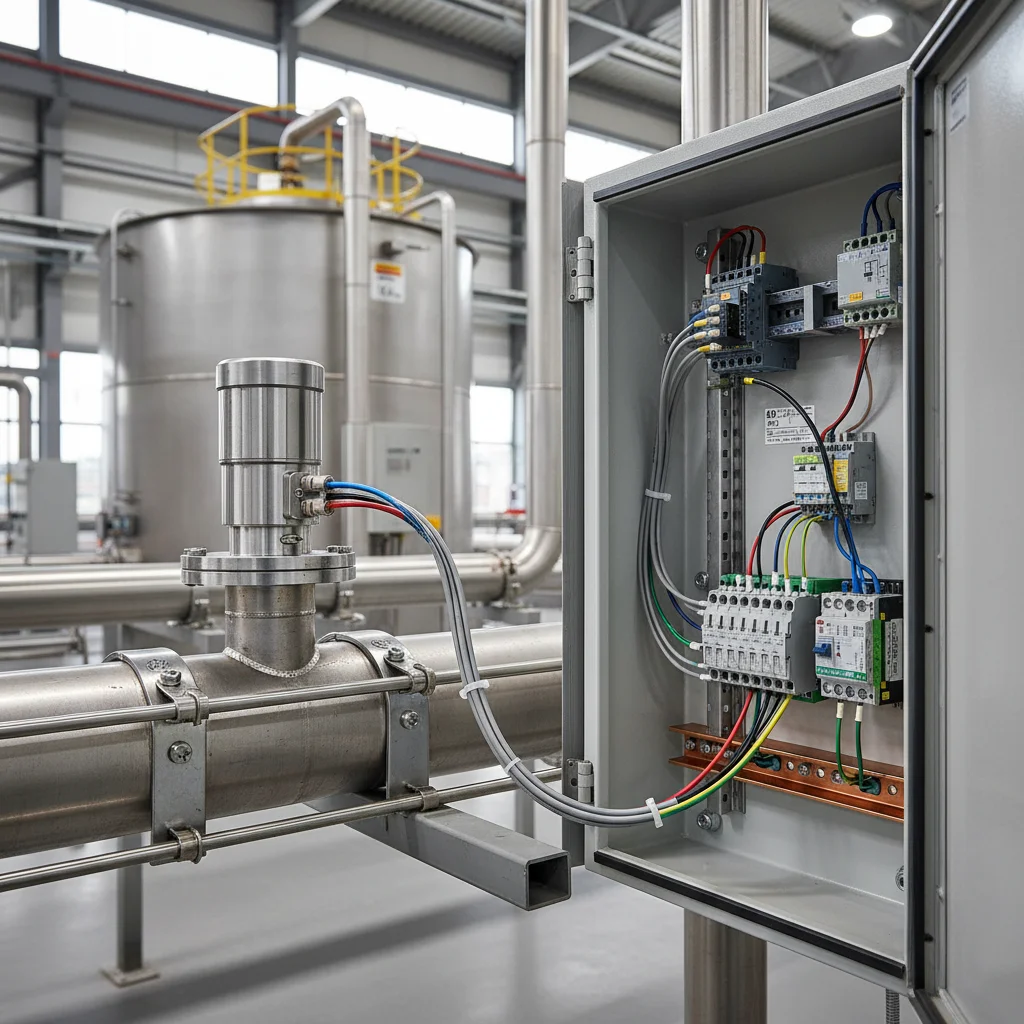
The signal cable must not run in the same bundle as the power cables. In our practice the power and signal runs are separated (a rough guide is about 15 cm) or, where a crossing is unavoidable, routed perpendicular to each other. This sharply reduces noise coupled into the current loop.
- The sensor signal cable — kept apart from the motor and mains cable.
- Crossings of runs — at 90°, not parallel.
- The shield — grounded at one end to the drive PE.
The E.PiD fault: what to check first
If the drive reports E.PiD, in the vast majority of cases the problem is in the sensor circuit, not in the drive itself. Checklist:
- Is the current arriving in the 4-20 mA range at AI2 (AS)?
- Is current input mode selected (DIP on the AC310)?
- Is the shield intact and grounded at one end?
- Are the signal and power cables separated?
- Is the sensor wiring polarity correct?
This approach is typical for pump applications — find more ready solutions in the category of drives for pumps. For the overall map of correct wiring when replacing a drive, see the reference article.
Setting up the input for 4-20 mA
The cable itself is only half the job. For the drive to read the sensor correctly, the input must be prepared:
- Input mode. On the AC310, switch the DIP of the relevant input (AI1/AI2) to current mode — otherwise the drive expects a 0-10 V voltage and will not "see" the sensor signal.
- Signal scaling. Map 4 mA to the minimum of the setpoint and 20 mA to the maximum. If inversion is needed (higher pressure → lower frequency to hold a constant pressure in PID), it is set in the corresponding parameter group.
- Verification. In monitoring mode, check whether the input reading rises smoothly from 4 to 20 mA as the pressure changes. Jumps indicate coupled noise or a poor contact.
Step-by-step setup of the sensor and PID loop is in a separate article on connecting a 4-20 mA sensor — covering both polarity and characteristic inversion.
FAQ
Why can't the shield be grounded at both ends?
Because there is a potential difference between the two ground points, and an equalizing current flows through the shield — it becomes a source of interference itself. Grounding at one end (at the drive) breaks this loop.
The sensor shows pressure in jumps — what's the cause?
Most often it is coupled noise: the cable is unshielded, the shield is grounded at both ends, or the signal run goes alongside a power run. Check the shield and separate the cables.
Speed rises together with pressure instead of falling — is that the shield too?
No, this is already feedback logic: positive feedback instead of negative. Check the sensor wiring polarity, and in the settings the characteristic mapping (where "less pressure" = "more frequency"). The shield has nothing to do with it, but it is worth checking in parallel.
Can the signal cable run in the same tray as the power cable?
It is not advisable. If there is no other way — separate them as far as possible within the tray and avoid long parallel sections; make crossings at a right angle.