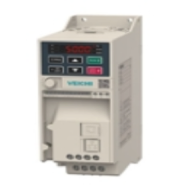
Quick Setup of Veichi Remote Start: The Main Rule
To activate control of the Veichi frequency inverter from external terminals, you must immediately set the value of parameter F01.01 to 1. This basic setting switches the source of start and stop commands from the local control panel to the device's terminal block. If this parameter remains at its default value (0), the device will ignore any signals on digital inputs X1-X6, which is the most common mistake during initial installation.
Veichi frequency inverters, represented by our specific category of equipment, have a flexible control signal distribution structure. Parameter F01.01 determines where the processor expects the Start command from. A value of 0 activates the RUN/STOP buttons on the device itself, a value of 1 transfers the logic to external physical terminals, and a value of 2 is intended for control via the RS-485 serial communication interface (Modbus RTU protocol). Switching to terminal control is an essential step in integrating the VFD into a general automation cabinet where external buttons, relays, or programmable logic controller (PLC) outputs are used.
Button Connection Diagram and the Critical Error with the GND Terminal
When connecting remote start buttons to digital inputs X1-X6, the common return wire must be exclusively the COM terminal, not the analog GND terminal. Using the GND terminal as a common ground for discrete signals is a gross engineering error that leads to serious equipment malfunctions.
The electrical logic of frequency inverters clearly separates digital and analog circuits to prevent mutual interference. The COM terminal is the common point for the internal +24V power supply used to poll the state of dry contacts (buttons, toggle switches, relay outputs). Inputs X1-X6 operate through optical isolation (optocouplers), protecting the microprocessor from voltage spikes. The GND terminal, in turn, is the reference zero for analog frequency control signals (0-10 V or 4-20 mA) coming from potentiometers or pressure and temperature sensors.
If you connect the start button between the X1 terminal and the GND terminal, the following negative consequences occur:
- High-frequency interference penetration: Switching digital inputs through the analog GND ground causes impulse noise in the sensitive circuits of the analog-to-digital converter (ADC).
- Sensor signal distortion: The operation of discrete inputs creates a voltage drop on the common GND wire, causing readings from pressure or temperature sensors to fluctuate erratically.
- Unstable motor speed: Since the VFD regulates speed based on an analog signal, noise on the GND terminal leads to constant drifting of the output frequency and motor rotor twitching.
Step-by-Step Algorithm for Connecting Two-Wire and Three-Wire Control
To implement remote start, you must choose one of two wiring schemes: two-wire (using a maintained toggle switch) or three-wire (using momentary, non-latching Start and Stop buttons). Before starting any installation work, be sure to de-energize the frequency inverter and wait at least 5 minutes for the DC capacitors to discharge completely.
The two-wire scheme is the simplest and requires only one maintained switch. The step-by-step installation is as follows:
- Connect one contact of the toggle switch to the COM terminal.
- Connect the second contact of the toggle switch to the X1 terminal (by default, this corresponds to forward motion - FWD).
- Apply power to the frequency inverter.
- Set parameter F01.01 = 1.
- Check parameter F05.20 (terminal control mode selection). For two-wire mode 1, set the value to 0.
The three-wire scheme is safer for industrial environments because it prevents the motor from starting automatically after power is restored. To implement it, you need a Start button (normally open, NO) and a Stop button (normally closed, NC). Connection algorithm:
- Connect one contact of the Stop button (NC) to the COM terminal.
- Connect the second contact of the Stop button to one of the contacts of the Start button (NO) and simultaneously connect this node to the X3 terminal (or another free terminal, such as X2).
- Connect the free contact of the Start button (NO) to the X1 terminal.
- Set parameter F01.01 = 1.
- Set the three-wire control mode in parameter F05.20. Set the value to 2 or 3 depending on the selected logic.
- Assign the X3 terminal as the three-wire control input by setting parameter F05.02 = 3.
Configuration of Digital Input Parameters X1-X6
Each digital input of the Veichi frequency inverter can be programmed to perform dozens of different functions using the F05 group parameters. This allows the device to be adapted to the specific technological requirements of the production line.
Below is a table of the main configuration parameters for digital inputs most commonly used when building remote control systems:
| Parameter Number | Input Name | Default Value | Recommended Value for Remote Start | Function Description |
|---|---|---|---|---|
| F05.00 | Digital Input X1 | 1 (FWD - Forward) | 1 (FWD) or 3 (Three-wire control) | Defines the function of the first input. In a two-wire scheme, it starts the motor forward. |
| F05.01 | Digital Input X2 | 2 (REV - Reverse) | 2 (REV) | Defines the function of the second input. Used for reverse or stop. |
| F05.02 | Digital Input X3 | 4 (Forward rotation) | 3 (Three-wire control) | Assigned as the NC stop button in a three-wire control scheme. |
| F05.20 | Terminal Control Mode | 0 (Two-wire 1) | 0, 1, 2, or 3 | Determines the interaction logic of inputs X1, X2, and X3 for starting and reversing the motor. |
When configuring parameters F05.00-F05.05, it is important to avoid duplicating values. If two different inputs are programmed for the same function, the frequency inverter will output a parameterization error or operate incorrectly, ignoring commands from both terminals.
Diagnostics and Troubleshooting in Remote Control
To resolve issues with a lack of response to button presses or false triggering, it is necessary to perform sequential diagnostics of the electrical circuits and software settings. Most often, problems arise due to electromagnetic interference from the motor power cable or an incorrect choice of input logic type (NPN or PNP).
As a first step, check the position of the hardware logic type switch (SINK/SOURCE or NPN/PNP) located on the control board next to the terminal block. If the switch is set to the NPN (SINK) position, then to activate the input, the X1 terminal must be shorted to COM (0V). If the switch is in the PNP (SOURCE) position, the inputs are activated by applying +24V, and the button connection diagram must be revised according to the manufacturer's manual.
Also, pay attention to the length of the cables from the buttons to the VFD. If the distance exceeds 10-15 meters, the control cable must be shielded. The cable shield should be grounded on one side only — on the frequency inverter side to a special PE ground terminal, but never to the COM or GND terminals. This minimizes the impact of high-frequency noise from the IGBT power transistors on the control logic circuits.