

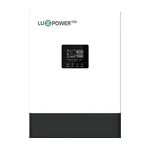
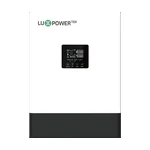
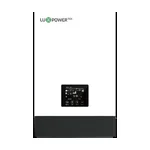
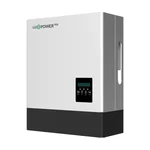
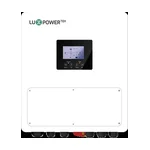
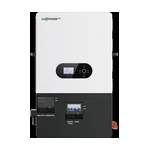
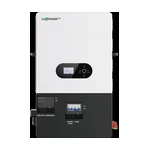
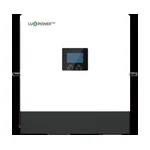
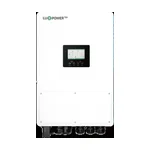
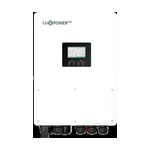
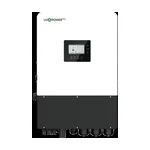
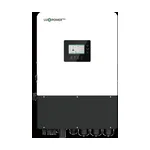
LuxPower inverters: 12 models from 1.5 to 20 kW across two different lines
Lux Power Technology builds two distinct lines, and mixing them up costs more than any other selection mistake. The off-grid and eco-hybrid GETA and SNA series hold autonomy and backup, routing surplus generation into self-consumption. The hybrid GEN3, GEN Pro, LXP and the three-phase TriP2 are positioned by the manufacturer as grid-oriented, with energy management on the utility side. Our price list holds 12 items, all made to order: availability and lead time are confirmed per model.
Off-grid line: GETA and SNA. No grid feed-in here
This is the single most important thing to know before buying. The manufacturer places the GETA and SNA series in the off-grid and eco-hybrid class: their job is backup during outages and self-consumption of your own generation. They do not export surplus to the grid. For SNA PRO-EU the manufacturer states it plainly, «designed for Zero-Export», and adds that in markets where export requires separate certification the model works as a premium off-grid backup system.
The larger SNA units (SNA2-EU-LT) do carry an Export to Grid item in the menu, yet the manufacturer allows enabling it only where export is not restricted by regulation. In Ukraine that is a matter of a contract with the distribution utility and of certification, not a checkbox in the inverter menu. Hence the practical rule. Planning to sell surplus? Take the hybrid line, and arrange the connection with the utility separately. Need autonomy and backup instead, and GETA with SNA close that job for less.
What the off-grid line actually contains. GETA 1.5K at 1.5 kW for a 12 V battery and GETA 3.6K at 3.6 kW for 24 V: niche units for a cottage or a camper, where a 48 V bank is overkill. Then the 48 V group: SNA5000 Wide PV at 5 kW, SNA PRO-EU 6.5K at 6.5 kW in an IP65 enclosure, and three high-power single-phase units at 12 and 14 kW: SNA-EU 12000, SNA-EU 14000, SNA2-EU-LT 14K.
Hybrid line: GEN3, GEN Pro, TriP2
GEN3-LB-EU 8K is a single-phase hybrid at 8 kW in an IP66 enclosure, with battery charge and discharge current up to 180 A. GEN Pro-LB-EU 12K applies the same approach at 12 kW and up to 270 A. The three-phase TriP2-LB-3P 15K and TriP2-LB-3P 20K connect to a 3×380 V supply while running the same low-voltage 48 V battery as the single-phase models. There is also LXP6K at 6 kW: a passively cooled unit whose part number we have not yet reconciled with the current manufacturer catalogue, so ask us before relying on its figures.
Key models compared
| Model | Power | Supply | Battery | Max charge/discharge current | Class |
|---|---|---|---|---|---|
| SNA5000-WPV | 5 kW | 1×230 V | 48 V, 38.4–60 V | 110 A | off-grid |
| SNA PRO-EU 6.5K | 6.5 kW | 1×230 V | 48 V, 40–60 V | 140 A | off-grid, IP65 |
| GEN3-LB-EU 8K | 8 kW | 1×230 V | 48 V, 40–60 V | 180 A | hybrid, IP66 |
| SNA2-EU-LT 14K | 14 kW | 1×230 V | 48 V, 46.4–60 V | 270 A | off-grid |
| TriP2-LB-3P 20K | 20 kW | 3×380 V | 48 V, 40–60 V | 250 A | hybrid |
Enclosure rating appears for two models only. For the rest our data and the manufacturer's summary catalogue disagree, and until that is resolved we print nothing here.
What replaces SNA6000 WPV
Of all LuxPower models this is the one people search for most, and our price list does not carry it. The closest available items are SNA5000 Wide PV at 5 kW and SNA PRO-EU 6.5K at 6.5 kW. Both are single-phase 230 V units running a 48 V battery, so they fill the slot SNA6000 occupied. They differ in maximum battery current (110 A versus 140 A) and in the enclosure: the PRO version in IP65 goes where the unit does not sit in a dry room. If SNA6000 is already installed and you need a swap without redoing the wiring, send us the PV array parameters and we will say which of the two drops in unchanged.
Monitoring and documentation
Every model carries a local display on the enclosure. Remote monitoring runs through the Luxpower app and web portal, and that needs a Wi-Fi module (datalogger). Communication interfaces differ by model: the smaller GETA units offer LCD and Wi-Fi, while the 48 V group adds RS485 and CAN for talking to the battery BMS. The exact list per unit sits on each product page.
Which batteries fit
All 48 V LuxPower units work with ordinary low-voltage LiFePO4 modules. Brands in our catalogue: Dyness, Felicity, BIOM, Deye. The full list is gathered on the LiFePO4 batteries page. GETA 1.5K and 3.6K need 12 V and 24 V banks respectively, a different class that does not appear in the main 48 V selection. The inverter-oriented shortlist is here: batteries for inverter.
Where to look next
For a cross-brand comparison see Deye hybrid inverters and the full hybrid inverter catalogue. Still choosing a rating? 6 kW, 8 kW, 12 kW. We covered three-phase supply and when it is genuinely needed in single-phase or three-phase and three-phase hybrid inverter 380 V, while the general sizing guide for a house lives here: how to choose a hybrid inverter for a home.
We order the whole LuxPower range, not only the popular ratings. Tell us your supply type and daily consumption. Add whether grid export is planned, and we will answer which series belongs there and where another brand works out better.