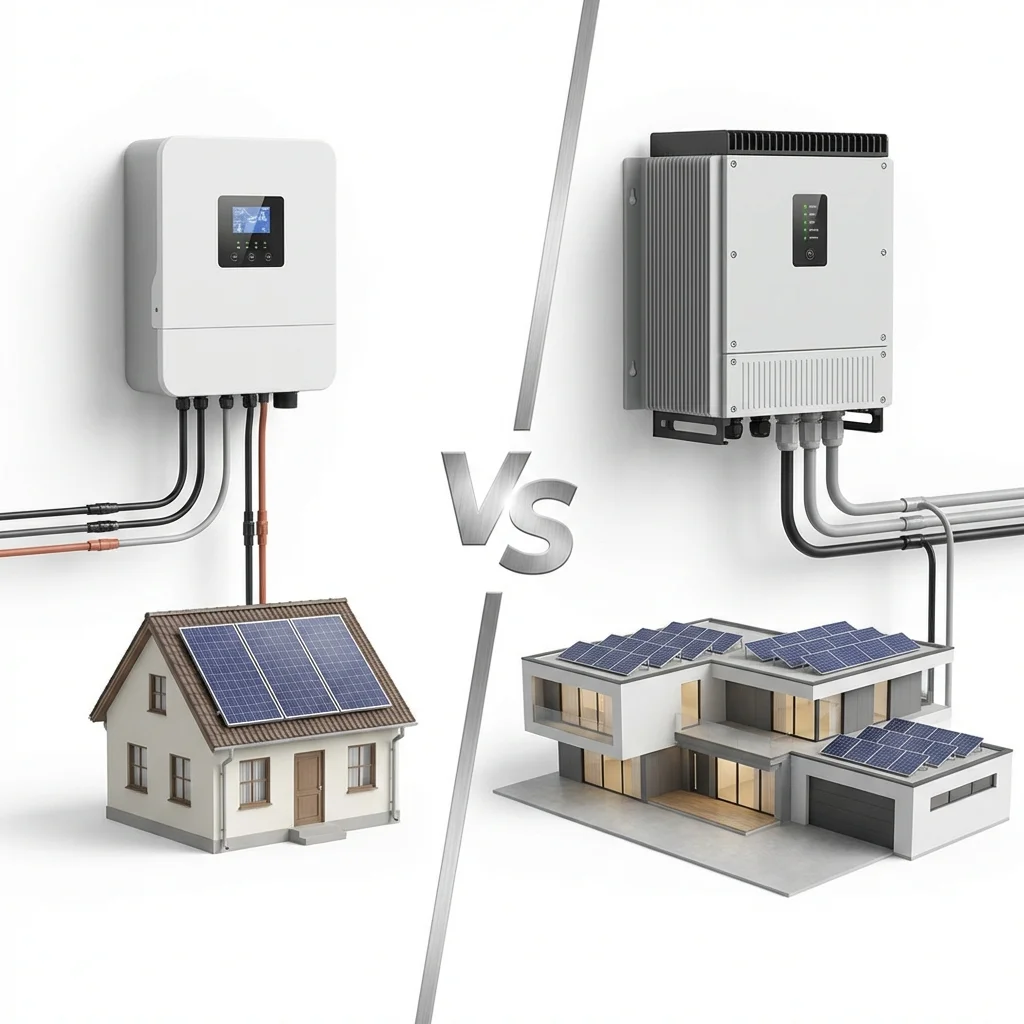
Single-Phase and Three-Phase Hybrid Inverter — Key Differences
Choosing between a single-phase and three-phase hybrid inverter is one of the first and most critical decisions when designing a solar power system. This choice affects not only equipment cost but also overall system efficiency, scalability, and backup power reliability during blackouts. Let us examine both options in detail so you can make an informed decision.
What Is a Single-Phase Hybrid Inverter (220V)
A single-phase hybrid inverter operates with one phase of alternating current at 220V. This is the standard grid connection for most apartments and small private homes in Ukraine. Such an inverter simultaneously performs three functions:
- Converts direct current from solar panels to 220V alternating current
- Charges battery storage for autonomous power supply
- Automatically switches between grid, solar, and battery power
Single-phase models range from 3 to 8 kW. This is sufficient for homes up to 150 m², where the main consumers are lighting, a refrigerator, water heater, heating pump, and household appliances. Popular models include the Deye SUN-5K-SG05LP1, GoodWe GW5000-ES, and Growatt SPH 5000.
What Is a Three-Phase Hybrid Inverter (380V)
A three-phase hybrid inverter operates with three phases of 220V each (line-to-line voltage of 380V). It distributes the load evenly across all phases, which is critical for high-power consumers: three-phase motors, industrial equipment, heavy-duty air conditioners, and electric boilers.
Power output ranges from 5 to 50 kW and beyond (cascade connection). Three-phase models are mandatory for homes with three-phase supply, commercial facilities, and industrial sites. Key models include the Deye SUN-10K-SG04LP3, GoodWe GW10K-ET, and Growatt SPH 10000TL3.
Comparison Table: Single-Phase vs Three-Phase
| Parameter | Single-Phase (220V) | Three-Phase (380V) |
|---|---|---|
| Grid voltage | 220V, one phase | 380V (3x220V), three phases |
| Power range | 3–8 kW | 5–50 kW |
| Typical application | Apartments, homes up to 150 m² | Homes 200+ m², business, industrial |
| Three-phase motors | Not supported | Full support |
| Inverter price (5 kW) | $800–1,500 | $1,200–2,500 |
| Installation complexity | Simple, standard wiring | Requires three-phase meter, permits |
| Phase balancing | Not required | Automatic or manual |
| Scalability | Limited (up to 8 kW) | High (cascade to 100+ kW) |
| Efficiency at low loads | Higher (lower idle losses) | Lower (three inverter bridges) |
| Backup power during blackout | One phase, all outlets | All three phases or selective |
When to Choose a Single-Phase Hybrid Inverter
Apartment or Small Home
If your home is connected to a single-phase grid (which is the case for most apartments and homes up to 150 m² in Ukraine), a single-phase inverter is the only logical choice. Installing three-phase equipment would require upgrading to a three-phase supply, which means:
- Filing an application with the regional power company and negotiating new technical specifications
- Replacing the meter, circuit breakers, and cable from the utility pole
- Expenses from UAH 15,000 to 50,000 for electrical work alone
- Waiting time of 1 to 6 months
Budget Solar Power System
For a 3–5 kW system with a LiFePO4 battery of 5–10 kWh, a single-phase inverter costs 30–40% less than its three-phase counterpart. Savings amount to $400–800 on the inverter itself, plus simpler installation.
Backup Power During Blackouts
A single-phase inverter powers all outlets in the house equally — there is no problem of "one phase working while two are down." For basic needs (lights, refrigerator, charging, Wi-Fi router, boiler), a 3 kW inverter with a 5 kWh battery is sufficient.
When to Choose a Three-Phase Hybrid Inverter
Large House or Cottage
Homes of 200 m² or more typically have three-phase supply and high-power consumers: a 9–15 kW electric boiler, air conditioners on every floor, an electric cooktop, and a sauna. Total peak load can reach 15–25 kW — a single-phase inverter simply cannot handle this.
Three-Phase Motors and Equipment
If you have a deep well pump, industrial compressor, or other equipment with a three-phase motor, you need a three-phase inverter. A single-phase unit cannot generate the three phase-shifted waveforms required for such motors.
Commercial and Industrial Facilities
Shops, offices, manufacturing plants, and farms require power outputs from 10 to 50 kW. Three-phase hybrid inverters can be cascaded together for output exceeding 100 kW. Brands like Deye, Growatt, and Solis offer commercial lineups.
Planning for Future Expansion
If you plan to increase your system capacity over time (for example, from 10 to 30 kW), a three-phase platform offers far more flexibility. Additional inverters simply connect in parallel to the same three-phase bus.
Connection Specifics in Ukraine
Single-Phase Supply (Most Households)
The standard residential connection in Ukraine is single-phase, 220V, with a limit of 5–16 kW (depending on your contract with the regional power company). To install a solar system with a single-phase inverter, you need to:
- Apply for a "green tariff" or net metering
- Install a bidirectional meter
- Obtain a commissioning certificate
Three-Phase Supply (Requires Approval)
To upgrade to three-phase power or increase capacity, you must:
- Submit an application to your local power company
- Receive new technical specifications
- Complete an electrical supply design
- Replace the cable from the utility pole and the meter
- Pass inspection and receive a certificate
The cost of upgrading to three-phase supply depends on the distance to the transformer and ranges from UAH 20,000 to 80,000. The timeline is 2 to 6 months.
Choosing a Battery for Single-Phase and Three-Phase Systems
The inverter type affects your choice of battery storage:
- Single-phase 3–5 kW: a 5 kWh battery is the minimum, 10 kWh is optimal for 8–12 hours of autonomy
- Single-phase 6–8 kW: a 10–15 kWh battery for full home backup
- Three-phase 10–15 kW: a 15–30 kWh battery, often a cascade of multiple modules
- Three-phase 20+ kW: 30+ kWh battery, LiFePO4 server rack units
We recommend LiFePO4 batteries — they provide 6,000+ cycles, are safe, and maintenance-free. For solar panels, consider home kits with 500W or 600W panels.
Total System Cost Comparison
| Component | Single-Phase 5 kW | Three-Phase 10 kW |
|---|---|---|
| Inverter | $900–1,300 | $1,800–2,800 |
| Solar panels | $1,000–1,500 (10 pcs x 500W) | $2,000–3,000 (20 pcs x 500W) |
| LiFePO4 battery | $1,500–2,500 (10 kWh) | $3,500–5,500 (20 kWh) |
| Installation and materials | $500–800 | $1,000–1,500 |
| Total | $3,900–6,100 | $8,300–12,800 |
A three-phase system costs roughly twice as much but also delivers twice the power output and complete coverage for a large home.
Popular Hybrid Inverter Brands
Deye
The Chinese market leader with the widest product range: single-phase from 3 to 8 kW, three-phase from 5 to 50 kW. Key advantage — compatibility with most batteries and reliable software. Browse the Deye hybrid inverter catalog.
GoodWe
Premium quality with an excellent monitoring app (SEMS). The ES series (single-phase) and ET series (three-phase) are among the most reliable on the market. 10-year warranty.
Growatt
Best value for money. The SPH series (single-phase) and SPH TL3 (three-phase). Intuitive ShinePhone app. 10-year warranty.
Solis
One of the world's largest inverter manufacturers. The RHI (hybrid) series is available in both single-phase and three-phase configurations. Known for stable operation and competitive pricing.
Practical Scenarios: What to Choose for Your Situation
Scenario 1: Apartment in a High-Rise
Solution: single-phase 3–5 kW. A balcony solar station + 5 kWh battery. Provides 4–6 hours of backup power during blackouts. The grid is single-phase — no other option is available.
Scenario 2: Private Home 100–150 m²
Solution: single-phase 5 kW or 6 kW. Covers essential needs: lighting, refrigerator, water heater, pump. A 10 kWh battery provides overnight backup.
Scenario 3: Cottage 200–300 m²
Solution: three-phase 10 kW. Electric boiler, air conditioners, appliances — you need the power and three phases. A 20 kWh battery for 12+ hours of full autonomy.
Scenario 4: Farm or Small Business
Solution: three-phase 15–30 kW. Three-phase motors, cold storage, production equipment. A cascade of two or three inverters + 30+ kWh battery.
Frequently Asked Questions (FAQ)
Can I connect a three-phase inverter to a single-phase grid?
No, a three-phase inverter requires a three-phase supply (three phases + neutral). Connecting to a single-phase grid is impossible without upgrading the service entrance, which requires utility company approval and significant expense.
Which is better for blackouts — single-phase or three-phase?
For basic backup (lights, refrigerator, router), a single-phase is simpler and cheaper. It powers all outlets evenly. A three-phase makes sense if you have critical three-phase equipment (pump, boiler) that must operate during outages.
What is the price difference between single-phase and three-phase inverters?
At the same power rating (e.g., 5 kW), a three-phase inverter costs 30–50% more. However, three-phase models are available in a much wider power range (up to 50 kW), while single-phase units are limited to 8 kW.
Can I upgrade from single-phase to three-phase later?
Yes, but this effectively means replacing the entire system: inverter, wiring, meter, and permits. If you plan to expand, it is better to install a three-phase inverter at a lower power rating (5 kW) from the start and scale up later.
How many solar panels do I need for a single-phase vs three-phase inverter?
For a single-phase 5 kW system — 8–10 panels of 500W or 600W each. For a three-phase 10 kW system — 16–20 panels. The exact number depends on roof orientation and desired surplus for battery charging.