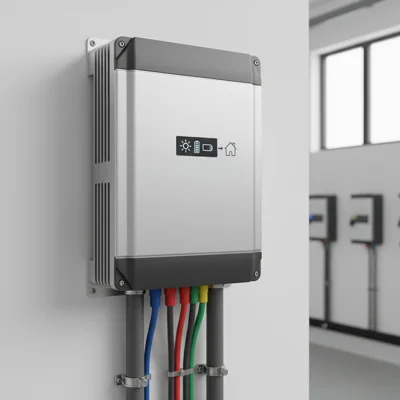
BMS — what it is and why every LiFePO4 battery has one
BMS (Battery Management System) is an electronic board inside the battery that controls charge, discharge, temperature, and cell balance. Without BMS, a lithium battery can overcharge, overheat, or fail due to cell imbalance.
Every LiFePO4 battery we sell has a built-in BMS. But quality varies widely between brands and price segments.
What BMS does: 5 core functions
1. Overcharge protection
Disconnects charging when any cell reaches the upper threshold (typically 3.65 V). Without this — cell swelling or rapid degradation.
2. Over-discharge protection
Disconnects load when cell voltage drops below minimum (typically 2.5-2.8 V). Deep discharge below 2.5 V damages cell chemistry irreversibly.
3. Cell balancing
16 cells in a 51.2 V module have slight parameter variations. BMS equalizes charge between cells.
- Passive balancing: cheaper, simpler. Dissipates excess as heat. Current 50-200 mA
- Active balancing: more expensive, more efficient. Redistributes energy. Current 1-5 A
4. Temperature monitoring
Sensors on cells. Overheating (above 55-60°C) stops operation. Freezing blocks charging.
5. Current limiting
Controls maximum charge and discharge current. Exceeding the limit triggers disconnect.
BMS communication with inverter
Via CAN or RS485, BMS sends the hybrid inverter: exact charge level, battery health status, allowable current, temperature. Without communication, the inverter operates blind.
How to evaluate BMS quality
| Parameter | Good BMS | Weak BMS |
|---|---|---|
| Balancing | Active or strong passive (200+ mA) | Passive 30-50 mA |
| Communication | CAN + RS485 + Bluetooth | Basic protocol only |
| Temperature sensors | 3-4 on different cells | 1 sensor or on board |
| Monitoring | App with per-cell voltage | Total voltage only |
Problems with cheap BMS
- Cell imbalance: 200-500 mV difference → failure within a year
- False disconnects: under normal load
- No temperature control: charging in frost → cell degradation
- No communication: inverter works blind, -20-30% lifespan
BMS in popular brands
- Deye BOS-G: CAN, Bluetooth, passive 150 mA. Good for the price
- Veichi: CAN + RS485, active in higher models, 4 sensors, IP65
- Pylontech US: CAN + RS485, passive 200 mA, solid monitoring
- Felicity Solar: CAN, passive, basic monitoring. Reliable
Frequently Asked Questions
Can the BMS be replaced?
At a service center — yes. DIY — risky. BMS must match cell configuration.
Does BMS affect capacity?
BMS determines how much capacity is available. If it cuts off at 20% — you get 80% of nominal.
Is active balancing much better than passive?
For 16 cells at home — the difference is small. Passive at 150-200 mA handles it fine.
Why does the battery briefly disconnect at full charge?
BMS is balancing cells. This is normal behavior, not a fault.
Can LiFePO4 be used without BMS?
Absolutely not. Without BMS there is no protection. Cells will fail within months. All batteries in our catalog include BMS.
Summary
BMS is not optional — it is a mandatory component. When choosing a battery, check balancing type, CAN/RS485 support, and Bluetooth monitoring. Browse the LiFePO4 battery catalog with BMS specs for each model.