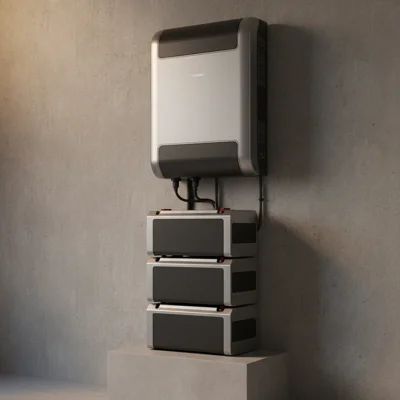
Battery for an inverter — what determines the choice
The right battery for a hybrid inverter is a LiFePO4 module at 48V (51.2 V) with CAN or RS485 communication protocol. Everything else is details. But those details make the difference between a system that runs 12 years maintenance-free and one that causes problems after a year.
We select batteries for 30-40 installations every month. From one-bedroom apartments in Kyiv to country houses of 200 m². The patterns are clear by now — and we are sharing them.
Battery-inverter compatibility
First thing to figure out — does your inverter support the specific battery model? Not just "lithium" in general, but a specific communication protocol. There are three options:
- CAN bus: the most common protocol. Deye, Growatt, Veichi all work via CAN. The battery sends the inverter exact charge level, temperature, and allowable current
- RS485: an older protocol used in budget systems. It works but transmits fewer parameters
- No protocol: the inverter estimates charge by voltage. Inaccurate, leads to undercharge or over-discharge. We do not recommend this
Manufacturers publish compatible battery lists. Deye SUN-5K-SG03LP1 works with Deye BOS-G, Pylontech, Felicity. Veichi SIS-5K has its own battery lineup with full integration. If you get a hybrid inverter and battery from the same brand — no compatibility issues.
What capacity to choose
Depends on two things: average load during an outage and how many hours without power you want to last. Here is a reference table:
| Property type | Load | Recommended capacity | Autonomy time |
|---|---|---|---|
| Apartment (minimum) | 300-500 W | 5.12 kWh | 8-14 hrs |
| Apartment (comfort) | 800-1200 W | 10.24 kWh | 7-10 hrs |
| House (no heating) | 1500-2500 W | 15-20 kWh | 5-10 hrs |
| House (with heat pump) | 3000-5000 W | 30+ kWh | 5-8 hrs |
Golden rule: get one module more than you think you need. A battery that regularly discharges to 20% will outlast one that hits zero every time. At 50% depth of discharge instead of 80%, cycle life grows from 4,000 to 7,000+.
What if you have solar panels?
Then you can reduce capacity. Panels recharge the battery during the day, so a smaller reserve suffices at night. For a house with a 3-5 kW solar panel array, 10 kWh is usually enough instead of 15-20.
One large module or several small ones
Both options work. One 10.24 kWh module or two 5.12 kWh modules — electrically it is the same thing (parallel connection). But there are nuances.
One module means simpler installation, fewer cables, one BMS. Multiple modules offer flexibility: start with one and add another in a year. Most of our clients (probably 60-70%) start with 5 kWh and buy a second one within 3-6 months.
- One module: fewer connection points, simpler maintenance. But if the BMS fails — the whole system is down
- Two+ modules: redundancy. If one module is being serviced, the other keeps working. Downside — you need modules of the same brand, preferably same batch
Brands: what we recommend and why
Three brands we work with most:
- Deye BOS-G: most popular in Ukraine. Price starts from 19,000 UAH for 5.12 kWh. Works with all Deye inverters out of the box. CAN communication, app monitoring. Downside — plastic case, not for outdoor use
- Veichi: metal case, IP65, can be installed in unheated spaces. CAN + RS485. 15-20% more expensive than Deye, but noticeably better build quality
- Felicity Solar: wide range from 2.56 to 15.36 kWh. Good option for large systems where you need 30+ kWh total
Browse the battery catalog for inverters with prices and availability.
Common mistakes — what we see on installations
Over 3+ years of installations, we have seen it all. Here are typical mistakes that cost money:
- Bought AGM "because it is cheaper": after 2 years capacity drops by half. The client spends the same amount again on replacement. LiFePO4 does not have this problem
- Got a battery without communication protocol: the inverter cannot see real charge level, cannot limit current. Result — over-discharge, cell degradation
- Connected batteries of different brands in parallel: different BMS systems conflict. One battery takes all the current, the other sits idle. After a year — imbalance and failure
- Installed in an unheated garage: in winter, BMS blocks charging below 0°C. The battery discharges but will not charge. Morning — zero percent
How to connect the battery to an inverter
Physical connection is simple: two power cables (positive and negative) from battery to the inverter battery input, plus a communication cable (CAN or RS485). Power cable cross-section — from 16 mm² for modules up to 5 kWh, from 25 mm² for 10+ kWh.
After connecting, select the battery type in the inverter menu. For example, in Deye: Settings - Battery - Battery Type - Lithium. The inverter then automatically reads parameters via CAN and starts operating.
If you already have a hybrid inverter with LiFePO4, contact us — we can help with remote setup.
Frequently Asked Questions
Which battery works with Deye inverters?
Deye BOS-G (5.12 or 10.24 kWh) is the native solution with full integration. Pylontech US series and Felicity Solar with CAN protocol are also compatible.
Can I connect a car battery to an inverter?
Technically yes, but it is a bad idea. Car batteries are not designed for deep discharge. After 50-100 cycles, capacity drops to a third. Use only deep-cycle or LiFePO4 batteries.
How many batteries can be connected in parallel?
Depends on the model. Deye BOS-G — up to 32 modules (163 kWh). Veichi — up to 16 modules. For a private home, 2-4 modules is usually enough.
Do I need a separate breaker for the battery?
Yes. A DC breaker or fuse between battery and inverter is mandatory. Rating should match the battery maximum current (typically 100-150 A for a 5 kWh module).
What happens if the battery fully discharges?
The BMS disconnects the battery when minimum voltage is reached (usually 44-46 V). This protects cells from damage. Once connected to grid or panels, charging resumes automatically.
Next step: making the purchase
Determine your load, choose capacity with margin, verify inverter compatibility. Or just write to us — we will select a kit for your property in 15 minutes. The LiFePO4 battery catalog with current prices is on the website.