Skip to content
Selection by parameters
Brand
Seriya

Jinko Solar Panels

Found 11 products
JinkoSolar ×
Скинути фільтри

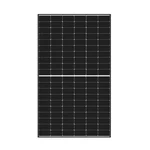
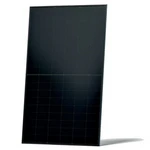
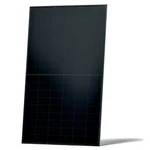
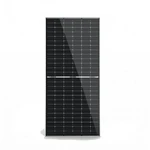
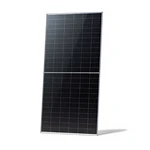
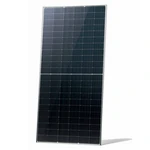
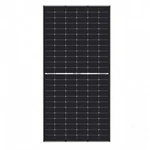
JinkoSolar is represented in stock by the JKM series — monocrystalline modules from 430 to 620 W at 21.5–23.0% efficiency. The number after JKM equals the nameplate rating, and the number before HL gives the whole-cell count: 54HL4R means 108 half-cells in a 1762×1134×30 mm frame, 72HL4 means 144 cells at 2278×1134, and 66HL4M means 132 cells at 2382×1134. Weight runs from 22 kg for the compact format to 32.5 kg for the largest module.

The BDV (and BDVP) suffix marks a bifacial module with rear glass. Six of the eleven items qualify: JKM430N-54HL4R-BDV, JKM555M-72HL4-BDVP, JKM565N, JKM585N, JKM590N and JKM620N-66HL4M-BDV. Monofacial units carry a B or V suffix and, in the large frame, weigh 3–4 kg less: JKM585N-72HL4-V is 27 kg against 31 kg for JKM585N-72HL4-BDV. In the compact 108-cell frame there is no weight penalty at all — both variants are 22 kg.

Open-circuit voltage across the range is 38.6–52.9 V and current at maximum power point 13.27–15.22 A. The current spread is narrow, which makes Jinko modules easy to combine within one frame size. When laying out a string, check Voc against the inverter maximum input voltage rather than against the MPPT operating window.

Frequently Asked Questions

How many 585 W Jinko panels make 10 kW?

Seventeen JKM585N modules give 9.95 kW, which is the standard configuration for a 10 kW inverter. Allowing for oversizing, installers fit up to 20–22 panels where the area permits. Split them across at least two strings of 8–11 modules: at 52.7 V Voc per module, a single long string quickly runs into the inverter maximum input voltage.

What does the BDV suffix on a Jinko panel mean?

BDV denotes a bifacial module with rear glass instead of a backsheet. It also collects light reflected off the surface beneath the panel and weighs 3–4 kg more than the monofacial equivalent. The gain depends on what lies below: over light gravel or a white membrane it is meaningful, over dark bitumen or grass it is close to nothing.

What is the difference between Jinko N and M models?

They are different cell generations. Ten of the modules in stock carry the N index (JKM430N through JKM620N) with efficiency from 21.52% to 22.95%. One M-index model remains — JKM555M-72HL4 at 21.48%. In the same 2278×1134 mm frame the N module produces 585–590 W against 555 W for the M, so the same roof area yields 5–6% more.

What are the dimensions and weight of Jinko panels?

Three formats. Compact 1762×1134×30 mm at 22 kg covers the 430–440 W models on 108 half-cells. The standard large frame 2278×1134 (30 or 35 mm thick) at 27–32 kg covers 555–590 W on 144 cells. The longest, 2382×1134 at 28.2–32.5 kg, covers 615–620 W on 132 cells. Modules over 2.3 m need two people to install and a different mounting pitch than residential sizes.

Jinko or LONGi — which should I choose?

On the specifications we stock the ranges overlap: Jinko covers 430–620 W up to 22.95% efficiency, LONGi covers 410–655 W up to 24.2% with a far wider catalogue (50 items against 11). In practice the deciding factors are availability of the specific wattage and the price at the time of order. If the array will be extended in stages, the wider line is the safer bet — matching the same model later is easier.