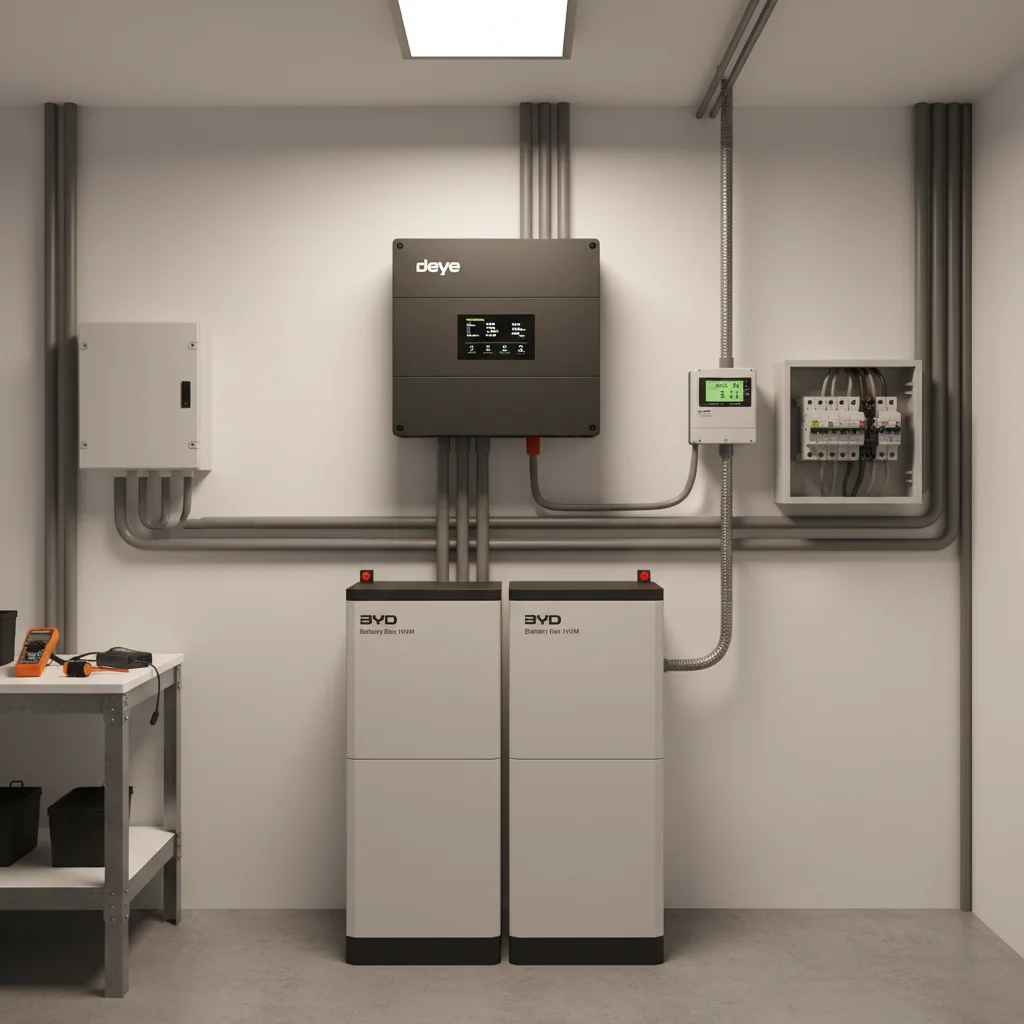
Top 5 Advantages of Deye Inverters — according to reviews on the "Deye Ukraine" forum
1. Wide range of powers and configurations
Users actively discuss and use models from 6 kW single-phase to 80 kW three-phase. In the group, there are requests for Deye 6kW, 10kW, 15kW, 20kW, 30kW, 80kW — this means that the brand covers the needs of both residential and commercial objects. Such flexibility is a significant advantage compared to competitors.
2. Ability to connect various types of batteries (LiFePO4, Tesla, self-assembled)
The forum is full of examples of connecting Tesla Model 3 batteries, self-made LiFePO4 batteries, Deye batteries, and third-party manufacturers' batteries. The inverter supports CAN/Pylontech protocols for communication with BMS — this provides great freedom in choosing batteries and is a clear advantage for technically prepared users.
3. Flexible control via app and cloud monitoring (SolarmanPV)
Group members actively use remote firmware updates and cloud monitoring via the app. The manufacturer can update firmware remotely via WhatsApp/support — this is a modern and convenient feature, which experienced installers positively perceive.
4. Developed community and mutual assistance (40,000+ participants)
The group itself has 40,100+ participants, where experienced installers ("star co-authors") help for free with settings. The presence of such a large active community is indirect evidence that the product is popular and in demand in the Ukrainian market.
5. Affordable price and availability in the Ukrainian market
Compared to competitors (for example, Solis 30kW, which the client chose instead of Deye 10kW), Deye is positioned as a more affordable option. New and used models are actively sold in the group, and there are dealers throughout Ukraine (Dnipro, Kyiv, etc.), which indicates good availability and developed distribution even in wartime conditions.
TOP 5 Difficulties users face
🔋 1. Problems with battery charge settings
The most frequent topic in the group — incorrect or unclear battery charging current and mode. Users ask: what maximum current should be set from the grid to charge batteries faster without damaging them. Specifically, for LiFePO4, it is recommended not to exceed 0.5C, but factory values allow significantly more. Separately, there is a problem of limiting the charge to 16A — regardless of the settings.
Essence: The inverter either does not adhere to the specified charging parameters, or the factory settings contradict the recommendations of battery manufacturers.
⚡ 2. "AC Overload" error (output overload)
Several posts with photos and videos show the "AC overload" error — the inverter turns off or switches to Off-grid mode for no apparent reason when loads are connected. One commentator jokingly recommended "putting a stabilizer in front of Deye," which indicates the prevalence of problems with the quality of the incoming mains voltage (recorded drops to 170V when switched on).
Essence: The inverter is too sensitive to mains voltage drops or incorrectly interprets the load as excessive.
🔄 3. Firmware problems and incorrect display
There are complaints about incorrect data display on the screen (left or right part of the display does not correspond to reality) and interface glitches. The solution in many cases is a firmware update (for example, from version "2008" to "200d"). There is also a post about distorted localization — the interface shows gibberish instead of normal characters, and users are looking for a way to set a normal language.
Essence: Firmware contains bugs, and updating is not easy and requires special knowledge or contacting support.
🔧 4. Asynchronous charging/discharging of multiple batteries
When users add a second or third battery, a problem arises with a 20-30% SoC difference between batteries — they do not charge and discharge simultaneously. The reason is an incorrect connection scheme (series instead of diagonal), but many do not know this. Technical support and forum participants also point to the need for a firmware update for correct balancing.
Essence: Connecting multiple batteries is technically complex, documentation is incomplete, and without experience, the system works incorrectly.
⚙️ 5. Complex and confusing settings (ToU, Peak Shaving, operating modes)
A large number of questions concern the setting of Time of Use (ToU), Peak Shaving, "Load First" / "Grid First" modes, etc. After enabling the Peak Shaving function, ToU is automatically activated with factory parameters that are "incorrect". Users, especially new ones, do not understand how to correctly configure power priorities (grid → battery → load).
Essence: The settings interface is complex, default factory values are often incorrect for Ukrainian conditions, and documentation is insufficient.