When Parallel Connection Is Needed
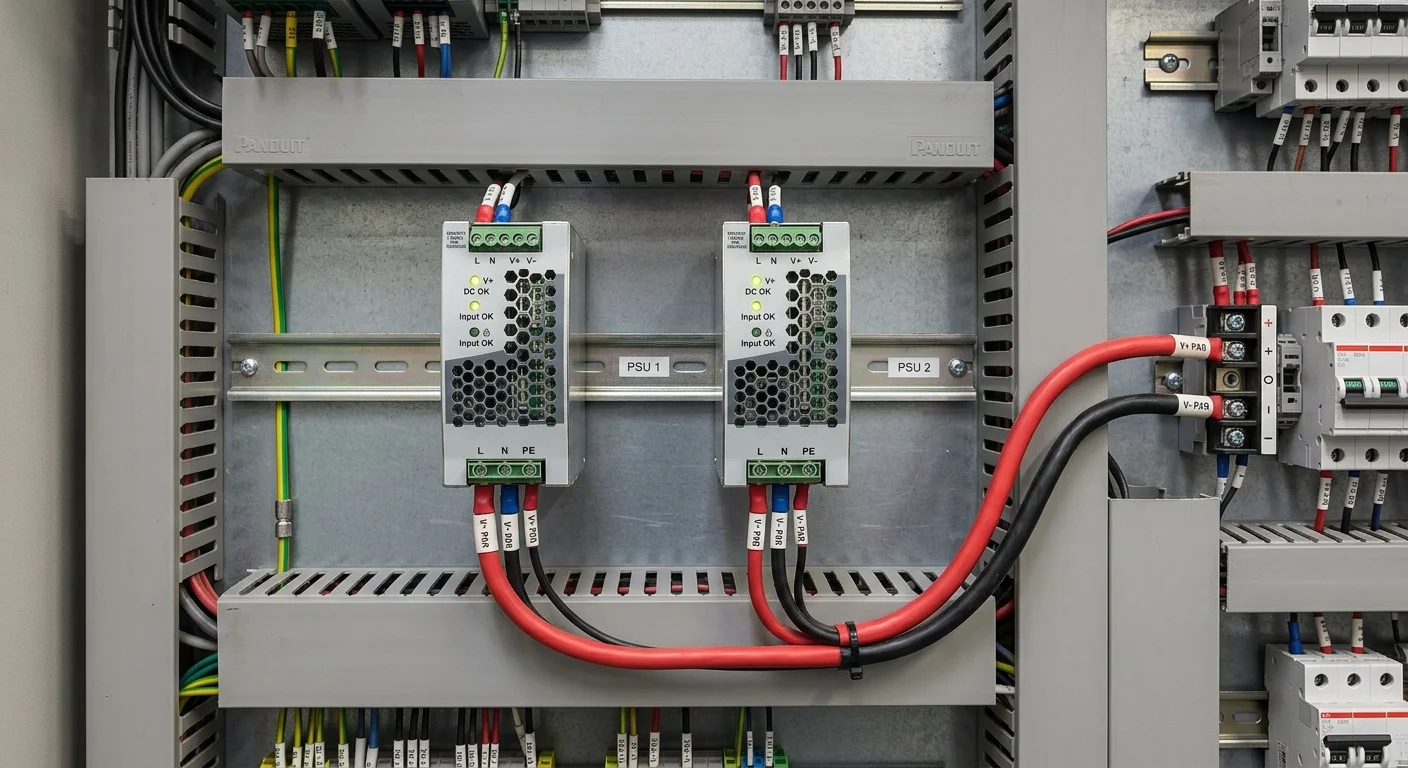
Parallel power supply connection is used when the total load current exceeds a single unit's capacity. For example, a PLC-based control system with distributed I/O modules may draw 30–40 A at 24 V — no standard DIN-rail PSU can supply that alone. Two or three units in parallel is the solution.
It's important to distinguish between two tasks that look similar but serve different purposes:
- Parallel for more current — two units share the load, delivering higher combined current. If one fails, the system goes down.
- Redundancy for reliability — one active, one hot standby. No current increase, but a single unit failure doesn't stop the system. See our article on power supply redundancy.
Not All PSUs Support Parallel Operation
Most power supplies are not designed for parallel use. Connecting two standard units in parallel means the one with the slightly higher output voltage will supply all the current and overheat. Even a 0.1 V difference is enough to cause this problem.
Parallel operation requires units with current sharing functionality or single-wire parallel synchronization. Manufacturers clearly state this in product documentation — if the spec sheet doesn't say "parallel operation" or "current sharing," the unit cannot be paralleled.
How Current Sharing Works
PSUs with parallel support have a built-in load equalization mechanism. Each unit monitors the total load via a sync bus and adjusts its output current to maintain equal shares.
A 10–20% imbalance is acceptable in practice. If two 20 A units are connected (40 A combined), one may deliver 22 A and the other 18 A — this is within spec and poses no risk.
Voltage Balancing via Vadj
Before parallel connection, output voltages must be matched using the Vadj (Voltage Adjust) trimmer present on most DIN-rail PSUs:
- Connect each unit separately to a load (not in parallel).
- Measure output voltage under load.
- Use Vadj to set identical voltages — difference should not exceed 0.05 V.
- Only then connect the outputs in parallel.
Series Supporting Parallel Operation
| Series | Brand | Power | Parallel Feature | Example |
|---|---|---|---|---|
| NDR | Mean Well | 75–480 W | Current sharing, Vadj | NDR-480-24 20A — parallel up to 40A+ |
| RSP | Mean Well | ~500 W | Current sharing, Vadj | RSP-500-48 10.5A — for 48V systems |
| DRP | Delta Electronics | 240–480 W | Current sharing | DRP024V480W3BN — three-phase input with parallel support |
Mean Well DR, HDR, MDR, and LRS series do not support parallel operation.
Risks Without Isolation
Paralleling units without built-in current sharing requires external isolation via ORing diodes (Schottky) or dedicated ORing controllers. Without isolation, the higher-voltage unit supplies all the current; the lower-voltage unit effectively charges from the first — a dangerous condition that shortens both units' lives.
Practical Sizing Examples
- Need 24 V, 35 A? One NDR-480-24 delivers 20 A. Two in parallel: up to 40 A, with a 5 A (14%) headroom — appropriate for continuous operation.
- For 48 V, 20 A — two RSP-500-48 units (10.5 A each) yield 21 A total. Minimal headroom; three units are safer for systems with load spikes.
- Not sure which configuration fits your application? Send us your load list — we'll specify the right solution within 1 business day.
Parallel vs. a Single Larger Unit
Before paralleling, check whether a single unit of the required rating exists. Two NDR-480-24 units give 40 A but require twice the DIN-rail space and cost twice as much. If cabinet space allows an enclosed RSP or equivalent Delta unit, a single device is often the simpler choice.