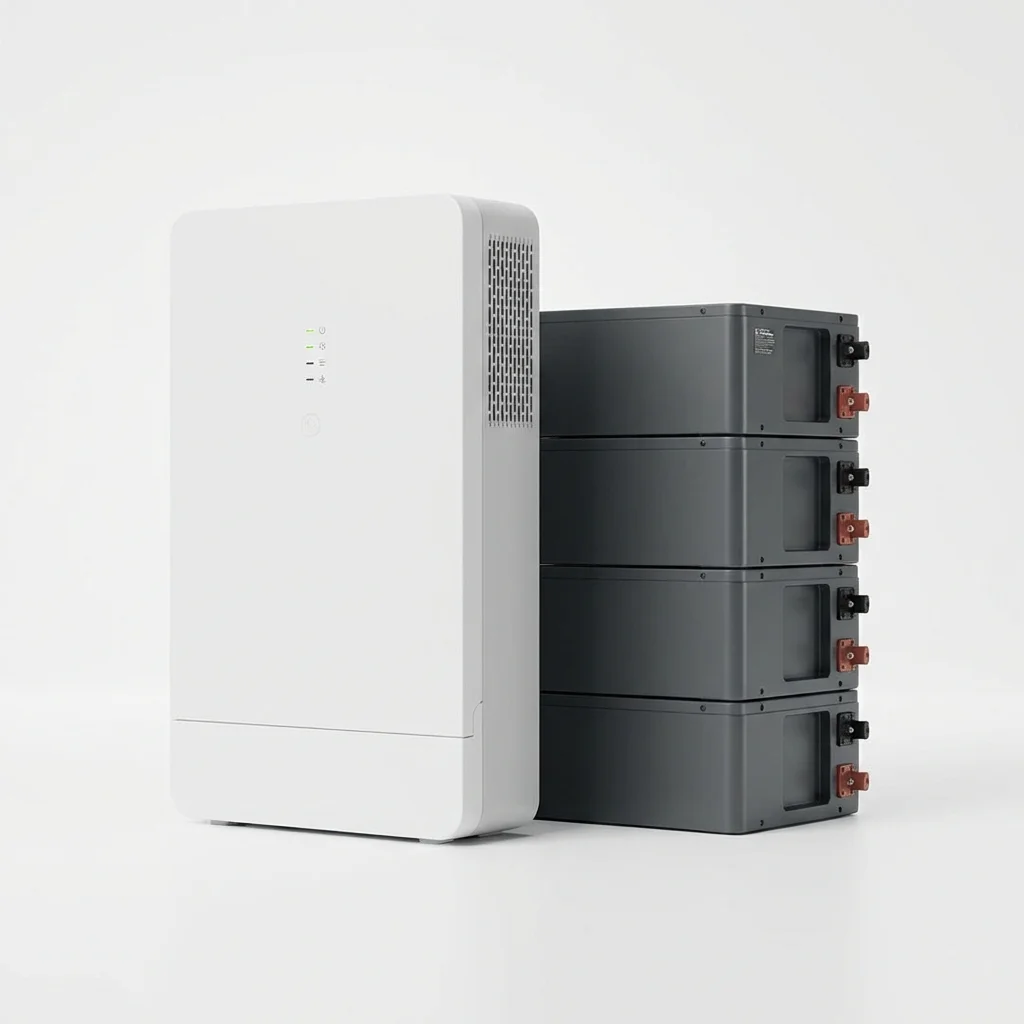
Autonomous Power System: Hybrid Inverter + LiFePO4 Battery
Blackouts, unstable grid, and rising tariffs — three reasons why Ukrainian homeowners are massively adopting autonomous power systems. The combination of a hybrid inverter + LiFePO4 battery is the most balanced solution in terms of price, quality, and lifespan. This guide walks you through building such a system from scratch: from calculating your consumption to selecting specific models from our catalog.
Why LiFePO4 Instead of Lead-Acid
LiFePO4 (lithium iron phosphate) batteries have displaced AGM and GEL from the home autonomy segment for several reasons:
- 4,000–6,000 cycle lifespan vs. 300–500 for lead-acid — 10 times longer
- Depth of Discharge (DoD) 90–95% vs. 50% — you actually use the full capacity
- 3 times lighter — a 5 kWh battery weighs 40–50 kg instead of 120+ kg
- Stable voltage throughout the discharge cycle — appliances work correctly
- Built-in BMS (Battery Management System) protects against overcharge, overheating, and deep discharge
Over 5–7 years of operation, LiFePO4 costs less than lead-acid because it does not need replacement every 2–3 years.
Step 1: Calculate Daily Consumption
Before choosing an inverter and batteries, you need to understand how much electricity your home uses per day. Here are typical loads for a Ukrainian household:
| Appliance | Power, W | Hours/Day | Consumption, kWh |
|---|---|---|---|
| Refrigerator | 100–150 | 24 (compressor ~8 hrs) | 0.8–1.2 |
| LED Lighting (10 fixtures) | 100 | 6 | 0.6 |
| Wi-Fi Router | 15 | 24 | 0.36 |
| TV / Laptop | 50–100 | 4 | 0.2–0.4 |
| Heating Circulation Pump | 50–80 | 12 | 0.6–1.0 |
| Phone Charging (3 devices) | 30 | 3 | 0.09 |
| Water Heater (80 L) | 2,000 | 1.5 | 3.0 |
| Washing Machine | 500 | 1 (every other day) | 0.25 |
Base load (without water heater and washer): 2.5–3.5 kWh/day — the minimum for comfortable living during a blackout. With water heater and washer — 5–7 kWh/day.
Step 2: Calculate Battery Capacity
The formula is simple:
Required Capacity = Daily Consumption / DoD / Inverter Efficiency
Example: consumption 5 kWh/day, DoD = 90% (LiFePO4), inverter efficiency = 95%:
5 / 0.9 / 0.95 = 5.85 kWh — minimum battery bank capacity.
In practice, we recommend a 20–30% margin, meaning 7–8 kWh for this consumption level. This allows you to:
- Avoid discharging the battery to 0% daily (extends lifespan)
- Have reserve for longer blackouts
- Compensate for capacity degradation over time (down to 80% after 4,000 cycles)
Step 3: Choose System Voltage — 48V or High-Voltage
The battery voltage must match the inverter input. There are two main options:
| Parameter | 48V (51.2V) | High-Voltage (96–450V) |
|---|---|---|
| Typical module capacity | 5–10 kWh | 5–15 kWh |
| Scaling | Parallel (up to 4–8 modules) | Series (stacking) |
| Current at 5 kW load | ~100 A (thick cable) | ~15–30 A (thinner cable) |
| Cost | Lower, more models available | Higher, fewer options |
| Best for | Homes up to 10 kW | Large homes / commercial |
Our recommendation: for most residential homes, choose a 48V (51.2V) system — it is the standard for residential hybrid inverters, and most LiFePO4 batteries in our catalog are designed for this voltage.
Step 4: Select a Hybrid Inverter
The hybrid inverter is the heart of the system. It performs 4 functions simultaneously: converts DC from batteries and solar panels to AC 220/380V, manages battery charging, switches between grid and batteries, and monitors system status.
Key selection criteria:
- Rated power — must cover the total power of simultaneously running appliances (typically 5–10 kW for homes)
- Battery voltage — must match your chosen batteries (48V or high-voltage)
- MPPT input — if you plan to add solar panels, check the MPPT range and number of trackers
- Phase type — single-phase (220V) or three-phase (380V) depending on your home's power supply
- Switchover time — under 10 ms ensures uninterrupted operation of sensitive equipment
Popular Models from Our Catalog
| Model | Power | Phases | Battery | Price, UAH |
|---|---|---|---|---|
| Veichi SISV-8.2K | 8.2 kW | 1-ph | 48V | 25,000 |
| Veichi VHS-5K (silent) | 5 kW | 1-ph | 48V | 30,000 |
| Deye SUN-5K-SG05LP1 | 5 kW | 1-ph | 48V | 53,400 |
| Deye SUN-8K-SG05LP1 | 8 kW | 1-ph | 48V | 71,200 |
| Deye SUN-10K-SG04LP3 | 10 kW | 3-ph | 48V | 90,700 |
Step 5: Select LiFePO4 Batteries
After choosing your inverter, select batteries compatible with it by voltage and communication protocol (CAN/RS485). Options from our catalog:
| Model | Capacity | Voltage | Price, UAH |
|---|---|---|---|
| Veichi VCLB-5K | 5 kWh | 51.2V | 60,000 |
| Felicity 5.12 kWh | 5.12 kWh | 51.2V | 60,014 |
| Felicity 8.7 kWh | 8.7 kWh | 51.2V | 80,989 |
| Rosen 10 kWh (rack) | 10 kWh | 51.2V | 89,000 |
| Veichi VCLB-10K | 10 kWh | 51.2V | 96,000 |
| Felicity 25 kWh | 25 kWh | 51.2V | 195,287 |
Step 6: Proven Combos — Ready-Made Kits
Not all inverters work equally well with any battery. Here are field-tested combinations:
- Deye SUN-5K + Felicity 5.12 kWh — the classic combo for apartments or small homes. Total cost ~113,400 UAH. Autonomy: 5 kWh x 0.9 (DoD) = 4.5 kWh — that's 6–8 hours of base load.
- Veichi VHS-5K + Veichi VCLB-5K — single-vendor solution, guaranteed compatibility, CAN bus, silent operation. ~90,000 UAH.
- Deye SUN-8K + 2x Felicity 5.12 kWh — for homes with water heater and washing machine. ~191,200 UAH. Autonomy: 10.24 x 0.9 = 9.2 kWh — a full day of base load.
- Veichi SISV-8.2K + Rosen 10 kWh — budget kit with large capacity. ~114,000 UAH. 9 kWh of usable energy.
Autonomy Calculator
How many hours will the system last during a blackout? Formula:
Autonomy Time = (Battery Capacity x DoD x Efficiency) / Average Load
Examples:
| Battery | Usable Energy | Load 0.5 kW | Load 1 kW | Load 2 kW |
|---|---|---|---|---|
| 5 kWh | 4.3 kWh | 8.6 hrs | 4.3 hrs | 2.1 hrs |
| 10 kWh | 8.6 kWh | 17.1 hrs | 8.6 hrs | 4.3 hrs |
| 15 kWh | 12.8 kWh | 25.7 hrs | 12.8 hrs | 6.4 hrs |
| 25 kWh | 21.4 kWh | 42.8 hrs | 21.4 hrs | 10.7 hrs |
At a load of 0.5–1 kW (refrigerator + lights + router + pump), even a single 5 kWh battery provides 4–8 hours of autonomy.
Cost Breakdown: How Much Does It Cost
Estimated component prices as of March 2026:
| Component | Price Range, UAH | Notes |
|---|---|---|
| Hybrid Inverter 5 kW | 25,000 – 53,400 | Veichi — budget, Deye — premium |
| Hybrid Inverter 8–10 kW | 29,500 – 90,700 | For homes with electric heating |
| LiFePO4 Battery 5 kWh | 60,000 – 66,000 | Starting capacity, 1 module |
| LiFePO4 Battery 10 kWh | 89,000 – 96,000 | Optimal for home use |
| Solar Panels (6 x 500 W) | 45,000 – 75,000 | Optional, 3 kW array |
| Cables, breakers, installation | 10,000 – 25,000 | Depends on complexity |
Minimum kit (5 kW inverter + 5 kWh battery + installation): from 95,000 UAH.
Optimal kit (5–8 kW inverter + 10 kWh battery + 3 kW panels): from 200,000 UAH.
Scalability: Start Small
The main advantage of a LiFePO4 system is modularity. You do not need to buy everything at once:
- Stage 1 — Backup Power: hybrid inverter + 1 battery (5 kWh). Budget: from 85,000 UAH. Covers blackouts of 4–8 hours.
- Stage 2 — Expand Capacity: add a second battery in parallel. +60,000 UAH. Autonomy doubles.
- Stage 3 — Solar Generation: connect solar panels to the inverter's MPPT input. Batteries charge during the day from sunlight — less grid consumption.
- Stage 4 — Full Autonomy: expand your panel array and battery capacity to fully cover daily consumption.
Most hybrid inverters in our catalog support parallel connection of up to 4–8 battery modules — you can scale capacity gradually.
Installation and Safety
Important installation guidelines:
- Ventilation — the inverter needs clearance for cooling (minimum 20 cm on each side)
- Moisture protection — IP65 inverters can be installed outdoors under a canopy; others — indoors only
- Cables — for a 48V system, use cable with a minimum cross-section of 16 mm2 for distances up to 3 m, 25 mm2 for 3–5 m
- Grounding — mandatory for the inverter and battery rack
- Circuit breakers — separate DC breaker between battery and inverter, AC breaker on the output
- Temperature — LiFePO4 operates at -20 to +55 C, but optimal range is 15–25 C. In unheated spaces, winter capacity drops by 10–15%
FAQ — Frequently Asked Questions
Can I connect LiFePO4 to any inverter?
No. The inverter must support lithium battery mode and have matching voltage (48V or high-voltage). All hybrid inverters in our catalog are compatible with LiFePO4.
How long will a LiFePO4 battery last?
With daily full cycles (charge-discharge) — 10–15 years. With partial use (50% DoD) — up to 20 years. Manufacturer warranty is typically 5–10 years.
Do I need solar panels, or can I use grid only?
Panels are not required. A hybrid inverter charges the battery from the grid, and during outages switches to battery power. Solar panels add independence and reduce electricity bills, but system functionality does not depend on them.
What happens during deep discharge of LiFePO4?
The built-in BMS automatically disconnects the battery when the lower voltage threshold is reached (typically 2.5 V/cell). This protects against damage. Once connected to a charging source, the battery resumes operation.
Can I expand the system later?
Yes, and this is the main advantage of modular LiFePO4 systems. You can add batteries in parallel (up to the maximum specified by the inverter manufacturer), connect solar panels, or even cascade inverters to increase power output.