

Skip to content
Selection by parameters
Main Power, kW
Supply input, V
IP protection level
Hybrid Power (AC/DC-Solar)
Remote Control

Frequency converters 160.0 kW

Found 121 product
160 ×
Скинути фільтри
B2B Сервіс

160 kW Variable Frequency Drives — Power for Heavy Industrial Loads

A 160 kW variable frequency drive (VFD) is a high-power AC drive designed to control three-phase asynchronous motors in heavy industrial environments. Supply voltage: 3x380V, output current: 290–310 A. The VFD catalogue at chastotnik.ua offers 11 models from 10 leading manufacturers at 160.0 kW, available in stock and to order.

Applications for 160 kW VFDs

160 kW corresponds to motors with a rated current of approximately 300–310 A. This power class is required in the following industrial scenarios:

  • Pump stations — flow control for water supply and wastewater systems (municipal infrastructure pumps, high-pressure industrial pumps).
  • Industrial ventilation and exhaust systems — large fans in boiler rooms, metallurgy, and chemical plants.
  • Compressor units — air and process compressors with pressure and flow regulation.
  • Hoisting and transport equipment — gantry cranes, overhead cranes, mine hoists.
  • Conveyor lines and crushers — heavy drives for quarrying and mining machinery.
  • Rolling mills and presses — precision speed control in metallurgical production.

Using a VFD instead of direct-on-line starting reduces energy consumption by up to 50–60% on pumps and fans due to the quadratic relationship between power consumption and motor speed.

160 kW VFD Models in the Catalogue

The table below compares available 160 kW models by key specifications. The Veichi AC310-T3-160G/185P-L is the most frequently ordered model in this power class.

Model Brand / Series Output Current, A Protection Key Features
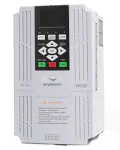
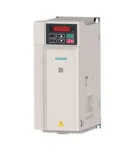
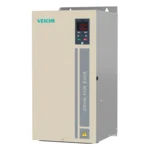
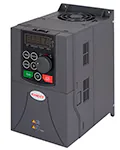
AC310-T3-160G/185P-L Veichi AC310 310 IP20 FOC vector control, built-in brake chopper, PID, Modbus/CANopen
AC70-T3-160G/185P Veichi AC70 310 IP20 Closed-loop vector, encoder feedback, 200% torque at 0 Hz
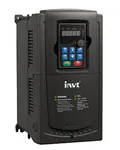
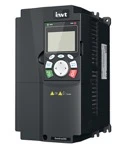
GD200A-160G/185P-4 INVT GD200A 305 IP20 Sensorless vector control, 150% torque at 0.5 Hz
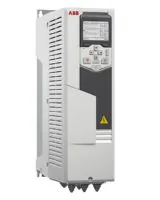
ACQ80-01-160KW-4 ABB ACQ80 310 IP21 Dedicated pump/fan drive, built-in ACH filter, pipe monitoring
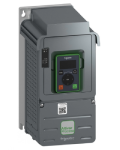
ATV610C16N4 Schneider Altivar 610 IP20 Built-in EMC filter class C2, integrated PLC, EtherNet/IP, Modbus TCP
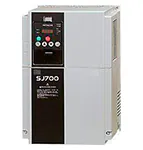
SJ700B-1600HFF Hitachi SJ700 290 IP20 Advanced sensorless vector, built-in PLC, up to 590 Hz output
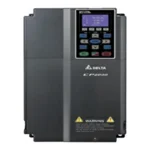
VFD1600CP43A-21 Delta VFD-CP2000 310 IP20 Optimised for pumps and fans, built-in PLC, Modbus RTU
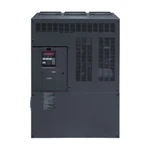
FR-F840-03610-E2-60 Mitsubishi Electric FR-F 299.6 IP20 Optimum Excitation Control (OEC), auto-tuning, EnergySaving, RS-485
DX100-4T1600Q Simphoenix DX100 310 IP20 Closed-loop FOC vector, f_max=1000 Hz, for CNC spindles and machine tools
p0800120 ENEXT e.f-drive.pro 304 IP20 Ukrainian brand, SVC vector control, f_max=300 Hz, built-in EMC filter

Other Power Ratings

If 160 kW does not match your motor specification, browse adjacent power classes in our catalogue:

Warranty and Support

All 160 kW VFDs in the chastotnik.ua catalogue carry the official manufacturer's warranty. Our engineers provide free technical selection assistance for your motor and application. Payment by bank transfer, cash, or card. Delivery across Ukraine via Nova Poshta and Ukrposhta.

Frequently Asked Questions

How do I correctly size a VFD for a motor?

The key parameter is the motor's rated current in amps (from the nameplate), not kilowatts. The VFD's rated current must equal or exceed the motor current. Power in kW is a secondary guide: at the same rating, an older 6-pole motor draws more current than a modern 4-pole. For heavy-start loads (crushers, high-inertia belt conveyors, screw compressors) go one frame size up. For pumps and fans no margin is needed — torque drops quadratically with speed, so the VFD never sees overload during ramp-up.

What is the difference between a VFD and a soft starter?

A soft starter limits inrush current and removes mechanical jerk; once the motor is up to speed it is either bypassed or simply holds the motor at full voltage — it cannot vary speed during operation. A VFD does both smooth starting and speed control from zero to 400–600 Hz, plus PID control of pressure or flow. The choice is straightforward: if motor speed is always constant, use a soft starter (cheaper, smaller cabinet); if any speed adjustment is needed during operation, use a VFD.

Scalar (V/f) or vector (SVC/FOC) control: which one for which load?

Scalar V/f control maintains a fixed voltage-to-frequency ratio and works well for pumps and fans (quadratic torque M∝n²) where speed regulation accuracy under load is not critical. Sensorless vector (SVC) is needed when the motor drives a conveyor, extruder, or hoist: full torque is required from as low as 3–5 Hz with a stiff speed characteristic. Closed-loop FOC with an encoder gives ±0.01% speed accuracy — used in cutting lines, winding, and lifting equipment. Most series in the catalogue (Veichi AC10/AC310, INVT GD20) include both modes in one unit; pure scalar-only models are INVT GD10 and GD200A.

Can I run a three-phase 380 V motor from a single-phase 220 V supply using a VFD?

Yes, with one important note. A single-phase input produces a three-phase output at roughly 220 V, not 380 V — that is a physics constraint, not a device limitation. The motor will deliver approximately 60–70% of its rated power due to the lower voltage. If the motor is wound for star-connection at 220 V it will run at full power. Models in our catalogue with single-phase 220 V input and three-phase output: Veichi AC10-S2, Veichi AC01-S2, INVT GD10-S2, INVT GD20-S. To drive a 380 V three-phase motor from a single-phase supply you need either a step-up transformer or a VFD with a built-in boost stage.

Which VFD brands are available and what warranty is offered?

Over 1,720 models from 14 manufacturers in stock. Largest selections: Danfoss (225 SKUs: VLT FC102/FC202/FC302), Schneider Electric (218: Altivar 12/310/320/610/650/950), Siemens (182: Sinamics G120/G130), Bosch Rexroth (159: EFC/VFC 3610/5610), INVT (138: GD10/GD20/GD200A/GD350), ABB (123: ACS355/ACS580/ACS880), Veichi (123: AC01/AC10/AC310/AC70). By sales volume 2025–2026 Veichi AC10 and AC310 lead — primarily because of their price-to-feature ratio and available Ukrainian service centre. Warranty is 12 months on all series, 24 months on Veichi AC10/AC310 and INVT GD20.

What determines the price of a VFD?

Four factors. Power: price scales roughly linearly with kW. Control type: scalar VFDs cost 15–30% less than vector models at the same power. Features: built-in PLC, Profinet/EtherCAT interface, braking chopper, EMC filter, STO certificate — each option adds to the price. Brand: Japanese and European series (Mitsubishi FR, Siemens G120, Danfoss FC302) cost more than Asian brands at the same rating. Reference prices: budget 1.5 kW — from UAH 3,500; mid-range 5.5 kW — from UAH 9,000; industrial 37 kW with Profinet — from UAH 65,000.

When is a braking resistor or input reactor required?

A braking resistor is needed when the motor brakes frequently or decelerates a high-inertia load: hoists, centrifuges, cutting lines. During regenerative braking the VFD feeds energy back into the DC bus; without a resistor the bus voltage climbs until the OV protection trips. An input reactor (line choke) is recommended for drives 22 kW and above, or when powering from a generator: it reduces capacitor inrush peaks and cuts harmonic THDi from 80–120% down to 30–40%. On sites with sensitive equipment, fit both a reactor and an EMC filter together.

The VFD shows an E.OC fault (overcurrent) — what should I do?

First localize the source. Disconnect the motor from outputs U/V/W and run the drive with no load. If the fault clears, the problem is in the motor or cable (shorted turns, a damaged cable, a damp terminal box). If E.OC persists even without a motor, the output power module (IGBT) is damaged: measure resistance between the DC+/DC- bus terminals and outputs U, V, W — zero resistance confirms a breakdown. A special case for drives above 40 kW: dried-out thermal paste under the heatsink lets the module overheat locally within milliseconds, faster than the temperature sensor can react — inspection and re-pasting fixes it.

Can I set 300 V in the parameters to give the motor more power?

No. A VFD is neither a stabilizer nor a step-up transformer — its output will never exceed the voltage coming in. For 220 V-class drives the motor rated voltage (parameter F02.05 on Veichi) is kept within ~253 V: that is the ceiling of a 230 V +10% supply, above which you risk the DC-bus capacitors. If the motor really lacks torque at low speed, the answer is not «more voltage» but the correct control mode (vector SVC instead of scalar V/f) and torque boost — not inflating the voltage figure.

There is voltage on the motor or panel housing — is it dangerous and how do I remove it?

Yes — stray voltage on the housing is both a safety issue and the reason nearby electronics (scales, controllers, sensors) misbehave. First rule: the motor ground wire must go directly to the VFD PE terminal, not to a shared building bus — otherwise high-frequency PWM currents return through «earth» and induce a potential on the housings. If you measure more than 5 V between neutral «0» and protective earth, the grounding loops must be separated. Ground the shield of signal cables (4-20 mA sensors) at one end only — at the VFD side — otherwise the shield itself becomes an antenna.