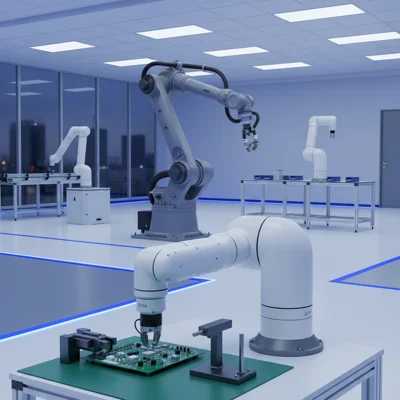
Veichi Robots — The Chinese Alternative to KUKA and FANUC with UAH Pricing
If your budget for an industrial robot is UAH 300–800k rather than one and a half million, Veichi is probably the only serious option actually available in Ukraine. Chinese manufacturer Veichi Electric was founded in 2005 in Suzhou, known mainly for AC310 VFDs and SD7 servo drives, and moved into robotics in 2018. Over the years the lineup grew to eight series covering almost every standard task: fast pick and place, collaborative work next to a human, six-axis handling, welding and bag palletizing up to 180 kg. We carry 52 active Veichi SKUs — effectively the full model range officially imported into Ukraine. Prices start from UAH 207k for the VCSH030 and reach UAH 1.44M for the heavy VCR210. We will be honest about the trade-offs — Veichi's repeatability and reducer life are a bit behind German and Japanese counterparts, and we would not recommend them for optics or semiconductors. But for 90% of assembly, palletizing and welding tasks, they get the job done with room to spare.
Veichi Robot Series — Full Breakdown Across All Eight Lines
The Veichi model range is split by kinematics and task. Short rule: if speed matters more than payload, pick a SCARA (VCSH). If the robot works next to an operator, go with a VCC cobot. If you need versatility, a 6-axis VCR. If palletizing, a VCP. Below we go through each series with numbers and typical applications.
VCSH SCARA — The Fastest Series for Pick and Place and Assembly
VCSH robots are four-axis SCARA units with horizontal reach and a vertical Z-axis. We stock 8 models — from the VCSH030-400 (3 kg, 400 mm reach) up to the VCSH500-1200 (50 kg, 1200 mm reach). The customer favorite is the VCSH100 at 10 kg with 600–1000 mm reach. Repeatability ±0.02 mm, peak tool speed up to 6 m/s, a 25-40 mm pick and place cycle of about 0.3 seconds. Typical applications:
- Loading small parts onto an assembly line
- PCB assembly, connector insertion
- Bead-dispensing of adhesive or sealant
- Blister packaging for chocolate, medicine, cosmetics
- Belt-to-belt transfer in confectionery lines
Prices: VCSH030-400 from UAH 207k, VCSH100-600 at UAH 287k, the top VCSH500-1200 at UAH 563k. For 90% of small-plant tasks, the VCSH030 or VCSH100 is enough.
VCC Cobots — Collaborative Robots for Working Beside an Operator
A cobot is a robot you can install without a fence. VCC is built to ISO 10218-1 and ISO/TS 15066, collision force capped at about 150 N, and the drive stops instantly on contact with a human. We have 5 models: VCC03-580 (3 kg), VCC05-900 (5 kg), VCC10-1310 (10 kg, 1310 mm reach — the most popular), VCC20-1650 (20 kg), and the heavier VCC30-1800. Programming is done via hand-guiding — the operator physically moves the robot arm along the path, which is then recorded. Repeatability ±0.03 mm.
Where cobots actually work on our customer sites: light machining (driving screws on a conveyor next to a human), lab testing, packaging, loading parts into a CNC machine. The VCC10-1310 costs UAH 598k, which is more than a 6-axis VCR20 of similar payload. Fence-free safety comes at a price.
VCR — 6-Axis Universal Manipulators, Our Biggest Series
VCR robots are classic industrial 6-axis units with a work envelope like the KUKA KR QUANTEC or FANUC M-20iA. VCR is what gets bought most often — 21 SKUs, 20 active, from 3 to 210 kg payload. Reach ranges from 370 mm (VCR01-370) up to 2700 mm (VCR210-2700). Repeatability is ±0.05 mm, worse than FANUC's ±0.02 mm, but good enough for welding, stacking, bonding and light milling.
The models people buy most often:
- VCR01-370 — 1 kg, 370 mm reach, for labs and dispensers, UAH 402k
- VCR06-720 — 6 kg, 720 mm reach, compact for small machines, UAH 437k
- VCR12-1410 — 12 kg, 1410 mm reach, the sweet spot, UAH 460k
- VCR20-1720 — 20 kg, 1720 mm reach, for mid-size frame welding, UAH 598k
- VCR50-2440 — 50 kg, 2440 mm reach, for heavy parts, UAH 978k
- VCR210-2700 — 210 kg, 2700 mm reach, for car bodies, UAH 1.44M
VCRC — 6-Axis Robots for Heavier Tasks
VCRC differs from VCR in link design and reducers — the series is built for longer runs under load, with a higher stated reducer life. We stock 5 models. Used where VCR cannot keep up on duty cycle — long shifts with heavy loads, continuous 24/7 production. The choice between VCR and VCRC is not always obvious — if you are unsure, drop us a line and we will run the numbers on your cycle and load.
VCRP — Specialized 6-Axis for Unusual Tasks
Two models (VCRP04-DS, VCRP04-QT) with an extended work envelope. Niche use — where a standard VCR cannot reach or a specific wrist kinematics is needed. Rare series; buy only if our engineers confirm a standard VCR will not do.
VCSG — Welding 6-Axis Robots with Integrated Source
VCSG is a turnkey package — robot plus welding source plus torch — with pre-calibrated MIG/MAG programs. Two models: VCSG030-500 (3 kg, 500 mm reach, UAH 356k) for small parts and VCSG100-700 (10 kg, 700 mm reach, UAH 517k) for frames. Typical customers make agricultural equipment, frame structures, gates. The controller supports DeviceNet, CAN and EtherCAT to talk to the source (OTC, Lincoln, Fronius).
VCSH and VCSW — Additional SCARA and Assembly Series
Beyond the main VCSH SCARA, there is the VCSW series — 5 models, 3-6 kg, 500-700 mm reach, a variant with a different drive type for cleanrooms and light dust. VCSW030-500 costs UAH 230k, VCSW060-500 UAH 253k. Compared to VCSH — lower noise, lighter maintenance, but slightly lower peak speed.
VCP — 4-Axis Palletizing Robots up to 180 kg
If the task is stacking grain bags, canned-food boxes or oil barrels, go VCP. These are dedicated 4-axis palletizers with a long reach up to 3200 mm and payload up to 180 kg. We have 4 models: VCP12-1430 (12 kg, UAH 345k), VCP30-1840 (30 kg, UAH 460k), and the heavy VCP120-3200 / VCP180-3200 (price on request — configuration follows the task). Why 4 axes and not 6 — for palletizing, extra axes only complicate the trajectory and add cost. A VCP120 runs up to 900 cycles per hour on 25 kg bags.
Full Comparison Table of Veichi Series
| Series | Axes | Payload | Reach | Repeat. | Focus | Price from, UAH |
|---|---|---|---|---|---|---|
| VCSH SCARA | 4 | 3-50 kg | 400-1200 mm | ±0.02 mm | Pick&place, assembly | 207,000 |
| VCSW | 4 | 3-6 kg | 500-700 mm | ±0.02 mm | Cleanroom assembly | 230,000 |
| VCSG welding | 6 | 3-10 kg | 500-700 mm | ±0.05 mm | MIG/MAG welding | 356,000 |
| VCP palletizers | 4 | 12-180 kg | 1430-3200 mm | ±0.1 mm | Bag and box stacking | 345,000 |
| VCR 6-axis | 6 | 1-210 kg | 370-2700 mm | ±0.05 mm | Universal handling | 402,000 |
| VCRC | 6 | up to 50 kg | up to 2000 mm | ±0.05 mm | Heavy 24/7 cycles | on request |
| VCRP | 6 | 4 kg | special | ±0.05 mm | Specialized tasks | on request |
| VCC cobots | 6 | 3-30 kg | 580-1800 mm | ±0.03 mm | Work next to humans | 517,000 |
How to Pick a Veichi Series for a Specific Task
The short rule: decide payload and reach first, then the task type, then whether people share the work zone. Here is the algorithm we run in consultations:
- Pick and place of small parts up to 10 kg, speed critical — VCSH SCARA (VCSH030 or VCSH100)
- Stacking heavy bags or boxes 25-120 kg — VCP palletizer (VCP30-1840 for medium, VCP120-3200 for heavy)
- MIG/MAG welding of frames, gates, ag equipment — VCSG (VCSG030 for small, VCSG100 for medium)
- Working next to an operator without a fence — VCC cobot (VCC10-1310 as the baseline)
- Long reach over 1700 mm with a heavy part — VCR50, VCR70 or the VCR210 for extreme cases
- Loose positional accuracy, cleanroom assembly — VCSW or a lightly loaded VCSH
If you are unsure, check the Veichi catalogue — every product card lets you run a quote against your cycle.
Veichi vs KUKA vs FANUC — An Honest Comparison Without the Marketing
"Why not KUKA?" — we hear it on every other call. The truth: KUKA and FANUC have been building robots for longer, their Nabtesco and Harmonic Drive reducers last longer, their repeatability is a bit better. But the price tag is different too. We will benchmark a 6-axis robot rated at 20 kg with around 1700 mm reach — the most common configuration in Ukrainian plants.
| Parameter | Veichi VCR20-1720 | KUKA KR 16 | FANUC M-20iA |
|---|---|---|---|
| Price incl. VAT, UAH | 598,000 | ~900,000 | ~700,000 |
| Repeatability | ±0.05 mm | ±0.03 mm | ±0.02 mm |
| Reducer life | ~25,000 h | ~40,000 h | ~40,000 h |
| Programming language | Visual + Python | KRL | KAREL |
| Official UA dealer | Us, direct import | Through distributor | Local representation |
| Lead time | 2-6 weeks | 8-16 weeks | 4-10 weeks |
| Spares from UA stock | Yes, Kyiv | No, on order | Partial |
We will not claim Veichi beats FANUC — it does not. But at a 30-50% price difference, in tasks where ±0.05 mm repeatability is acceptable, Veichi gets the job done. If your business is watchmaking or optical instruments, buy FANUC. If you do palletizing, frame welding or simple pick and place — Veichi is enough.
Three Real Cases From Our Installations
Enough theory — here is how it actually plays out.
Case 1. LED Luminaire Assembly Line — VCSH100-800
Small plant near Zhytomyr, 120 luminaires per hour. The customer complained that a new operator seated terminals crookedly every 30th unit — 3.3% scrap. We installed a VCSH100-800 in the terminal-seating area: robot picks the terminal from a tray, inserts into the housing, presses home. Cycle 1.8 seconds. First-month scrap: 0.12%. ROI on the UAH 289k investment: 7 months.
Case 2. Grain Bag Palletizing — VCP120-3200
Grain company in Poltava, 25 kg bags, three 8-hour shifts. They had three loaders, two of whom could not keep pace. They went with a VCP120-3200 plus infeed conveyor, gripper a vacuum plate. Speed: 15 bags per minute against 7-8 for humans, with no fatigue or sick leave. Payback 14 months, but the real value is stable throughput and zero torn bags.
Case 3. Frame Welding for Ag Equipment — VCSG100-700
A trailer manufacturer in Cherkasy region, welding a 3×1.5 m frame from rectangular profile. Manual welding took four hours per frame, seam uneven. We installed a VCSG100-700 with a positioner and a Lincoln PW 400 source. Frame welding time dropped to 52 minutes, seam quality ISO 5817 level B. The UAH 517k investment doubled output without hiring a grade-6 welder.
Integration With the Veichi Ecosystem — A Flexible Advantage
A robot never works alone. Veichi built their ecosystem so every component speaks the same language. In practice, the robot controller drives the conveyor through a Veichi AC310 VFD, the positioner through an SD7 or SD15 servo drive, and the operator sees it all on a Veichi HMV HMI panel.
- EtherCAT bus — links the robot to servo, PLC, VFDs with a 1 ms update rate
- Modbus RTU/TCP — for legacy systems and sensors, SCADA integration
- OPC UA — for MES and ERP level, exchanges cycle, downtime and defect data
- PLC block libraries — ready-made functions for Veichi PLCs, no need to write comms from scratch
- VFD integration — conveyor and robot in sync, saving 5-10% of takt time
This is not marketing — when every component comes from one vendor, setup takes days rather than weeks. We built a filling line where robot, conveyor and dispenser all run off a single Veichi controller — the project went from order to commissioning in 6 weeks.
Life, Service and Warranty in Ukraine
Warranty on Veichi robots is 24 months from commissioning. Reducer life is roughly 25,000 hours at rated load — about 6-7 years of two-shift operation. Less than FANUC (40,000 h), but the price is different. Spare parts — servomotors, reducers, cables — are in stock at our Kyiv warehouse, average delivery 7 days across Ukraine. Our field engineer handles commissioning and operator training (2-3 days on site).
What to keep in mind about maintenance:
- Reducer grease change — every 10,000 hours
- Zero-point calibration — once a year or after a crash
- Belt inspection (VCSH and VCP) — every 6 months
- Controller program backup — before every firmware update
- Regular cleaning — dust and chips cut the life in half
Real-world note: we have a customer running a VCR12 in its fourth year, 20-hour daily duty cycle, no serious breakdowns, only scheduled maintenance. Not a guarantee you will have the same, but a sign the series holds up.
Frequently Asked Questions
Why is Veichi 30-50% cheaper than KUKA and FANUC?
Three reasons: smaller marketing budgets, China-based manufacturing (not Germany or Japan), and a younger engineering school. Veichi reducers are Nabtesco units or Chinese class-B equivalents, whereas top KUKA models use Nabtesco premium. The gap in durability is real, but not 3x as the price would suggest.
Is a Chinese robot worth it instead of a European one?
It depends on the task. For high-precision assembly in optics, medical devices or microelectronics — buy FANUC. For welding, palletizing, simple pick and place, CNC tending — Veichi pays back faster because of the price gap.
How long will a Veichi last under heavy use?
Reducers give roughly 25,000 hours — that is 6-7 years of two-shift duty or 3-4 years of continuous 24/7. After the reducer runs out, it gets replaced (UAH 50-120k per unit depending on series), while the robot body lasts considerably longer.
What are Veichi robots programmed in?
The controller supports visual block programming via the teach pendant and a Python API for complex algorithms. There is no proprietary language like KRL or KAREL — a plus for teams that already know Python.
What does the warranty and service cover?Free: repair or replacement of defective components for 24 months, phone support around the clock, access to the knowledge base and training videos. Paid: field engineer callouts for emergency repair (UAH 10-20k), out-of-warranty parts, upgrades.Wrap-Up and Where to Buy
Veichi is a sensible pick when the task is standard and the budget is tight. Not the best robot in the world, but enough for most real tasks in Ukrainian plants. Eight series span the range from a VCSH SCARA in a packaging cell to a VCP180 for heavy palletizing and a VCR210 for car bodies. Our Veichi robot catalogue carries 52 SKUs in stock. If you want to compare brands, check KUKA or the general industrial robots category. For cobots there is a dedicated collaborative robots page, and for palletizers — palletizing robots. Also read our article on the robotics industry and the Veichi AC10 VFD overview. Need a pick for a specific task — write to us and we will run the numbers together.