Configuring ABB VFD for Constant Water Pressure: Step-by-Step Guide
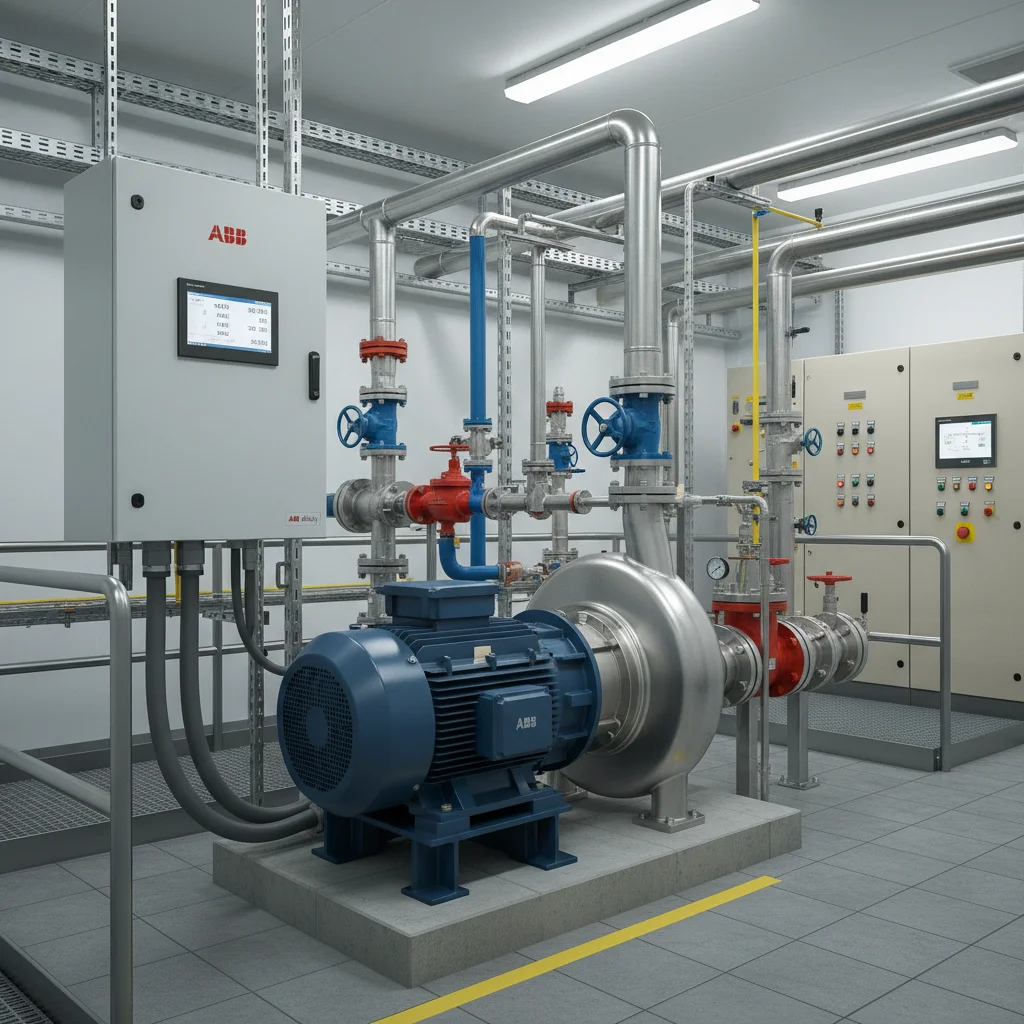
For borehole pumps with motor power ratings from 0.37 to 22 kW, ABB variable frequency drives are highly durable and reliable. These drives adjust the motor speed based on feedback from a pressure sensor. At our Kiev warehouse, we frequently prepare these ready-to-install packages for domestic water supply and irrigation systems. This setup prevents water hammer in the pipes and performs pump speed regulation, which also allows the system to save 35-45% of electricity. Automatic operation is possible because of the integrated PID controller and the sleep algorithm.
Connecting a 4-20mA Pressure Sensor to ABB VFDs
A 2-wire pressure transmitter with a 4-20mA signal is the standard choice for feedback in water supply systems. The current loop signal is immune to electromagnetic noise. This allows the sensor to be located up to 150 meters away from the control panel. We recommend using a shielded cable for this connection.
The physical wiring diagram for the sensor to the ACS150 and ACS355 VFD series is as follows:
- Sensor Power Supply: Connect the positive (+) terminal of the sensor to the +24V terminal (terminal 9) on the VFD terminal board.
- Signal Wire: Connect the negative (-) terminal of the sensor to the analog input AI1 terminal (terminal 2) or AI2 terminal (terminal 5, which is available on the ACS355 only).
- Common Ground: Connect the analog ground to the GND terminal (terminal 10 or 11).
- Cable Shield: Clamp the metal shield of the cable to the ground bar or the SCR terminal (terminal 1) to eliminate electrical noise.
There is a crucial detail for installation. Under the removable control panel of the ACS150 and ACS355, there is a small DIP switch labeled J1. This switch toggles the analog input AI1 between voltage (V) and current (I). Move this switch to the current (I) position before powering on the drive. If left in the voltage (V) position, the VFD cannot process the 4-20mA signal.
For the modern ACS580 drive, the wiring connects to the XD24 and XD2D terminal blocks:
- Connect the positive (+) sensor terminal to the +24V terminal (terminal 10 on the XD24 block).
- Connect the negative (-) sensor terminal to the analog input AI1 (terminal 2 on the XD2D block) or AI2 (terminal 5).
- Connect the analog ground to the AGND terminal (terminal 3 or 6).
- Switching the input mode is performed with the S1/S2 DIP switches on the control unit or via the parameter settings in Group 12.
PID Control Parameter Configuration (Group 40) for ABB Drives
The VFD automatically maintains the system pressure. It compares the target setpoint with the actual feedback signal. All control loop parameters are located in Group 40. Our team has prepared a parameter table for configuring the primary ABB drive series.
For convenience, we provide the parameter mapping for both the classic drives (ACS150, ACS355) and the modern generation (ACS580).
| Controller Function | ACS150 / ACS355 Parameter | ACS580 Parameter | Default Value | Practical Recommendation |
|---|---|---|---|---|
| Feedback Source | 4014 (FBK SEL) | 40.08 (Set 1 feedback 1) | AI1 (or AI2) | Defines the analog input where the pressure sensor is connected. |
| Proportional Gain (P) | 4001 (GAIN) | 40.32 (Set 1 gain) | 1.0 | Set to 1.5. If pressure oscillates in the pipes, reduce it to 1.0. |
| Integration Time (I) | 4002 (INTEGR TIME) | 40.33 (Set 1 integr time) | 60.0 s | Set to 2.5 s. This quickly smooths out pressure drops. |
| Setpoint Source | 4010 (SET POINT SEL) | 40.16 (Set 1 setpoint 1) | INTERNAL | Selects the internal digital register as the target pressure. |
| Internal Target Value | 4011 (INTERNAL SETPNT) | 40.21 (Set 1 internal setpoint) | 40.0% | Set as a percentage of the sensor scale. For example, 30% with a 10-bar sensor equals 3.0 bar. |
Based on our experience, the default integration time of 60 seconds in the factory settings is too slow for water systems. The pump responds slowly when taps are opened. The water pressure drops heavily before the drive accelerates the motor. We recommend reducing the integration time to 2.5 or 3.5 seconds. This ensures smooth and rapid regulation.
Configuring Sleep and Wake-up Modes
The sleep function turns off the pump when there is no water usage. Without this function, the motor continues to spin at minimum frequency. This heats the water in the pump casing and can damage the shaft seals. To enable sleep mode, configure four primary parameters in Group 40.
For the ACS150 and ACS355 series, the configuration is as follows:
- Sleep Activation (4022 SLEEP SELECTION): Set this to INTERNAL (or code 7) to start the automatic sleep algorithm.
- Sleep Level (4023 PID SLEEP LEVEL): Set this between 32.0 and 35.0 Hz. This is the speed where the pump runs against closed valves without producing useful flow. Our Kiev team recommends checking this value during commissioning.
- Sleep Delay (4024 PID SLEEP DELAY): Set this to 5-10 seconds. The drive waits this long after the motor speed falls below the sleep level to prevent false shutdowns.
- Wake-up Deviation (4025 WAKE-UP DEV): Set this between 10% and 15%. This defines the pressure drop that restarts the pump. For a 3.0 bar target, a 10% deviation wakes the drive up when pressure drops to 2.7 bar.
For the ACS580 series, the logic is identical but the parameter numbers are different. Parameter 40.21 (Set 1 sleep mode) must be set to Internal. Parameter 40.22 (Set 1 sleep level) defines the sleep frequency. Parameter 40.23 (Set 1 sleep delay) sets the delay time. Parameter 40.24 (Set 1 wakeup deviation) defines the restart threshold. Our practice shows that if the pump takes too long to sleep, you must increase the sleep level by 0.5 or 1.0 Hz. If the pump wakes up under low flow conditions, increase the wakeup deviation to 15% or 20%.
Dry-Run Protection Using Digital Inputs DI3 or DI4
Dry running quickly ruins pump impellers and diffusers. The most reliable method is to connect an external float switch or a dry-run pressure switch to the digital inputs on the VFD. We use digital inputs DI3 or DI4 for emergency shutdowns.
For the ACS150 and ACS355 drives, configure the settings as follows:
- Connect the wire from the float switch between terminal DI3 (or DI4) and the digital common GND terminal (terminal 10).
- Set parameter 3003 (EXTERNAL FAULT 1) to DI3 (or DI4).
- When water is gone, the contacts open, and the VFD instantly stops the pump with fault code F0009.
For the ACS580 drive, the digital protection is configured as follows:
- Connect the dry-run sensor wire to terminal DI3 (or DI4) on the XD2D block.
- Configure parameter 31.01 (External event 1 source) to DI3 (or DI4).
- Configure parameter 31.02 (External event 1 type) to Fault. The drive stops the motor and displays fault code 9001 (External event 1).
This wiring prevents motor overheating and dry friction of working parts.
Expansion Tank Sizing and Air Pre-Charge Rules
In constant-pressure systems, large 80-100 liter expansion tanks are not needed. They slow down the system response and complicate PID tuning. However, you cannot run the system without a tank. A small expansion vessel of 8 to 24 liters protects the system from rapid cycling. This rapid cycling is caused by micro-leaks like dripping taps or a leaking check valve.
Guidelines for tank preparation in a VFD-controlled system:
- Tank Volume: A small tank of 8, 12, or 24 liters is sufficient for domestic pumps.
- Pre-charge Air Pressure: This is an important step. The air pressure in the dry tank (with no water) must be 60-70% of the target system pressure. If the target system pressure is 3.0 bar, pre-charge the air bladder in the tank to 1.8-2.1 bar.
- Maintenance: Check the air pressure in the tank with a pressure gauge every six months after draining all water from the pipes.
If the air pressure drops to zero or the membrane ruptures, the VFD starts cycling every few seconds when a tap is opened. This rapid cycling quickly damages the drive power stage and the motor windings.
Summary and Recommendations
A properly configured ABB variable frequency drive turns a standard borehole pump into a constant-pressure water station. The main task is to set the sleep frequency (parameter 4023 or 40.22) and install a small expansion tank of 8-24 liters with the correct air pre-charge pressure. Check out our catalog to see the available ABB Frequency Inverters for different power ratings. For specialized pumping applications, visit our section on frequency inverters for pumps. Our engineering team will help you calculate the parameters and provide free wiring advice. We also recommend reading our guide on the Delta VFD pump PID setup to compare PID tuning features on different drives.