Why voltage is the first question, not power
When sizing a power supply, people start with watts. But the voltage should be settled first: it dictates which sensors, relays and controllers you'll work with, what cable cross-sections you'll lay, and how expensive the wiring gets. Getting the voltage wrong isn't "a slightly wrong model" — it's reworking the whole low-voltage side of the cabinet.
Industrial supplies deliver a handful of standard ratings: 5, 12, 24, 48 V (plus the buffer 13.8 and 27.6 V for battery-backed systems). Each has its own zone where it belongs. Let's go through them by real application, not by abstract "advantages".
24 V — the industrial automation standard
In short: in nine cabinets out of ten the answer is 24 V. It's the de-facto standard the industry settled on over decades. Almost every PLC, operator panel, inductive and optical sensor, interface relay and I/O module from the leading makers is built around 24 V DC.
Why 24 V won. The voltage is low enough to be safe to the installer's hands and to avoid the special measures 400 V power demands. And it's high enough that currents stay moderate and the voltage drop over long runs in a large cabinet doesn't eat the useful signal. It's a working compromise between safety and practicality.
For 24 V we have the widest choice: enclosed Mean Well LRS-100-24 (4.5 A, 108 W, ₴640) for budget panel mounting, and DIN units like the NDR-120-24 (5 A, 120 W) in a row with the PLC. If you're designing a cabinet from scratch and the choice is open — take a 24 V power supply and step away from it only when there's a direct need.
12 V — low-current automation and peripherals
12 V stays alive where the loads are historically built for it. That is:
- CCTV — most IP and analogue cameras run on 12 V DC;
- LED cabinet lighting, indication, LED strips;
- legacy sensors and platforms already wired for 12 V;
- dedicated boards and access controllers.
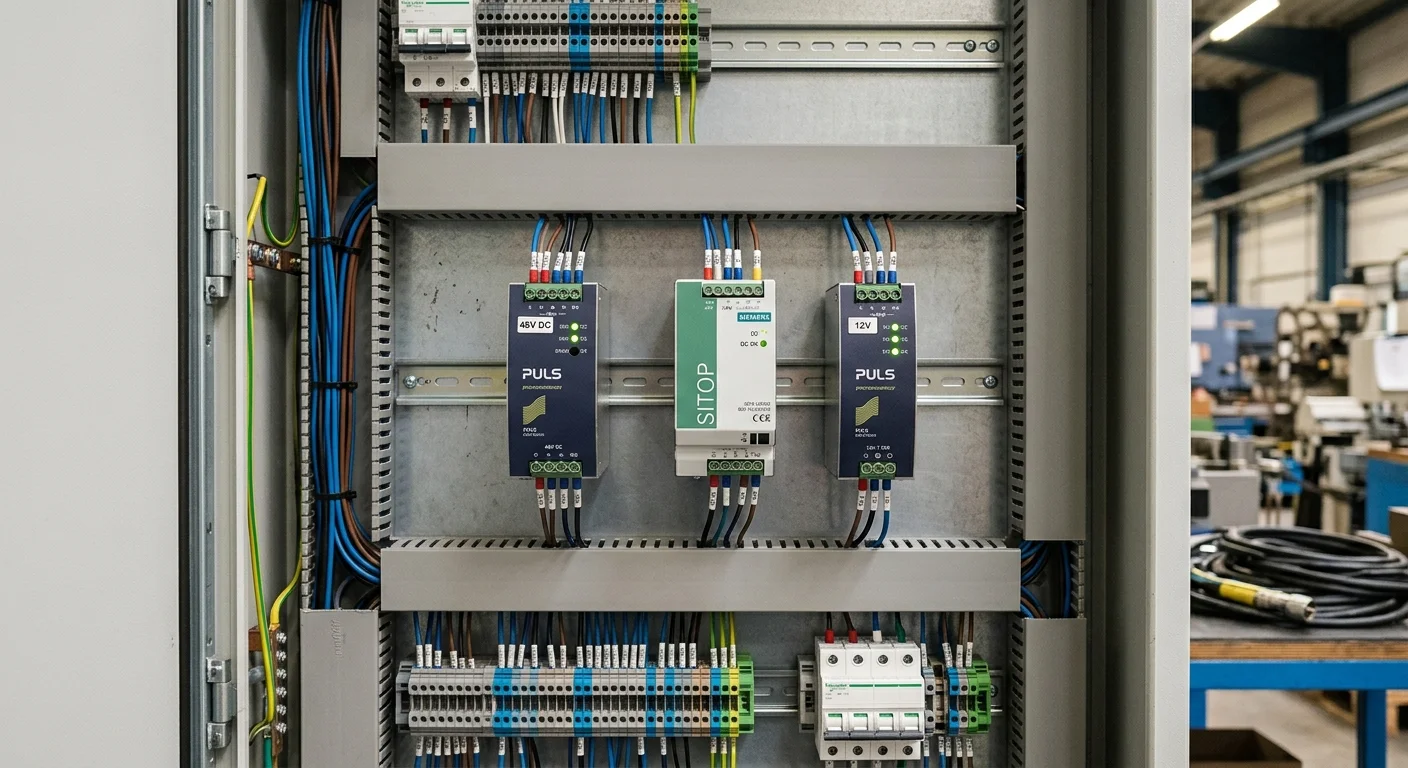
It's often simpler to add a small standalone 12 V power supply for that group than to run a DC-DC converter off the main 24 V line. For 12 V you take compact DIN units like the Mean Well HDR-15-12 for small loads, or the more powerful enclosed LRS-100-12 when there are many cameras and lights.
48 V — telecom, PoE and long runs
48 V is a voltage you take deliberately, for a specific task. Four typical cases:
- Telecom and network gear — 48 V is the historical comms standard.
- PoE infrastructure — powering network cameras and access points over the Ethernet cable.
- Servo and high-power drives of low-to-mid power that run on 48 V DC.
- Long supply runs. This is the key technical argument: at the same power, the current at 48 V is half that at 24 V. Less current means less voltage drop over a long cable and a thinner conductor cross-section. On a sprawling site this directly saves on copper.
In industrial cabinets 48 V isn't only for telecom: it powers the drive loop (servo and stepper motors) and field devices 20+ metres away from the cabinet. Less current at the same power means lower losses on a long run and a thinner cable — on a sprawling site that's real savings.
For 48 V we take enclosed Mean Well LRS-100-48 (2.3 A, ₴709) for small loads and DIN units NDR-240-48 (5 A, ₴2373) when you need to hold 48 V on a heavier load or a long trunk line.
5 V and 36 V — niche ratings
5 V is used for logic and dedicated electronics — microcontroller boards, legacy sensors, interface modules that need exactly this level. There's no point running 5 V across the whole cabinet: you put a local supply right next to the load.
36 V is rare — for some DC motors and specialised equipment. If the spec has no explicit 36 V requirement, don't even start with it.
Voltage comparison: a quick table
Let's distil the logic into one table. The "current at power" column shows why a higher voltage pays off on long runs — at the same watts the current drops.
| Voltage | Typical application | Current at 100 W | Typical series |
|---|---|---|---|
| 5 V | Logic, dedicated electronics, interface boards | ~20 A | Mean Well LRS, MDR |
| 12 V | CCTV, LED, legacy sensors | ~8.3 A | Mean Well HDR, LRS |
| 24 V | PLC, sensors, relays, HMI — automation standard | ~4.2 A | Mean Well HDR, MDR, NDR, LRS; Delta DRP, DRL |
| 48 V | Telecom, PoE, servo drives, long runs | ~2.1 A | Mean Well LRS, NDR; Delta DRP, PMT; Schneider ABLU3A48 (3-phase) |
The main point is clear: at 48 V the current for the same 100 W is half that at 24 V and a quarter of that at 12 V. So for long runs and high-power drives a higher voltage means a thinner cable and lower losses.
How to decide for your cabinet
The method is simple. Look at the bulk of your loads: if it's PLCs, sensors, relays and HMI — that's 24 V, no further thought. If the cabinet has a separate group for 12 V (cameras, LED) or 48 V (telecom, drive, long trunk) — give it its own supply at that voltage rather than a converter off 24 V. Leave 5 V to local loads next to the board.
The range with voltages, prices and filters lives in the power supplies category; by voltage — 24 V, 48 V, 12 V; by form factor — DIN-rail. Once the voltage is settled, the next step is sizing the power; that's covered in detail in the guide how to choose a power supply for an automation cabinet. Genuine products with warranty, shipped from stock. Have a list of loads? Send it over and we'll pick the voltage and model within one business day.
All three voltages — 12, 24 and 48 V — are in the industrial power supplies catalogue.