



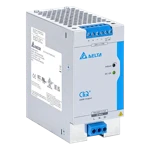


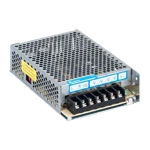
24V DC is the de facto standard of industrial automation: PLCs, discrete and analog sensors, relays, contactors, operator panels, encoders and drive logic all run on it. So a 24V supply in the cabinet is not «just another source» — it is the node the whole control logic depends on. The catalog gathers 24V switch-mode DC supplies from three makers — Mean Well, Delta Electronics and Schneider Electric — in two form factors: compact DIN-rail units (Mean Well HDR, MDR, DR, NDR; Delta DRP, DRL, DRM; Schneider ABLM, ABL2, ABLSU) for mounting in a row with breakers, and enclosed/panel types (Mean Well LRS, RSP; Delta PMT, PMC) for higher currents and dense layouts. All models share a universal 85–264 V input plus overload, short-circuit and over-temperature protection; the upper series add active PFC.
Sizing 24V by power
The logic is simple: add up the current drawn by every load on the node, add a 20–30 % margin for inrush from inductive loads (relays, valves), and pick the next larger current. One or two sensors means 15 W (Mean Well HDR-15-24, 0.63 A, from UAH 498). A small automation panel with a PLC and a few relays is 60–100 W (Mean Well LRS-100-24, 4.5 A, from UAH 640). A loaded node with an HMI, a bank of valves and reserve is 240–480 W (Mean Well NDR-240-24, 10 A; NDR-480-24, 20 A, 92.5 % efficiency).
| Model | Current | Power | Mounting | From, UAH |
|---|---|---|---|---|
| Mean Well HDR-15-24 | 0.63 A | 15.2 W | DIN | 498 |
| Mean Well MDR-20-24 | 1.0 A | 24 W | DIN | 594 |
| Mean Well LRS-50-24 | 2.2 A | 52.8 W | enclosed | 495 |
| Mean Well HDR-60-24 | 2.5 A | 60 W | DIN | 868 |
| Mean Well NDR-75-24 | 3.2 A | 76.8 W | DIN | 1075 |
| Mean Well LRS-100-24 | 4.5 A | 108 W | enclosed | 640 |
| Mean Well NDR-120-24 | 5.0 A | 120 W | DIN | 1252 |
| Mean Well LRS-150-24 | 6.5 A | 156 W | enclosed | 771 |
| Mean Well LRS-200-24 | 8.8 A | 211 W | enclosed | 1010 |
| Mean Well NDR-240-24 | 10 A | 240 W | DIN | 2265 |
| Mean Well LRS-350-24 | 14.6 A | 350 W | enclosed | 1312 |
| Mean Well NDR-480-24 | 20 A | 480 W | DIN | 4782 |
DIN vs enclosed, single- vs three-phase
Anything that mounts in a row with breakers and terminals goes on the DIN rail — that covers 90 % of automation cabinets up to ~250 W. Enclosed cases (LRS, RSP, Delta PMT) win when you need high current at the lowest cost per watt, or when the supply sits outside the main cabinet. On input: up to 480 W a single-phase 230 V input is usually enough, while heavy nodes fed from a three-phase line are best powered by a three-phase unit — Delta DRP024V060W3BN (3-phase, 60 W, DIN) or Schneider ABLU3A24050 (3-phase, 120 W) — for a balanced grid load.
What to check before you buy
Current margin — at least 20–30 % over the calculated draw, or the unit runs at its limit and overheats. Mounting type — DIN rail for a standard cabinet, enclosed for remote or high-power nodes. Input phase — single-phase up to 480 W, three-phase for three-phase feeds and large loads. PFC — Mean Well NDR from 240 W (NDR-240, NDR-480), the RSP series and Delta DRP add active power-factor correction that unloads the grid and is often required by code on larger sites. Efficiency — the upper HDR/NDR series reach 90–92.5 %, meaning less heat inside the cabinet. Unsure about the configuration — send us your load list and we will size a unit within 1 business day. Genuine products with warranty, shipped from stock. The full DC-source category lives on the power supplies page.