


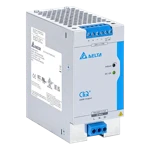


A DIN-rail power supply is a DC source that clips onto a standard 35 mm rail next to the breakers, terminals and relays, so the whole automation cabinet assembles into one clean row — no separate brackets, no wiring left to chance. That is why the DIN format is the workhorse of any control panel: compact width, a few seconds to mount, tidy routing. The catalog carries DIN supplies from three makers across every automation voltage: Mean Well (HDR, MDR, DR, NDR), Delta Electronics (DRP, DRL, DRM) and Schneider Electric (ABLM, ABL2, ABLSU), from 10 to 960 W, with a universal 85–264 V input and protection against overload, short circuit and overheating.
Voltages and series on the rail
The DIN rail carries all four automation working voltages — 5, 12, 24 and 48 V. The lion's share is 24 V (the PLC and sensor standard), followed by 12 V (sensors, relays, CCTV) and 48 V (telecom, heavy drives, PoE nodes). Series differ in width and cost per watt: Mean Well HDR is the slimmest, a slim case for a dense cabinet; MDR is the economy base line; DR is the classic; NDR is the upper series, with active PFC on models from 240 W (NDR-240, NDR-480). Delta DRP/DRL/DRM cover 30 to 960 W, including a three-phase input (DRP…3BN). Schneider ABLM/ABL2 are compact, while ABLSU goes up to 960 W.
| Series | Count | Power | Highlight |
|---|---|---|---|
| Mean Well HDR | 12 | 15–100.8 W | slim case |
| Mean Well MDR | 12 | 20–96 W | economy base |
| Mean Well DR | 12 | 15–120 W | classic line |
| Mean Well NDR | 10 | 75.6–480 W | PFC from 240 W |
| Delta DRP | 16 | 30–960 W | three-phase option |
| Delta DRL | 12 | 75–480 W | mid range |
| Delta DRM | 3 | 120–960 W | high-power modules |
| Schneider ABLM | 8 | 10–60 W | compact |
| Schneider ABL2 | 7 | 36–351 W | mid power |
| Schneider ABLSU | 18 | 50.4–960 W | wide range |
When DIN, when enclosed
Choose the DIN rail when the supply lives in the same cabinet as the rest of the automation — that is 90 % of jobs up to ~250 W: compact, mounted in a row, neatly routed. An enclosed case (Mean Well LRS, RSP; Delta PMT) makes sense when you need high current at the lowest cost per watt or the source sits separately. In practice most panels combine both: the main 24 V on the DIN rail (e.g. Mean Well NDR-120-24, 120 W) and a heavy remote node on an enclosed LRS-350-24 (350 W).
What to check before you buy
Voltage — 24 V for PLCs and sensors, 12 V for sensors/CCTV, 48 V for telecom and drives. Power with a 20–30 % margin over the calculated current. Width on the rail — in a dense cabinet the slim HDR series saves space. PFC — on larger sites pick the NDR from 240 W (NDR-240, NDR-480) or Delta DRP with active correction. Input phase — for three-phase feeds there is the Delta DRP…3BN. Mounting — every model fits the standard 35 mm TS35 rail. Unsure about the series — send us your load list and we will match one to your panel within 1 business day. Genuine products with warranty, shipped from stock. The full DC-source category lives on the power supplies page.