Why a cabinet needs its own 24 V power supply
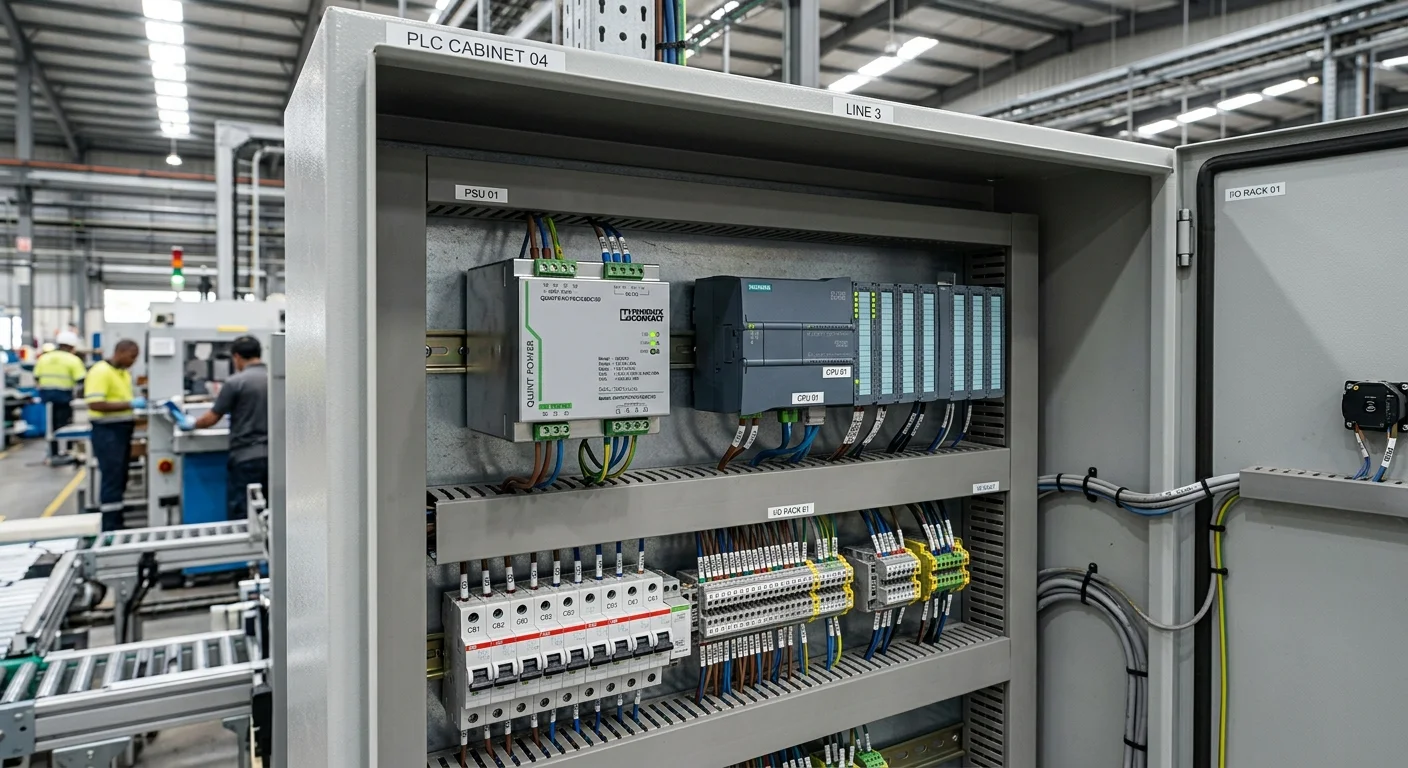
Every automation cabinet runs two separate networks. The power side — 230 or 400 V — feeds motors, contactors and heaters. The low-voltage side — a steady 24 V DC — feeds the "brain": the PLC, the operator panel, the sensors, the interface relays, the module inputs and outputs. The industrial power supply is exactly the block that takes one phase of 230 V and delivers clean 24 V DC for that logic.
Why did 24 V become the de-facto standard? It's a compromise the industry settled on over decades. The voltage is low enough to be safe to the installer's hands and to avoid the special measures 400 V demands, yet high enough that currents stay moderate and the voltage drop over long runs in a large cabinet doesn't eat into the useful signal. Almost every sensor, relay and PLC input from the leading makers is built around 24 V DC. So when people say "power supply for a cabinet", nine times out of ten they mean a 24 V power supply.
Other voltages stay niche: 5 and 12 V cover dedicated electronics or legacy sensors, 48 V serves some servo drives and telecom gear, 36 V is rare. Unless the spec says otherwise, start with 24 V and step away from it only when a specific load forces you to.
How to size the power: count current, not watts
The most common mistake at the start is adding up watts from datasheets. It works poorly, because the rated wattage of a sensor or relay is often ambiguous. The reliable path is to count the supply current on the 24 V side, then get the power by multiplying at the end.
The method is simple: list every load sitting on the 24 V line and its current in amps. Add all the currents. To that sum add 20–30 % headroom — for the inrush of relays and contactors, for future cabinet expansion, and so the supply isn't pinned at its maximum forever. Multiply the resulting current by 24 V — that's the minimum power for the supply.
A worked example on a real cabinet
Take a typical mid-size cabinet:
- PLC (CPU + base modules) — 0.5 A
- HMI operator panel — 0.7 A
- 12 inductive sensors × 0.2 A — 2.4 A
- 4 interface relays × 0.05 A — 0.2 A
Sum: 0.5 + 0.7 + 2.4 + 0.2 = 3.8 A at 24 V. Add 25 % headroom: 3.8 × 1.25 ≈ 4.75 A. In watts that's about 114 W, but it's better to size by current. We need a supply rated for at least 5 A. Good fits here are the Mean Well NDR-120-24 (5 A, 120 W, DIN-rail) or the slightly larger Mean Well LRS-150-24 (6.5 A, 156 W) — it gives looser headroom and costs less thanks to the enclosed form factor.
Don't chase a multiple-times margin "just in case": a 20 A supply under a 3.8 A load runs in a low-efficiency zone and eats extra rail space. A 20–30 % margin is healthy; a 2× margin is overpayment and worse thermal behaviour.
Which voltage to choose: 12, 24 or 48 V
If you're designing a cabinet from scratch and the choice is open — take 24 V. All the arguments above. Consider other voltages only when there's a direct need:
- 5 and 12 V — dedicated boards, legacy sensors, some access controllers. It's often simpler to add a small standalone supply for that voltage than to run a converter off 24 V.
- 48 V — some low-power servo drives, telecom equipment, certain DC motors. Currents here are half those at the same power, which is handy for long runs.
- 13.8 and 27.6 V — these are "buffer" ratings for battery-backed systems (backup power, alarms): the voltage is matched to charging a lead-acid battery.
The key rule — don't mix without reason. Every extra voltage in the cabinet is one more supply, one more line and one more point of failure.
Form factor: DIN-rail or enclosed
By construction the supplies fall into two large groups, and the cabinet itself almost always dictates the choice.
DIN-rail supplies
This is the workhorse of industrial automation. A housing that clips onto a standard 35 mm rail, terminals top and bottom, sitting in a row next to the PLC and the breakers. Mean Well series HDR, MDR, DR, NDR; in Delta — DRL, DRM, DRP. Upside — tidy wiring, clear servicing, easy replacement. These DIN-rail supplies are what we recommend by default for any automation cabinet.
Enclosed (panel) supplies
A perforated housing, screwed onto a mounting plate. Mean Well series LRS, RSP; Delta PMC, PMT. You take them when you need high power in a compact volume at an attractive price — the same LRS-150-24 is cheaper than the DIN equivalent of the same power. Downside — they take up plate space, don't sit in a row on the rail, so the build is less "modular".
Rule of thumb: a small-to-medium cabinet with tidy wiring — DIN. You need plenty of watts for minimal money and you have plate space — enclosed.
Why every industrial supply is a switching one
A modern industrial power supply is a switching one. Instead of a heavy 50 Hz transformer it converts the input voltage at high frequency, so for the same power it's far lighter, smaller and has a wider input range. The practical consequence that directly concerns you: a universal input of 85–264 V. The same supply runs off 230 V, off a sagging 180 V in an industrial zone, and rides out spikes — which matters where the mains is unstable.
The flip side of the switching principle — it generates high-frequency noise and itself reacts to the shape of the input current. Hence the next question.
PFC — and why you shouldn't skip it
PFC (Power Factor Correction) reshapes the current the supply draws from the mains. Without PFC a switching supply "yanks" current in short spikes at the peaks of the sine wave — that gives a low power factor (0.5–0.65) and pollutes the mains with harmonics.
Why it's your problem, not just the utility's:
- A supply with active PFC has a power factor of about 0.95. That means you draw more useful power from the same 230 V line and the same breaker.
- Several non-PFC supplies in one cabinet add up their harmonics, which heat the neutral conductor and the plant's supply transformer.
- On sites with their own metering and power-quality requirements, PFC is sometimes a direct spec demand.
In the range, active PFC is found on the more powerful DIN series (Mean Well NDR) and the enclosed RSP, plus the three-phase Delta DRP. The rule is simple: one small 60 W supply — fine without PFC; several supplies or one powerful one — take PFC. In the Mean Well NDR line, active PFC starts with the NDR-240-24 (240 W, 10 A); among the enclosed units, the RSP series carries PFC.
Single phase or three
The vast majority of cabinets run on a single-phase supply off 230 V — that's enough up to hundreds of watts. A three-phase input (380/400 V) makes sense in two cases: when the supply's power is high (hundreds of watts and up) and the single-phase line no longer carries it evenly, or when the cabinet has no single phase brought out at all, only a three-phase feed.
The three-phase supplies in our range are the Delta DRP series with a 3BN index in the name (for example, DRP024V240W3BN, 10 A / 240 W) and Schneider ABL with a U3A index. They load all three phases evenly and carry a higher power margin. A typical PLC-and-sensors cabinet doesn't need three phases — this is a solution for heavy loads.
Protections: what should be "on board"
A proper industrial supply protects both itself and the load. Four acronyms worth knowing:
- OVP (Over-Voltage Protection) — cuts the output if the voltage spikes above the limit. Saves an expensive PLC from breakdown.
- OCP (Over-Current Protection) — limits current on overload; the supply doesn't burn out, it goes into protection.
- OTP (Over-Temperature Protection) — shuts the supply down on overheat until it cools.
- Short-circuit protection — survives a short on the output without failing.
In the Mean Well, Delta and Schneider series this set is there by default — not a paid option but a hygienic minimum. Pay attention instead to the behaviour after a trip: some supplies recover by themselves (auto-recovery) once the cause is gone, others require a power-cycle. For unattended sites auto-recovery is more convenient. Every unit in the Industrial power supplies category carries this baseline protection set.
Efficiency and temperature derating
Efficiency is the share of input power that reaches the load. The rest turns into heat inside the cabinet. Modern supplies reach up to 92.5 % efficiency — that's what top DIN series hold at full power (for example, the powerful Mean Well NDR-480-24). A couple of percent may look trivial, but in a closed cabinet it's tens of extra watts of heat you'll have to remove.
Derating is the drop in allowable output power as temperature rises. The supply delivers its rated amps up to a limit (often +50 °C); above that the output must be reduced along a curve from the datasheet. The practical takeaway: if the cabinet stands in the sun, near a furnace or is just densely packed and hot, don't plan the supply "to the brim". The same 20–30 % current margin partly covers derating too, but in hot conditions take a larger margin or provide ventilation.
Redundancy: when you fit two supplies
For critical sites — where losing logic power means stopping the line or causing a fault — redundancy is used. The most common scheme: two identical supplies run in parallel through a diode redundancy module. If one supply fails, the other instantly takes the whole load, and the line doesn't stop.
For this to work, each supply must carry the full load alone, not half of it. That is, the two supplies are sized with headroom rather than "splitting" the current in half. Redundancy usually pairs more powerful units — enclosed models like the LRS-350-24 (350 W) or high-power DIN. For an ordinary cabinet this is overkill, but for continuous production, pumping stations or safety systems it's a justified investment.
Common mistakes when choosing
- Counting watts instead of amps. The load current on 24 V is the base; you get watts by multiplying at the end.
- Sizing a supply "to the brim". Without 20–30 % headroom the first inrush or an extra sensor sends the supply into protection.
- A 2× margin "to be sure". Excess power means low efficiency, wasted space and wasted money.
- Ignoring PFC with several supplies. Combined harmonics heat the mains and drag down the whole site's power factor.
- Not accounting for cabinet temperature. In a hot cabinet the rated amps are out of reach — derating is needed.
- Skimping on protections. A no-name supply without OVP will kill a PLC worth ten supplies when it fails.
How to match it to a specific cabinet: a quick table
Let's distil the logic into a working table. It's a guide for typical scenarios — pick the exact model for your current and conditions.
| Scenario | Approx. 24 V current | What to take | Example model |
|---|---|---|---|
| Small cabinet: PLC + a few sensors | up to 2.5 A | DIN, PFC not mandatory | Mean Well HDR-60-24 (2.5 A) or MDR-60-24 |
| Mid cabinet: PLC + HMI + 10–15 sensors | 3.5–5 A | DIN or enclosed; for PFC — NDR-240 | Mean Well NDR-120-24 (5 A) / LRS-150-24 (6.5 A); with PFC — NDR-240-24 (10 A) |
| Large cabinet / lots of I/O | 10–20 A | DIN with PFC, high efficiency | Mean Well NDR-480-24 (20 A, 92.5 %) |
| Three-phase feed only | 10 A and up | 3-phase DIN | Delta DRP024V240W3BN (10 A) / Schneider ABLU3A24100 |
| Premium, strict quality requirements | 2.5–10 A | Schneider, high efficiency | Schneider ABL2REM24045K (4.5 A) / ABLM1A24025 (90 %) |
In short: work out the total current at 24 V, add a quarter, choose the DIN form factor, check for PFC on the powerful supplies — then look at stock by brand. The full range with prices and filters lives in the Industrial power supplies category; by maker — Mean Well, Delta Electronics, Schneider Electric. Genuine products with warranty, shipped from stock. Have a list of loads with their currents? Send it over and we'll pick the model to your diagram within one business day.