Count current, not watts
The most common mistake when sizing a supply is adding up watts from datasheets. It works poorly: the rated wattage of a sensor or relay is often ambiguous, and real draw varies. The reliable path is to count current on the 24 V side in amps, then get watts by multiplying at the end. That way you see the real load on the supply's output, not a top-down estimate.
The logic is simple: a supply is rated by its output current at its voltage. If you know how many amps the loads draw in total, you immediately see which supply you need. Watts are a derived figure.
The method in four steps
- List the loads. Everything on the 24 V line: PLC, operator panel, sensors, relays, I/O modules, indication.
- Add the currents. Take each one's draw in amps and sum them. That's the base load.
- Add 20-30 % headroom. For inrush of inductive loads, for the project maturing, and so the supply isn't pinned at maximum.
- Multiply by the voltage. The resulting current × 24 V = the minimum supply power in watts.
One-line formula: P = (sum of currents × margin factor) × U. For 24 V and a 25 % margin that's P = ΣI × 1.25 × 24.
A worked example on a real cabinet
Take a typical mid-size cabinet and work through the method:
- PLC (CPU + base modules) — 0.5 A
- HMI operator panel — 0.7 A
- 12 inductive sensors × 0.2 A — 2.4 A
- 4 interface relays × 0.05 A — 0.2 A
Sum of currents: 0.5 + 0.7 + 2.4 + 0.2 = 3.8 A at 24 V. Add 25 % headroom: 3.8 × 1.25 ≈ 4.75 A. In watts that's 4.75 × 24 ≈ 114 W, but we size by current. Conclusion: we need a supply rated for at least 5 A.
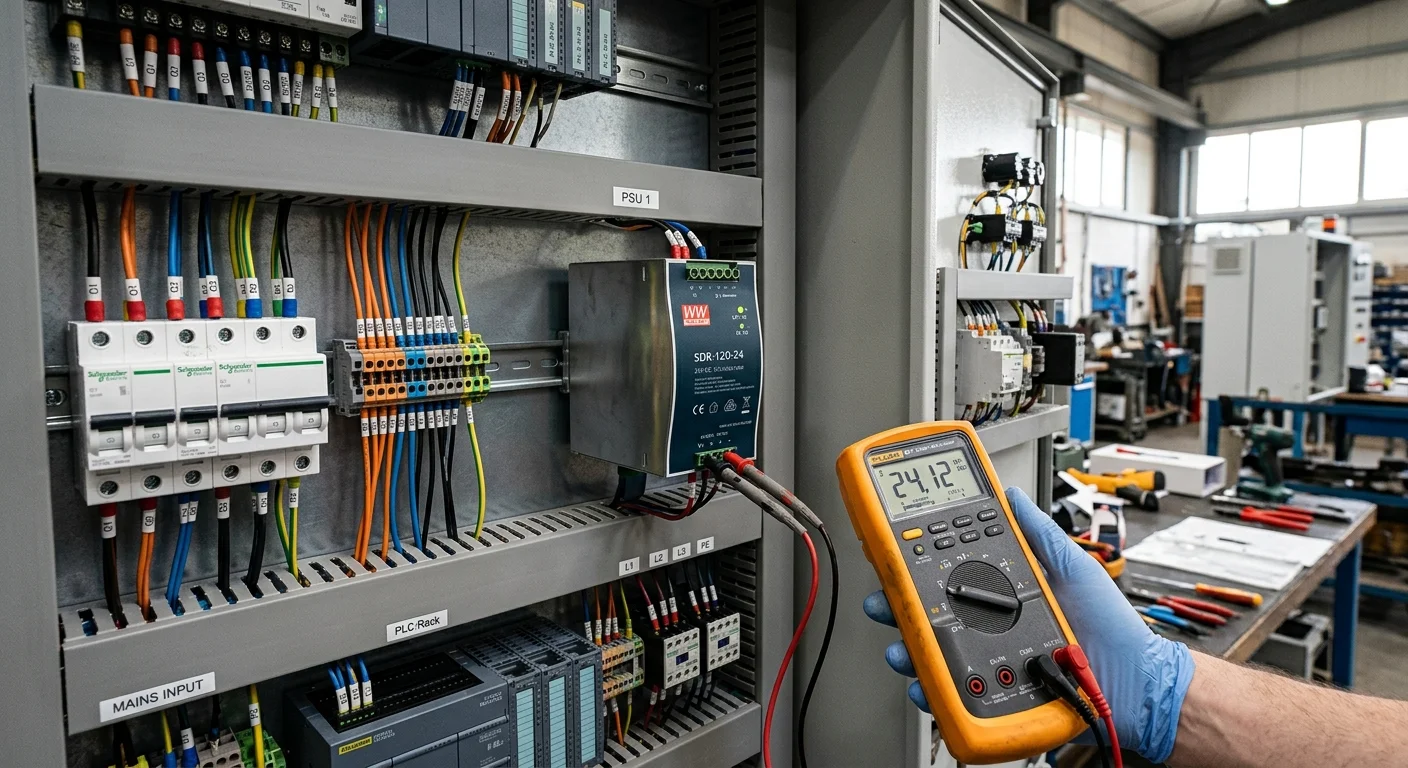
Good fits here are the Mean Well NDR-120-24 (5 A, 120 W, DIN-rail) or the slightly looser Mean Well LRS-150-24 (6.5 A, 156 W, enclosed, ₴771). The LRS-150 gives more headroom at a lower price thanks to its enclosed form factor; the NDR-120 wires more tidily in a row with the PLC.
Inrush: why the margin isn't "just in case"
A 20-30 % margin isn't insurance against uncertainty — it compensates real physics. Inductive loads — relay coils, solenoid valves, contactors, brake coils — draw an inrush current at switch-on that's noticeably above their running value. If you size the supply "to the brim" by running currents, the first simultaneous switch-on of several valves will sag the voltage and may trip the supply into protection.
So in the calculation the base current is taken with headroom. The more inductive loads in the cabinet that switch on together, the closer the margin is to 30 % rather than 20 %.
Voltage drop on long runs
Another factor easy to miss is the voltage drop on the cable itself. If sensors are spread across a large site and fed by long, thin runs, part of the 24 V "settles" on the wire's resistance and less reaches the load. A sensor sensitive to the lower voltage limit may start to misbehave.
Practically this means two things: lay an adequate conductor cross-section on long sections, and don't plan the supply at the very bottom limit. The same current margin helps here too — the supply holds its rating more confidently. If the runs are very long, it's sometimes more sensible to raise that group's supply voltage (more on that in the article on choosing 12/24/48 V).
Temperature derating: watts become heat
A supply's efficiency is the share of input power reaching the load; the rest dissipates as heat inside the cabinet. The lower the efficiency and the higher the power, the more heat. And heat triggers derating — a drop in allowable output as temperature rises. The supply delivers its rated amps up to a limit (often +50 °C); above that the output must be reduced along a curve from the datasheet.
The takeaway for sizing: in a hot cabinet (in the sun, near a furnace, densely packed) the real available current is below the rated value. A 20-30 % margin partly covers this, but if conditions are genuinely hot — take a larger margin or provide ventilation.
Headroom for expansion
A cabinet rarely stays unchanged: a sensor gets added, a relay, another I/O module. If the supply was sized to the brim, every expansion runs into replacing it. A 20-30 % margin built in from the start usually covers several future minor additions without reworking the power. It's part of the same margin factor, not a separate allowance.
Why you shouldn't take a 2× margin
It seems logical to take a supply "with a big margin, to be sure". But a 2× margin isn't safety — it's three downsides:
- Worse efficiency at light load. Switching supplies are most efficient near their rating; a 20 A supply under a 4 A load runs in an inefficient zone and heats the cabinet.
- Wasted space. A more powerful supply is bigger — on the rail and the plate that's real centimetres.
- Wasted money. You pay for watts you'll never use.
A healthy margin is 20-30 %. It covers inrush, derating and expansion without forcing the supply into an inefficient regime.
Selection table: from current to model
Let's distil the picking logic into a table. Go by the calculated-current column (already with headroom).
| Base current 24 V | With 25 % margin | Take a supply from | Example model |
|---|---|---|---|
| up to 2 A | up to 2.5 A | 2.5 A | Mean Well HDR-60-24 (2.5 A) |
| 3.8 A (our example) | 4.75 A | 5 A | NDR-120-24 (5 A) / LRS-150-24 (6.5 A) |
| 6-8 A | 7.5-10 A | 10 A | Mean Well NDR-240-24 (10 A) |
| 15-16 A | ~20 A | 20 A | Mean Well NDR-480-24 (20 A) |
In short: add up the currents of all 24 V loads, add 20-30 % for inrush and expansion, choose the next larger model — no 2× over-sizing. The full range with amperages and prices lives in the Industrial power supplies category; by voltage — 24 V; by form factor — DIN-rail. The overall logic of picking a supply across every criterion is covered in the guide how to choose a power supply for an automation cabinet. Genuine products with warranty, shipped from stock. Have a list of loads with their currents? Send it over and we'll pick the model to your diagram within one business day.