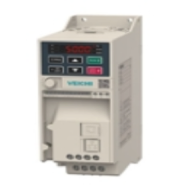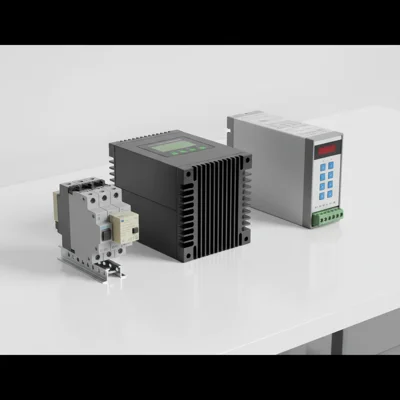
Star-Delta vs Soft Starter vs VFD: Which One Really Fits Your Job
Short version: variable load (irrigation pump, pressure-controlled ventilation, conveyor with multiple speeds) — pick a VFD, payback in 1-2 years on energy savings. Constant load with a smooth start requirement (large fan, compressor without unloader, screw feeder) — pick a soft starter. Use star-delta only when repairing an existing cabinet or working under a very tight budget.
Every month customers walk into Chastotnik.ua asking for a "standard star-delta". Ten minutes into the conversation about half realize a VFD pays back in 6-18 months and does five other jobs for free. The other half cuts a sensible compromise and goes with a soft starter. Only 10-15% actually end up with Y-Δ, usually electricians doing serious repairs with technical drawings already sized for the same scheme.
Three Solutions Across Eight Parameters
| Parameter | Star-Delta | Soft Starter | VFD |
|---|---|---|---|
| Starting current | 2-2.3 In | 2-4 In (adjustable) | 1-1.5 In |
| Starting torque | 33% (fixed) | 30-70% (adjustable) | 100-150% (adjustable) |
| Speed control | none | none | 0-200% smooth |
| Price for 15 kW, UAH | ~9,200 | ~12,500 | ~22,000 |
| Cabinet size | 400×600×200 mm | 300×400×180 mm | 250×350×180 mm |
| Install (man-hours) | 6-8 | 2-3 | 3-4 |
| Energy savings | 0% | 0-5% | 20-35% (variable load) |
| Max starts/hour | 6 | 30 | 60-120 |
These figures come from our April 2026 quotes for Veichi SJR2 (soft starter) and INVT GD200A (VFD) on a 15 kW load. The Y-Δ price covers: three ABB AF16 contactors + ABB CT-AHS timer relay + ETI 40A D breaker + IP54 enclosure + mounting plate + wiring.
Star-Delta: When It Still Makes Sense
We install Y-Δ in three scenarios:
- Legacy cabinet repair. Customer has a Y-Δ assembly from 1985, the 30 kW motor still spins, one contactor failed. Replacing the contactor for 800 UAH and the timer relay for 3,000 beats rebuilding the whole scheme around a VFD (+15,000 for the drive, +3,000 for cable, +4,000 for install).
- Very tight budget and a simple load. A farmer runs a 11 kW centrifugal pump for weekly irrigation. No speed control needed. A VFD feels expensive, a soft starter too. Y-Δ at 7,500 UAH handles the job for minimum money.
- Constrained market with no electronics access. Industrial sites with sanctions-driven import limits install contactors and timer relays made in Ukraine or Poland.
In other scenarios Y-Δ loses. The main shortcoming is the 33% starting torque, which will not accelerate any loaded machinery. And the 3-10k UAH saved on components vanishes quickly into electricity bills, motor insulation life (DOL starts eat insulation), and downtime for contactor repairs.
Soft Starter: The Middle Ground
A soft starter is a thyristor-based voltage regulator. During start it ramps motor winding voltage from 0 to 380 V over 3-15 seconds (configurable). Starting current and torque are both smoothly controlled.
When a soft starter is the right call:
- Large centrifugal pump without frequent flow changes (irrigation manifold, water supply, fire pump).
- Belt conveyor with constant load.
- Large-diameter fan without flow control.
- Crusher (needs 50-70% starting torque, which Y-Δ cannot deliver).
- Screw compressor without unloader.
Common models among our customers:
- Veichi SJR2 — 9,000-35,000 UAH depending on power. Affordable, reliable, localized menus.
- ABB PSE, PSTX — 15,000-80,000 UAH. Premium, up to 1,000 kW.
- Schneider ATS22, ATS48 — 12,000-65,000 UAH. Mid-range.
- Motortronics — 10,000-40,000 UAH. American engineering, solid on heavy loads.
Features Y-Δ lacks: soft stop (motor winds down smoothly rather than coasting), phase-loss protection, overload and underload protection (dry-run protection for pumps), energy-efficient mode (at partial load the soft starter reduces voltage, saving 2-5%). One unit replaces three contactors and a timer relay, and the install is much faster.
Why a Soft Starter Cannot Do What a VFD Does
Key point: a soft starter does NOT control speed. It only manages the start and stop events. During normal operation the motor always runs at 100% of rated speed. If the process needs variable speed, a soft starter is out — only a VFD fits.
Variable Frequency Drive: Paying and Not Regretting It
A VFD converts the 50 Hz grid frequency into anything from 0 to 400 Hz, which lets you control motor speed. Plus a few scenarios where the drive wins immediately:
Scenario 1: 15 kW irrigation pump, variable flow
The pump runs at 60% of max for 70% of the time. Old approach — Y-Δ start at 100% speed plus valve throttling. Hydraulic losses on the throttle: 30-40% of rated power. Power draw at 60% flow: 15 kW × 60% × 1.4 = 12.6 kW.
With a VFD: the drive delivers 30 Hz instead of 50, the pump runs at 60% speed, producing 60% pressure and 60% flow. By hydraulic law power consumption drops cubically: 0.6³ × 15 = 3.2 kW.
Savings: 12.6 - 3.2 = 9.4 kW. Over a 6-month season, 8 hours per day: 9.4 × 8 × 180 = 13,536 kWh. At a 4.32 UAH/kWh business tariff (2026), that is 58,475 UAH per season. The VFD costs 22,000 UAH → payback in a single season with room to spare.
Scenario 2: 11 kW ventilation with CO2 control
Old approach — the fan runs at 100% when the space is occupied, shuts off when empty. Problems: on/off cycling creates inrush, shortens motor life, and produces uneven climate control at occupancy transitions.
With VFD + CO2 sensor: the fan runs at 20-100% based on concentration. Average load — 40%. Energy savings 55-65%, motor life extended to 25 years instead of 10.
Scenario 3: 22 kW conveyor line, multi-mode operation
Morning shift — full speed (100%). Evening — half speed (50%) to prepare the next batch. Night — inspection (10-15%). Without a VFD you need three separate motors or a mechanical transmission. With a VFD one motor handles everything, with the operator selecting modes from a panel.
When the VFD Is Not the Best Choice
A VFD does not always win:
- Constant load with no need for speed control (fire pump — either off or at 100%). VFD energy economy does not apply.
- Old motor with Class B insulation from the 1970s. A VFD generates high-frequency voltage spikes that kill that insulation in 1-3 years. You need to add output chokes or replace the motor.
- Very long cable between VFD and motor (more than 50 m without shielding). Inductive loads build up and damage the drive.
Comparison by Load Type: What to Pick for Each Job
| Load | Power | Recommendation | Why |
|---|---|---|---|
| Centrifugal pump (irrigation) | 5.5-30 kW | VFD | Variable flow, 40-60% energy savings |
| Submersible pump | 2.2-11 kW | VFD 220V | Single-phase input, dry-run, soft start |
| Circulation pump (heating) | 0.75-5.5 kW | VFD | Control by return-line temperature |
| Fire pump | 11-75 kW | Soft starter | Two states only (100%/0%) but smooth start needed |
| Screw compressor | 11-45 kW | Soft starter or VFD | Soft starter for constant output, VFD for inverter-compressor |
| Piston compressor | 5.5-22 kW | Y-Δ or soft starter | Part-load start, VFD unnecessary |
| Axial fan | 5.5-75 kW | VFD | Variable output, cubic savings |
| Radial fan | 11-45 kW | VFD | Same plus pressure control |
| Belt conveyor | 5.5-22 kW | VFD | Feed speed control, soft start |
| Crusher, hammer mill | 15-75 kW | Soft starter | High starting torque needed, speed control not required |
| Lathe | 3-15 kW | VFD | Different cutting speeds |
| Screw feeder for bulk | 3-15 kW | VFD | Feed rate control |
| Overhead crane | 5.5-22 kW | VFD | Smooth lift and lower |
Practical strategy: when in doubt, go VFD. In 80% of jobs it wins long-term. Exceptions — fire pump (always 100% when running) and old motors slated for replacement.
Install: Time and Manpower
- Y-Δ: mounting plate with three contactors, six-conductor cable run to the motor terminal box, timer relay setup, interlock commissioning. 6-8 man-hours for an experienced electrician. Chastotnik.ua installs this package for 5,000-7,500 UAH depending on complexity.
- Soft starter: one unit in the cabinet, four-conductor cable to the motor (three phases + PE), ramp time and stop time programmed via the display. 2-3 hours. 2,500-3,500 UAH install.
- VFD: one unit in the cabinet, four-conductor shielded cable to the motor, 10-15 parameters programmed via the display or PC (basics: P1 ramp up, P2 ramp down, P3 min/max frequency, P4 load type, motor nameplate data). 3-4 hours for an experienced installer, 5-6 for a beginner. 3,500-5,000 UAH install.
Extra costs:
- Y-Δ needs a larger cabinet (+1,500-3,000 UAH) and more copper (6 conductors to the motor instead of 3-4).
- VFD on a long cable needs shielded cable (+30-50% cost) and possibly a braking choke (+3,000-8,000 UAH).
- Soft starter requires no extras.
Payback: A Concrete Example
Restaurant HVAC fan in Kyiv, 11 kW motor. Duty: 16 hours per day, 360 days per year. Average loading 60% of rated output.
Option 1: Y-Δ. The fan runs at 100% speed all the time, output is regulated by a duct damper. Consumed power: 11 × 0.7 (efficiency through the damper) = 7.7 kW on average. Annual consumption: 7.7 × 16 × 360 = 44,352 kWh. Cost: 44,352 × 4.32 = 191,601 UAH/year.
Option 2: Soft Starter. Same as above, just smoother starts to preserve motor life. Consumption matches Y-Δ. Economy mode saves 2-3% at partial load: 185,853 UAH/year.
Option 3: VFD. The fan runs at 60% speed for 70% of the time, at 100% for 30%. Cubic power relation: 0.6³ × 11 × 0.7 + 11 × 0.3 = 1.66 + 3.3 = 4.96 kW average. Annual consumption: 4.96 × 16 × 360 = 28,569 kWh. Cost: 123,418 UAH/year.
Delta: VFD vs Y-Δ saves 68,183 UAH/year. The VFD costs 18,000 UAH (INVT GD200A-011G option) + 5,000 install + 3,500 pressure sensor = 26,500 UAH total. Payback: 4.7 months.
This is a typical case for regulated-load ventilation. Pump numbers look similar. For conveyors with stable loads the VFD pays back slower — economy mode yields 5-8% instead of 40%.
Frequently Asked Questions
Can I combine Y-Δ with a VFD?
No, that is pointless. The VFD already limits starting current to 1-1.5 In without any star wiring. Wiring a motor through a Y-Δ scheme into the VFD input damages drive output filtering and voids the warranty. The motor connects directly to the VFD with four wires (three phases + PE), and the motor itself stays in permanent delta.
Which is cheaper over time — a soft starter or a VFD?
A VFD on variable loads (pumps, fans) beats the soft starter within 1-3 years thanks to energy savings. For constant loads (fire pump, compressor with unloader) the soft starter wins because the 9-15k UAH capex gap on the VFD never pays back.
Can I swap Y-Δ for a soft starter without changing the motor?
Yes. Remove the three contactors and the timer relay, install the factory delta bridges in the motor terminal box (U1-W2, V1-U2, W1-V2), and connect the soft starter with four conductors to the motor. Done. The motor keeps working unchanged — it just stays in delta all the time instead of switching.
What happens to the old Y-Δ hardware after the VFD swap?Working ABB/Schneider contactors resell on local marketplaces for 40-70% of new price. CT-AHS relays fetch 60-80%. Breakers — around 50%. A 15-year-old cabinet can recover 3-6k UAH, partially offsetting the VFD capex.How do I know whether I need a VFD, a soft starter, or Y-Δ?
Three questions: (1) Does the process need variable output/speed during operation? Yes — VFD, and only VFD. No — move on. (2) What is the load type? High starting torque needed (crusher, compressor without unloader) — soft starter (Y-Δ will not deliver torque). Starting torque uncritical (centrifugal pump, fan) — move on. (3) What is the budget? Up to 12,000 UAH for 15 kW — Y-Δ. 12-18,000 — soft starter. 18-25,000 — VFD.
Bottom Line: If You Only Read One Paragraph
For 80% of jobs in 2026 the right answer is a VFD. It pays back in 6-24 months on energy savings, doubles motor life, delivers speed control, and adds protection against a range of atypical faults. Soft starters win on constant loads where speed control is not needed (fire pump, crusher, compressor without unloader). Keep star-delta for repair work on existing cabinets and critically tight budgets. Further reading: Y-Δ current calculations, Y-Δ timer relay, soft starter vs VFD in depth, how a soft starter works, running a motor with a VFD. If you are not sure about a specific installation, write the Chastotnik.ua manager — we will size the right option against your equipment and duty cycle.
---