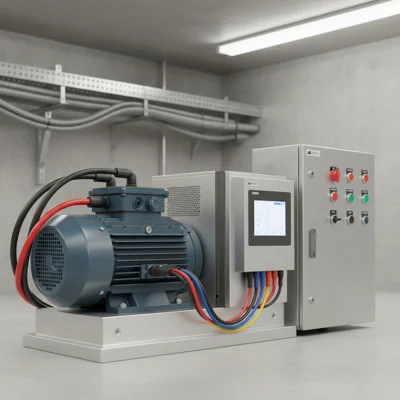
Motor plus VFD — what you need to know
Wiring a motor to a VFD takes about 30 minutes. Making that pair run for years without trouble — that is where the nuances come in. Bearing currents, overheating at low speed, dU/dt spikes on the winding — these are real problems we see at customer sites. Most of them are solved at the design stage, provided you know about them upfront.
Why use a VFD at all
In short: energy savings and smooth speed control. On fans and pumps — 20–50% savings. On conveyors — precise line-speed adjustment. On compressors — stable pressure maintenance.
- Soft start: inrush stays at rated level (instead of 5–7 times rated on DOL start)
- Speed control: from 0 to 100% and even above rated
- Motor protection: overload, phase loss, overheating, stall
- Braking: electric braking without mechanical pads
All from one device — a variable frequency drive. And for most AIR, WEG, ABB motors it fits without modifications.
Issue #1: overheating at low speed
A standard induction motor is cooled by a fan on its own shaft. When speed drops to 30–50% of rated — the fan slows down, cooling degrades. If the load stays at full rating — the motor overheats.
Solutions
- Do not load the motor at 100% below 50% speed. For fans and pumps this is not a problem — their load drops with speed. For conveyors — it can be critical.
- Forced cooling. A separate fan with independent supply. WEG W22 and ABB motors with the "IC416" option have it from the factory.
- Oversize the motor. One frame size up — it runs with thermal margin.
Issue #2: bearing currents
A VFD produces PWM voltage. Fast switching (2–16 kHz) creates parasitic currents that travel through winding-to-rotor capacitance into the bearings. The result — bearing raceway erosion (fluting). The motor starts making noise after 6–18 months, and then the bearing fails.
This mainly affects motors from 30 kW up. At lower powers bearing currents are usually negligible.
Solutions
- Insulated bearing. On the drive end (DE) or both ends.
- Shaft grounding ring. Diverts parasitic currents to ground through a brush contact.
- Shielded cable between VFD and motor. Shield grounded at both ends.
Issue #3: winding voltage (dU/dt)
The PWM signal from a VFD is not a sine wave but a train of rectangular pulses. With long cables (20–50 m+) pulses reflect and double the amplitude at the motor terminals. Peaks can reach 1,200–1,600 V instead of 560 V — winding insulation ages much faster.
Solutions
- dU/dt filter at VFD output. Softens pulse edges.
- Sine filter. Converts PWM back to a sine wave. More expensive but eliminates the problem entirely.
- Motor with reinforced insulation. WEG W22 and ABB inverter-duty motors handle 1,600 V peak.
Matching VFD to motor
| Motor parameter | What to check |
|---|---|
| Power | VFD must be equal or higher power |
| Voltage | 380 V motor → 380 V VFD. 220 V motor → 220 V VFD with three-phase output |
| Rated current | VFD output current ≥ motor rated current |
| Pole count | Does not matter — VFD controls frequency, not poles |
| Load type | Fan/pump (quadratic) — VFD can be one size smaller. Constant torque (conveyor) — full rating or higher |
VFD setup: minimum checklist
- Enter motor data: power, voltage, current, speed, cos phi — all from nameplate
- Run autotuning (motor ID). The VFD measures winding parameters and optimises control
- Set min and max frequency. Typical: min 10–15 Hz, max 50 Hz
- Accel / decel times. Fans: 15–30 s. Conveyors: 5–10 s. Pumps: 10–20 s
- Protection settings: current limit, overvoltage protection, thermal protection
Frequently Asked Questions
Can any motor work with a VFD?
Most three-phase induction motors can. Exceptions: old motors with class B insulation and very small motors (under 0.25 kW) — they may need additional filters or reinforced insulation.
Does a VFD shorten motor life?
With correct installation — no. Soft starting actually extends bearing and coupling life. Problems arise only from mistakes: long cable without a filter, full load at low speed.
Maximum cable length between VFD and motor?
Without filter: 20–50 m. With dU/dt filter: up to 100 m. With sine filter: up to 300 m. Cable should be shielded.
The VFD makes a whining noise — is that normal?
Yes, the characteristic whine is at the PWM switching frequency (2–8 kHz). If the motor hums at low speed — that is magnetostriction, also normal. Raising PWM frequency can reduce it.
Do I need a soft starter if I have a VFD?
No. A soft starter and a VFD serve different purposes, but both provide soft starting. If a VFD is installed — a soft starter is redundant.
Summary
A motor paired with a VFD handles 80% of industrial applications. The three things to watch: cooling at low speed, bearing currents at high power, dU/dt on long cables. Everything else is standard 30-minute wiring. Find the right VFD in our drive catalog.