Star-Delta Timer Relay: What It Does and Why You Cannot Skip It
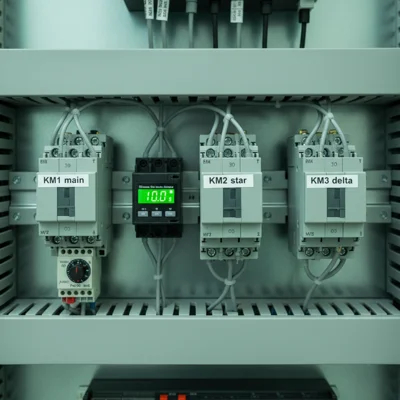
Short version: the timer relay in a Y-Δ circuit controls two contactors — KM2 (star) and KM3 (delta). It holds KM2 energized for the first 5-10 seconds while the motor accelerates on star, then drops KM2 and, after a 30-50 ms gap, closes KM3. Without that gap, KM3 contacts meet the arc from a not-yet-open KM2. Result: phase-to-phase short, tripped breaker, burnt motor winding.
A dedicated Y-Δ relay differs from a generic timer because it has three separate outputs with built-in "KM1→KM2→gap→KM3" logic, not a simple "time-up / time-down" switch. For a small project you could wire two universal relays for the same effect, but an industrial Y-Δ cabinet lives 15-20 years — saving 1,500 UAH on a specialized relay is short-sighted.
Four Working Models on the Ukrainian Market
| Model | Price, UAH | Time range | Y/Δ gap | Mounting | Best for |
|---|---|---|---|---|---|
| ABB CT-AHS.22 | 2,800-3,200 | 0.05 s - 100 h | 50 ms built-in | 22.5 mm DIN | Industrial cabinet, 5+ years |
| Schneider RE17LAMW | 3,700-4,200 | 0.1-180 s | 50 ms built-in | 22.5 mm DIN | ABB equivalent, alternative |
| Finder 80.91.0.240 | 2,000-2,300 | 0.05 s - 100 h | 50 ms built-in | 22.5 mm DIN | Budget industrial-grade |
| REV-201 (Rele-Avtomatyka) | 600-900 | 0.1-100 s | NONE (needs aux relay) | 45 mm wall-mount | Legacy cabinet repair |
Why ABB CT-AHS Most of the Time
This is our default pick. One relay, full Y-Δ logic. A physical selector sets the mode: Sy (star-delta), two time scales, and a coil voltage selector 24/110/230 VAC. The 50 ms gap between KM2 release and KM3 pull-in is handled by internal logic — no extra auxiliary relay needed. Our Chastotnik.ua team installed around 120 units on site in the last two years with zero returns.
ABB also makes the CT-AHD series (LED digital time display, 400 UAH more) — handy for on-site tuning when the datasheet is out of reach.
Finder 80.91 — Budget Alternative
Italian-made relay in the same class, 22.5 mm form factor. Y-Δ functionality matches ABB point for point: three outputs, 50 ms gap, dial regulator on the front. Saves 1,000 UAH per unit. The catch is supply — Ukrainian distributors keep thin stock, expect 2-4 weeks lead time.
REV-201 in 2026: Is It Worth Anything
An old electromechanical timer made in Ukraine. 800 UAH, available at any electrical store. But it is only a timer, not a Y-Δ controller. For the 50 ms gap you need a second identical relay with on-delay. Add coil interlock and the total build grows to four relays instead of one. The savings are fiction — the assembled solution has lower efficiency, wandering accuracy, and grows the cabinet by 60 mm in width.
We recommend REV-201 only for repair work on legacy cabinets where everything else is already sized around it and converting to CT-AHS means redesigning the whole layout.
Typical CT-AHS Wiring
Contactor coils here run on 230 V AC (the most common setup). CT-AHS terminals:
- A1, A2 — relay supply (230 V AC, energized the entire time the incoming breaker is on)
- 15, 16, 18 — KM1 (line) output contact — switches state when the start button is pressed
- 25, 28 — KM2 (star) output contact — closed for the first N seconds
- 35, 38 — KM3 (delta) output contact — closes N+0.05 seconds later
Operational flow: the operator hits "start" → CT-AHS receives the signal on terminal Y1 (START) → relay energizes output 15-18 (KM1 coil → KM1 pulls in → applies power to U1/V1/W1) → at the same time it energizes output 25-28 (KM2 coil → KM2 closes the neutral between U2/V2/W2) → motor starts in star → when the timer expires output 25-28 opens → KM2 drops → 50 ms gap → output 35-38 closes → KM3 pulls in → motor transitions to delta.
What the Control Circuit Includes
- 230 V AC supply (through a 1 A fuse) to CT-AHS terminals A1 and A2.
- Stop button — normally closed, passes supply to the start button.
- Start button — normally open, feeds the Y1 (START) terminal.
- KM1 NO auxiliary contact — wired in parallel with the start button for self-hold (once KM1 is in, releasing the button keeps Y1 powered through the aux).
- Thermal relay F2 (95-96 NC contact) — in series with the stop button, opens the circuit on overload.
- Interlock: KM2 NC aux in the KM3 coil line, KM3 NC aux in the KM2 coil line — covers the case of a CT-AHS failure.
Simpler than it looks. The relay does most of the work; you only need to wire buttons and the interlock correctly.
On-Site Time Setup
CT-AHS has two time controls on the front: a range selector (discrete steps 0.1 s / 1 s / 10 s / 1 min / 10 min / 1 h / 10 h) and a multiplier (0.05 - 1.0 continuous). For Y-Δ use the "10 s" range with a 0.5-1.0 multiplier — giving 5-10 seconds.
Finding the optimum:
- Start with 5 seconds (range 10 s, multiplier 0.5).
- Clamp a meter on one phase of the feed cable from breaker to cabinet.
- Press start. Record the peak current at 5 seconds — the Y→Δ transition moment.
- If the reading exceeds 3 In — delay is too short, the motor did not reach speed. Increase to 7 s.
- If the reading sits at 2-2.5 In — delay is fine, but try trimming. Test 4 s.
- Repeat until you find the shortest delay that keeps the post-switch current below 2.5 In.
Note: the first two or three starts show cooler windings, higher resistance, lower current. Tune on a warmed-up motor after 10-15 minutes of running.
Ballpark Delays by Load Type
- Axial fan with no VFD control — 4-6 s
- Centrifugal pump with valve open — 3-5 s
- Screw compressor without unloader — not a Y-Δ job, use a soft starter
- Empty belt conveyor — 5-7 s
- Loaded belt conveyor — not a Y-Δ job
- Machine tool with a 1,000-5,000 kg flywheel — 10-15 s
- Low-viscosity liquid mixer — 4-6 s
Field Mistakes When Wiring the Relay
- Swapped output terminals 25/28 and 35/38. The motor starts directly in delta, skipping star. 6-7 In inrush and the breaker trips. Ring the circuit with a meter BEFORE the first start.
- Forgot the self-hold loop through the KM1 aux. The start button has to stay pressed for the whole run, which you will notice the first time the operator walks away to wash hands.
- Using a generic timer without Y-Δ logic. KM2 and KM3 energize at the same time for 30-50 ms → phase-to-phase short through the windings → tripped breaker and insulation damage. If you must stick with REV-201, add a second relay for the gap.
- Coil voltage mismatch (24 V DC vs 230 V AC). The CT-AHS selector is set to 230 AC but you wired 24 V DC — the relay does nothing. Check the selector and measure voltage at A1-A2 before the first start.
- Time set too short (under 2 s). The motor never reaches 70% of rated speed, the Y→Δ switch triggers a near-DOL inrush. Start testing at 5 s and shorten carefully.
- No thermal relay in the circuit. CT-AHS does not protect against motor overheating. Install F2 (thermal) in the KM1 coil line, sized for In/√3 (delta current).
Replacing the Relay in a Working Cabinet
We often swap a worn REV-201 for a CT-AHS. Procedure:
- Open the main breaker and verify no voltage.
- Photograph the existing wiring (important — terminal numbering may differ).
- Remove the REV-201. Remember: it may be on a wall mount, not a DIN rail.
- Mount the CT-AHS on DIN. If space is tight, shift a neighboring breaker 22.5 mm to the right.
- Move the supply leads (A1, A2) and the START input (Y1).
- Connect outputs 25-28 and 35-38 to the KM2 and KM3 coils respectively (the REV-201 scheme may have used an intermediate relay — it can be removed).
- Set the time per the table above.
- Test start, clamp meter check, fine-tune the delay.
Total time — 1.5-2 hours including setup. If the existing scheme is unclear and the original drawings are lost, book our electrician: 2,500 UAH for the swap with a guarantee.
Frequently Asked Questions
Can I use a VFD timer relay?
No. A VFD timer relay handles completely different logic — output on/off events, ramp time via parameter F114, emergency stop. It does not have three outputs with a gap between them. For Y-Δ you need a dedicated relay like ABB CT-AHS or equivalent.
What if the relay time expires before the motor reaches speed?
Two possibilities: the delay is too short (extend it), or the motor is too weak for the load (check for shaft loading at start, a jammed mechanism, or cos φ drop from worn bearings). If the load is always heavy at startup, Y-Δ is not the right fit — install a soft starter.
Is the 50 ms gap really mandatory?
Yes. Without a gap: KM2 opens, an arc from inductive winding current lives in the contact gap for 5 ms. KM3 closes into that arc, the arc "jumps" to the KM3 contacts. Phase L1 shorts to phase L2 through a still-open KM2 and a just-closed KM3. Outcome — short circuit, tripped breaker, worst case a burnt contactor coil. ABB/Schneider/Finder handle the gap automatically; the old REV-201 does not.
How much coil power does the relay draw?
CT-AHS pulls 3-4 W at 230 V, meaning 15-20 mA. A 1 A fuse in the control circuit covers it with plenty of margin. If you run control through a 230/24 V safety transformer (industrial practice) pick a 25-50 VA unit — enough for the relay plus 2-3 contactors.
Can I fit two timer relays in one cabinet?
You can, but there is no point in a standard Y-Δ setup. A second timer only helps in multi-step schemes (Y → gap → reverse delta → gap → forward delta), which never show up in Ukrainian practice. When repairing older cabinets with two REV units, install one CT-AHS and remove the extras.
Wrap-Up
The timer relay is the core of a Y-Δ scheme, costing 800-4,000 UAH depending on the model. Our default pick is ABB CT-AHS (3,200 UAH) — the sweet spot for quality and price, with built-in Y-Δ logic and the 50 ms gap. Finder 80.91 saves 1,000 UAH without losing features. REV-201 belongs to repair jobs on legacy cabinets only. Tune the time with a clamp meter: find the minimum delay where the post-switch current stays below 2.5 In. Need help choosing and installing? The Chastotnik.ua engineers will recommend a full kit and do on-site installations in Kyiv and the region. Further reading: Y-Δ current calculations, Y-Δ vs soft starter vs VFD, how a soft starter works, running a motor with a VFD, soft starter vs VFD.
---