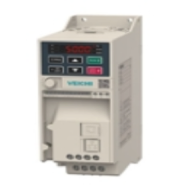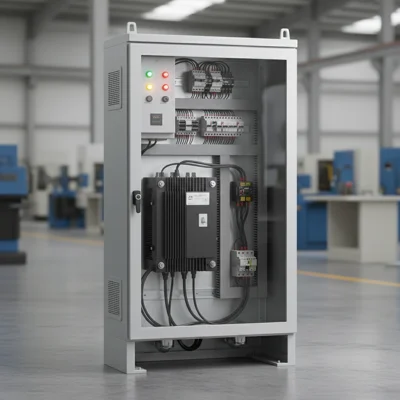
Soft start for a pump: soft starter or variable frequency drive
When a pump starts with a jerk, it is not only the motor that suffers. A hard start sends a pressure spike through the pipework (water hammer), the high inrush current sags the supply, and the impeller and bearings wear faster. The question we get most often: what should you fit to remove these jerks, a soft starter or a variable frequency drive (VFD)? The answer depends on whether you only need a gentle start, or also control of pressure and flow. Below we break it down from practice, without marketing, so you choose the right solution for your pump and do not overpay for what you do not need.
Why a pump needs a soft start
On a direct-on-line start an induction motor draws 4–6 times its rated current and develops torque in a step. For a pump this means three problems:
- Water hammer. The water column in the pipe moves instantly. On start, and especially on a hard stop, a pressure spike appears that loosens joints, fittings and valves. A gradual ramp of speed removes this shock.
- Inrush current. The current surge sags the supply voltage, disturbs other equipment, and prevents starting the pump from a weak generator. A soft start spreads the run-up over time and lowers the peak.
- Mechanical wear. The jerk loads the shaft, coupling, bearings and seals. A gentle run-up extends pump life.
Soft starter vs variable frequency drive
This is the most important choice, and exactly where people most often go wrong. In short: a soft starter controls only ramp-up and ramp-down, while a VFD controls speed the whole time the pump runs.
What a soft starter does
A soft starter gradually raises the voltage on the motor at start (typically from 30% to 100% over a set ramp) and lowers it just as gradually at stop. Once up to speed, the motor runs directly from the mains, often through a built-in bypass. The key limit: a soft starter does not regulate speed in steady state and does not save energy while running. Its job is to remove the jerk at start and stop. For a pump that runs "full on, then off", that is enough.
What a VFD adds
A VFD also provides a soft start, but beyond that it holds the motor at the required frequency the whole time. For pump applications this unlocks what a soft starter cannot:
- Pressure hold by sensor (PID control). The drive raises or lowers speed itself, holding a setpoint pressure regardless of draw. Fewer start-stops, steady head in the system.
- Energy saving. Pump power changes roughly as the cube of speed (affinity laws), so reducing speed at part load gives real savings. A soft starter gives no such effect.
- Sleep mode and dry-run protection. The drive sleeps when there is no draw and protects the pump from running dry by current.
From our practice: if the pump simply fills a storage tank by a float switch, a soft start for the pump is enough. If you need stable pressure in a water-supply system, a borehole with frequent draw, or energy saving, the right answer is a variable frequency drive for the pump, not a soft starter.
Single-phase (220 V) and three-phase (380 V) solutions
Here hides the second common confusion. A search for "soft start for a pump 220 V" often leads to inexpensive domestic soft-start relays that wire into the supply of a single-phase pump or pump station up to ~2.2–3 kW. This is an electronic module that clips the phase at start. For a small household pump that can be enough, and we say so honestly.
Industrial soft starters (Schneider Electric Altistart, ABB PSR/PSTX, Danfoss MCD, Siemens SIRIUS, Veichi SS70) work with three-phase 380 V motors and powers from a few up to hundreds of kW. This is a different class of equipment in reliability, protection and range than a domestic relay. A three-phase borehole or drainage pump on site needs exactly such a device or a VFD.
The industrial units we keep for pumps
So this stays concrete, here is what is actually on the shelf for a three-phase pump, priced as of September 2026.
| Motor | Unit | Current | Price | Typical buyer |
|---|---|---|---|---|
| 7.5 kW | ABB PSR16-600-70 | 16 A | UAH 9,489 | Borehole pump on a farm or country house |
| 15 kW | ABB PSR30-600-70 | 30 A | UAH 13,104 | Water-supply booster station |
| 22 kW | Schneider ATS130N2D45LT | 45 A | UAH 25,496 | Drainage, sewage pumping station |
| 37 kW | Schneider ATS130N2D73LT | 73 A | UAH 36,602 | Municipal pumping station |
| 55 kW | Veichi SS70-055-40 | 110 A | UAH 57,690 | Trunk-line pump, budget pick |
Compare that with a VFD of the same rating: at 22 kW our cheapest drive is UAH 31,763 against UAH 25,496 for a soft starter, at 45 kW it is UAH 63,680 against UAH 39,160. Not the multiple you often read about, but the gap is real, and what you get for it is PID pressure control, not just a gentle start. The full range with a current filter sits in soft starters for pumps; drives are in VFDs for pumps.
Sizing by power and typical mistakes
- Size by current, not only kW. Choose the soft starter or VFD by the motor rated current with headroom, especially for pumps with a heavy start.
- Do not confuse a soft starter with power-factor correction. A soft starter does not fix the power factor and does not replace a capacitor bank.
- Single-phase pump on a three-phase drive. A single-phase motor with a start capacitor is not driven directly by a three-phase soft starter or VFD; it needs its own solution.
- The stop matters too. To remove water hammer, set not only the start ramp but also the stop ramp, otherwise the shock returns at stop.
When to buy from us, and when a cheap relay is enough
Let us be frank. If you have a small 220 V household pump and the task is just to remove the jerk, an inexpensive soft-start relay from any electrical shop will do, and that is a fine solution. We specialise in the other case: three-phase industrial pumps, boreholes, water-supply stations, where you need a reliable industrial-class soft start for a pump or a VFD with PID pressure control. Look there too if the pump is part of an automation system with supervisory control. If you are not sure which class of solution fits your pump, write to us and we will advise, without pushing anything extra.