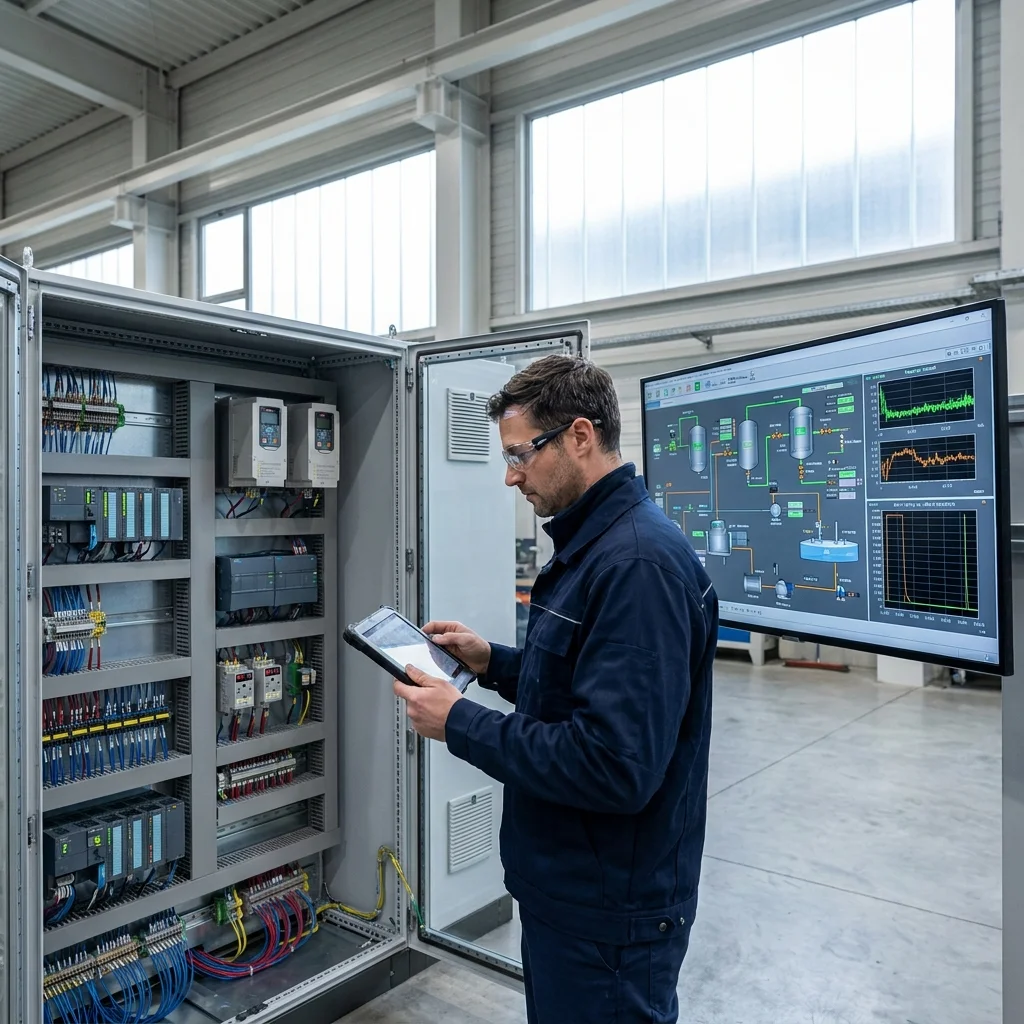
Turnkey Industrial Control System (ICS/SCADA) Implementation: from spec to commissioning
An industrial control system (АСУ ТП, ICS) is not a «box with a controller». It is a connected engineering system: field sensors and actuators, a control cabinet built around an industrial PLC, a human-machine interface, and a SCADA supervisory layer. Chastotnik.ua delivers the full implementation cycle, taking a site from the first audit and technical specification through to a working, formally commissioned system. Below we show how it actually works in practice, what an engineer should watch for when automating production, and where the costly mistakes usually hide, which is at commissioning.
A properly implemented control system delivers what shows up in reports, not just in a presentation: less scrap thanks to stabilised process regimes, lower dependence on the human factor, early detection of abnormal conditions before a line trips, integration with accounting, and remote access to process data. That is the practical point of automation, not «modernisation for its own sake».
Two implementation scenarios: new build and retrofit (reconstruction)
In our practice these two scenarios call for different approaches, and confusing them is a typical mistake at the budgeting stage.
- New build (greenfield). The system is designed from a clean sheet: network topology, cabinet composition, redundancy levels and SCADA architecture can be laid out optimally. Here the key is to get the technical specification right, because changing baked-in decisions during installation is already expensive.
- Retrofit (brownfield). A live production plant that cannot be stopped for long. We integrate into the existing infrastructure: capture the real as-is layout, agree shutdown windows, and migrate sections to the new control logic in stages. A money-saving point: existing power circuits, motors and some sensors are often reusable, so full replacement is not required, you change the brain, not the entire wiring.
Implementation stages
We break a project into eight stages. Each ends with sign-off by the customer, so we never move to the next stage with unresolved questions from the previous one.
- Control system design. Pre-design audit, functional requirements, choice of industrial network topology (Modbus RTU/TCP, Profinet, EtherCAT, Ethernet/IP) and the technical specification. This is the foundation: a mistake in the spec is cheap on paper and expensive in metal.
- Selection of sensors and actuators. Field-level specification for real conditions: IP rating, temperature range, signal type (4–20 mA, 0–10 V, discrete, digital bus). A typical trap is a sensor chosen from the catalogue that does not survive the vibration or chemically aggressive environment of the actual workshop.
- Control cabinet assembly on industrial controllers. A cabinet with a PLC, variable frequency drives, soft starters, protection and switchgear. We allow headroom for thermal load and space for future expansion, which is cheaper now than rebuilding the cabinet a year later.
- Installation and supervised installation. Mounting cabinets, routing signal and power lines separately to avoid interference, connecting field equipment. Supervised installation means the customer crew installs while our engineer provides technical oversight.
- Controller programming. PLC application software: process algorithms, modes (automatic, manual, setup), interlock and protection logic. Details are covered in a dedicated service, controller programming.
- Operator workstation (SCADA, visualisation, supervisory control). Process mnemonics, trends, event and alarm logs, access-rights segregation. The supervisory layer brings data from all sections into one window and keeps an archive, without it an incident is reconstructed from the operator memory.
- Commissioning. Verifying the sensor, PLC and actuator loops, tuning controllers (PID), testing alarm scenarios under load. A dedicated service is on-site commissioning of control systems.
- Handover. Integrated testing, as-built documentation, staff training. We hand the system over not as it happened to start, but with documented regimes and parameters, so it can be maintained without us.
What the hardware side of an ICS includes
We design on equipment we keep in stock and service ourselves, so the selection is never detached from real component availability. The basic building blocks:
- Programmable logic controllers — the brain of the system. PLC and expansion module catalogue: PLCs.
- Operator panels (HMI) — the local interface on the cabinet. See HMI operator panels.
- Variable frequency drives and soft starters for drive control of pumps, fans and conveyors. VFD catalogue; pump groups often use a soft starter for pumps.
- Servo drives where precise positioning is needed: servo drives.
- Sensors and instrumentation for pressure, temperature, level and flow: sensors.
A practical tip: design integration into the spec, not into commissioning
The most expensive rework we see comes from not agreeing the communication protocols at the start. If the PLC talks to the VFDs over Modbus RTU while the accounting or upper level expects Ethernet/IP, the gateway and register mapping have to be done on the fly. That is why our specification fixes the signal and protocol map before equipment is purchased, and it saves days on site.
Warranty and support
We do not disappear once the acceptance act is signed. After implementation you keep the as-built documentation, the description of parameters and regimes, and the option of technical support and maintenance. If you need a single stage rather than the whole system, see the related services: control system development for your task and development and maintenance of automation systems. To discuss a project, reach us via contacts, and we will advise where to start in your case.