Skip to content
Selection by parameters
Series
Mmax (1 min), %
IP protection level
Hybrid Power (AC/DC-Solar)
Remote Control

Frequency converters Danfoss Micro Drive FC51

Found 22 goods
Micro Drive FC51 ×
Скинути фільтри
B2B Сервіс

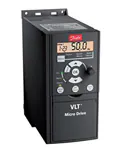
Danfoss Micro Drive FC51 Series Variable Frequency Drives

The Micro Drive FC51 series by Danfoss is a line of compact entry-to-mid-range variable frequency drives covering 0.75 to 22 kW. It is one of the best-known Danfoss VFD series: easy to commission, reliable in service, and fully compatible with IE2/IE3 induction motors.

The FC51 supports single-phase 220 V input (suffix -1P) and three-phase 380 V input (suffix -3P). The built-in AutoAdapt technology automatically tunes drive parameters to the motor without manual optimisation — a feature valued in large-scale pump and fan installations.

How to Choose a Danfoss FC51 Model — Lineup Overview

14 active SKUs with non-zero price cover 0.75 to 22 kW. Selection is based on motor power and supply voltage.

Single-phase 1×220 V supply

  • 132F0003 — 0.75 kW, output 3×220 V — from 10 134 UAH
  • 132F0005 — 1.5 kW, output 3×220 V — from 13 684 UAH
  • 132F0007 — 2.2 kW, output 3×220 V — from 17 062 UAH

Three-phase 3×380 V supply

  • 132F0018 — 0.75 kW — from 13 790 UAH
  • 132F0020 — 1.5 kW — from 17 456 UAH
  • 132F0022 — 2.2 kW — from 17 522 UAH
  • 132F0024 — 3.0 kW — from 24 787 UAH
  • 132F0026 — 4.0 kW — from 26 882 UAH
  • 132F0028 — 5.5 kW — from 31 333 UAH
  • 132F0030 — 7.5 kW — from 35 523 UAH
  • 132F0058 — 11 kW — from 51 594 UAH
  • 132F0059 — 15 kW — from 59 606 UAH
  • 132F0060 — 18.5 kW — from 73 663 UAH
  • 132F0061 — 22 kW — from 86 512 UAH

For up to 2.2 kW on a single-phase 220 V supply, models 132F0003/0005/0007 are the direct choice without a transformer. The top of the FC51 range is 22 kW (132F0061); for higher ratings Danfoss offers the FC51e or VLT HVAC Drive FC102 series.

Danfoss FC51 Technical Specifications

  • Power range: 0.75–22 kW
  • Supply voltage: 1×200–240 V or 3×380–480 V
  • Output frequency: 0–132 Hz (standard mode), up to 1 000 Hz (special mode)
  • Enclosure rating: IP20
  • Built-in braking module: up to 7.5 kW
  • AutoAdapt: automatic motor parameter adaptation
  • Communication: RS-485 ModBus RTU (optional)
  • Analogue inputs: 2×AI; digital inputs: 4×DI
  • Overload capacity: 160% for 60 s

Typical Applications for Danfoss FC51

  • Pumps and fans — EC-plus technology and AutoAdapt deliver up to 50% energy savings versus fixed-speed drives. See drives for pumps.
  • Conveyor equipment — minimal commissioning effort (fewer than 5 parameters needed to start) reduces on-site time.
  • Air conditioning and refrigeration — stable operation from -10 to +50°C without forced cooling.
  • Mixing and dosing equipment — accurate open-loop speed regulation in V/f mode.

Accessories and Related Equipment

For a complete FC51 installation: LCP 11 or LCP 12 remote keypad, braking resistors for models above 7.5 kW, Class A/B EMC filters, input line reactors, and RS-485 communication cards for larger models.

See also: all Danfoss VFDs, VFD options and accessories, full VFD catalogue.

Frequently Asked Questions

How do I correctly size a VFD for a motor?

The key parameter is the motor's rated current in amps (from the nameplate), not kilowatts. The VFD's rated current must equal or exceed the motor current. Power in kW is a secondary guide: at the same rating, an older 6-pole motor draws more current than a modern 4-pole. For heavy-start loads (crushers, high-inertia belt conveyors, screw compressors) go one frame size up. For pumps and fans no margin is needed — torque drops quadratically with speed, so the VFD never sees overload during ramp-up.

What is the difference between a VFD and a soft starter?

A soft starter limits inrush current and removes mechanical jerk; once the motor is up to speed it is either bypassed or simply holds the motor at full voltage — it cannot vary speed during operation. A VFD does both smooth starting and speed control from zero to 400–600 Hz, plus PID control of pressure or flow. The choice is straightforward: if motor speed is always constant, use a soft starter (cheaper, smaller cabinet); if any speed adjustment is needed during operation, use a VFD.

Scalar (V/f) or vector (SVC/FOC) control: which one for which load?

Scalar V/f control maintains a fixed voltage-to-frequency ratio and works well for pumps and fans (quadratic torque M∝n²) where speed regulation accuracy under load is not critical. Sensorless vector (SVC) is needed when the motor drives a conveyor, extruder, or hoist: full torque is required from as low as 3–5 Hz with a stiff speed characteristic. Closed-loop FOC with an encoder gives ±0.01% speed accuracy — used in cutting lines, winding, and lifting equipment. Most series in the catalogue (Veichi AC10/AC310, INVT GD20) include both modes in one unit; pure scalar-only models are INVT GD10 and GD200A.

Can I run a three-phase 380 V motor from a single-phase 220 V supply using a VFD?

Yes, with one important note. A single-phase input produces a three-phase output at roughly 220 V, not 380 V — that is a physics constraint, not a device limitation. The motor will deliver approximately 60–70% of its rated power due to the lower voltage. If the motor is wound for star-connection at 220 V it will run at full power. Models in our catalogue with single-phase 220 V input and three-phase output: Veichi AC10-S2, Veichi AC01-S2, INVT GD10-S2, INVT GD20-S. To drive a 380 V three-phase motor from a single-phase supply you need either a step-up transformer or a VFD with a built-in boost stage.

Which VFD brands are available and what warranty is offered?

Over 1,720 models from 14 manufacturers in stock. Largest selections: Danfoss (225 SKUs: VLT FC102/FC202/FC302), Schneider Electric (218: Altivar 12/310/320/610/650/950), Siemens (182: Sinamics G120/G130), Bosch Rexroth (159: EFC/VFC 3610/5610), INVT (138: GD10/GD20/GD200A/GD350), ABB (123: ACS355/ACS580/ACS880), Veichi (123: AC01/AC10/AC310/AC70). By sales volume 2025–2026 Veichi AC10 and AC310 lead — primarily because of their price-to-feature ratio and available Ukrainian service centre. Warranty is 12 months on all series, 24 months on Veichi AC10/AC310 and INVT GD20.

What determines the price of a VFD?

Four factors. Power: price scales roughly linearly with kW. Control type: scalar VFDs cost 15–30% less than vector models at the same power. Features: built-in PLC, Profinet/EtherCAT interface, braking chopper, EMC filter, STO certificate — each option adds to the price. Brand: Japanese and European series (Mitsubishi FR, Siemens G120, Danfoss FC302) cost more than Asian brands at the same rating. Reference prices: budget 1.5 kW — from UAH 3,500; mid-range 5.5 kW — from UAH 9,000; industrial 37 kW with Profinet — from UAH 65,000.

When is a braking resistor or input reactor required?

A braking resistor is needed when the motor brakes frequently or decelerates a high-inertia load: hoists, centrifuges, cutting lines. During regenerative braking the VFD feeds energy back into the DC bus; without a resistor the bus voltage climbs until the OV protection trips. An input reactor (line choke) is recommended for drives 22 kW and above, or when powering from a generator: it reduces capacitor inrush peaks and cuts harmonic THDi from 80–120% down to 30–40%. On sites with sensitive equipment, fit both a reactor and an EMC filter together.

The VFD shows an E.OC fault (overcurrent) — what should I do?

First localize the source. Disconnect the motor from outputs U/V/W and run the drive with no load. If the fault clears, the problem is in the motor or cable (shorted turns, a damaged cable, a damp terminal box). If E.OC persists even without a motor, the output power module (IGBT) is damaged: measure resistance between the DC+/DC- bus terminals and outputs U, V, W — zero resistance confirms a breakdown. A special case for drives above 40 kW: dried-out thermal paste under the heatsink lets the module overheat locally within milliseconds, faster than the temperature sensor can react — inspection and re-pasting fixes it.

Can I set 300 V in the parameters to give the motor more power?

No. A VFD is neither a stabilizer nor a step-up transformer — its output will never exceed the voltage coming in. For 220 V-class drives the motor rated voltage (parameter F02.05 on Veichi) is kept within ~253 V: that is the ceiling of a 230 V +10% supply, above which you risk the DC-bus capacitors. If the motor really lacks torque at low speed, the answer is not «more voltage» but the correct control mode (vector SVC instead of scalar V/f) and torque boost — not inflating the voltage figure.

There is voltage on the motor or panel housing — is it dangerous and how do I remove it?

Yes — stray voltage on the housing is both a safety issue and the reason nearby electronics (scales, controllers, sensors) misbehave. First rule: the motor ground wire must go directly to the VFD PE terminal, not to a shared building bus — otherwise high-frequency PWM currents return through «earth» and induce a potential on the housings. If you measure more than 5 V between neutral «0» and protective earth, the grounding loops must be separated. Ground the shield of signal cables (4-20 mA sensors) at one end only — at the VFD side — otherwise the shield itself becomes an antenna.