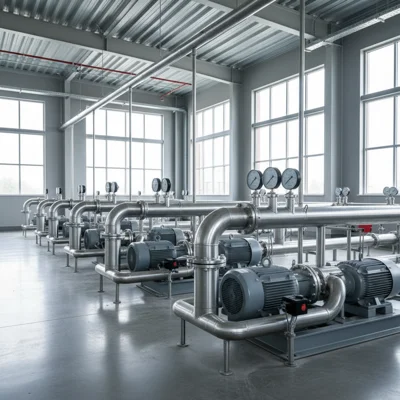
Selection and Calculation of a VFD for a Borehole Pump
For reliable operation of a borehole pump, choose a variable frequency drive with a current margin of at least 20-30% of the motor's rated current, and always use an output motor reactor (choke) if the cable length exceeds 50 meters. Submersible borehole pump motors have significant differences from standard industrial induction motors. Due to operating in a water environment and stator design features, they are characterized by an increased rated current at the same rated power in kilowatts, as well as a low power factor (cos φ). For example, if a standard 2.2 kW motor consumes about 5.0 A, a borehole pump of the same power can consume from 5.8 A to 6.5 A. Therefore, selecting a VFD solely by kilowatt power is a mistake. It is necessary to compare the rated output current of the frequency inverter with the current indicated on the pump's nameplate.
The second important factor is the length of the power cable. Boreholes often have a depth of 40 to 120 meters, which requires laying a long cable line. A long cable has significant self-capacitance. During VFD operation, high-frequency voltage pulses interact with this capacitance, creating significant capacitive leakage currents and causing a reflected wave effect. Voltage peaks at the motor terminals can reach 1000 V or more, leading to the destruction of the motor winding insulation and frequent VFD overcurrent faults. With a cable length of over 50 meters, installing an output motor reactor is a mandatory technical solution. Also, to overcome the static moment of inertia of the water column and the resistance of the long line during startup, manual torque boost must be configured. In Veichi frequency inverters, parameter F04.01 (Torque Boost) is used for this purpose. Its default value F04.01 = 0.0% means automatic torque boost; for a hard start on a long cable, set a fixed value in the range of 2% to 5% depending on the pump's submersion depth.
Configuring the PID Controller (Group F13) for Stable Pressure
To eliminate pressure fluctuations in the water supply system, set the proportional gain P=F13.11 and integral time I=F13.12 within moderate limits, completely disabling the derivative component D=F13.13=0.00. Note: F13.07 is NOT the proportional gain but "PID control selection" (feedback characteristic), so the control coefficients reside specifically in F13.11–F13.13. The operation of a frequency inverter in constant pressure maintenance mode is based on the proportional-integral-derivative (PID) control algorithm. A pressure sensor installed on the manifold transmits the current pressure value to the VFD's analog input (e.g., AI1, 4-20 mA signal). The VFD compares this value with the user-defined setpoint and adjusts the motor's output frequency.
In water supply systems, the derivative component (parameter F13.13) must be strictly equal to 0.00. Water is an incompressible fluid, so any change in the position of shut-off valves or hydrodynamic noise causes instantaneous local pressure fluctuations. If the derivative component is active, the VFD will try to react instantly to these microscopic fluctuations, leading to sharp frequency jumps, constant motor hunting, and water hammer. Configuring stable system operation is done exclusively using the proportional gain P (parameter F13.11) and integral time I (parameter F13.12). The proportional gain determines the strength of the reaction to pressure deviation: a value too high will cause system self-oscillations, while a value too low will cause a slow response. The integral time is responsible for eliminating the static control error: a shorter time forces the system to reach the target pressure faster but can trigger instability. The optimal approach is to set F13.11 within 1.50 - 2.50 and F13.12 within 2.00 - 5.00 seconds.
Sleep and Wake-up Mode: Optimizing Energy Consumption
Configure the VFD to enter sleep mode when the frequency drops to F13.30 = 30-35 Hz and wake up when the pressure drops by the delta F13.32 = 0.5-1.0 bar from the setpoint. When all taps in the house are closed, the demand for water disappears. The PID controller sees that the pressure has reached the setpoint and begins to reduce the pump motor speed. However, a submersible pump has a minimum operating frequency below which it is physically unable to lift water from the borehole and create enough pressure to overcome the check valve's resistance. For most borehole pumps, this frequency lies in the range of 30 to 35 Hz.
If the VFD is not stopped, it will continue to spin the motor at a low frequency. In this case, water is not pumped, no useful work is performed, but current still flows through the motor windings. Since a submersible motor is cooled by the flow of water bypassing its housing, operating at a low frequency without flow leads to rapid overheating and motor failure. To prevent this, sleep mode is configured. First enable the sleep function with parameter F13.29 = 1. Parameter F13.30 defines the sleep frequency (default 10.00 Hz; for a pump it is recommended to raise it to 30-35 Hz). If the operating frequency falls below this value for the time specified in parameter F13.31 (sleep delay, typically 5-10 seconds), the VFD smoothly stops the motor and enters standby mode. System wake-up occurs automatically when the system pressure drops below the target value by the wake-up deviation set in parameter F13.32 as a percentage of the sensor range (e.g., a 0.7 bar delta on a 0-10 bar sensor is 7.0%). This eliminates constant pump starts during minor water leaks and preserves equipment life.
The Large Pressure Tank Trap: Why 100 Liters is a Mistake
For VFD-controlled systems, a small pressure tank with a volume of 2 to 24 liters is ideal, whereas tanks of 100 liters or more create a critical delay in the PID controller's response and lead to pressure instability. In traditional water supply systems with on/off pressure switches, a large pressure tank of 100-200 liters is vital. It acts as an energy accumulator and limits the number of pump starts to the allowable 20 times per hour, protecting the starting windings from overheating.
In VFD-controlled systems, the motor start is always smooth (the frequency rises from 0 to operating frequency over 2-4 seconds), which completely eliminates inrush currents and mechanical shocks. A large pressure tank in such a system becomes a serious problem. Due to the large capacity of the tank, the pressure change when a tap is opened occurs very slowly. The VFD's PID controller receives the pressure drop signal with a delay. When the pressure finally drops significantly, the VFD abruptly accelerates the pump to the maximum frequency of 50 Hz. When the tap is closed, the large tank continues to accumulate water slowly, the pressure rises gradually, and the VFD continues to run at high speeds, pumping excess water. This leads to constant overshoot, pressure fluctuations in the system, and wasted electricity. A small pressure tank of 8 or 12 liters ensures instantaneous transmission of the hydraulic impulse to the pressure sensor. The VFD instantly reacts to the slightest change in water flow, smoothly adjusting the motor speed and maintaining stable pressure in the system. A small tank is only needed to compensate for microscopic leaks and to smooth out the first milliseconds of water hammer when taps are opened.
Dry Run Protection by Current Consumption
Reliably protecting a submersible pump from running without water without installing additional sensors is made possible by the underload current monitoring function (parameter group F10.32-F10.36; level threshold F10.33 = 50-60% of the rated motor current). Operating a borehole pump without water (dry run) is the most common cause of its failure. Water acts not only as the pumped medium but also as a lubricant for the pump end bearings and a cooling agent for the motor. During a dry run, the plastic diffusers and impellers of the pump melt within a few dozen seconds.
Traditional dry run sensors or float switches are difficult to install at great depths, and their cables are often damaged. The Veichi VFD solves this problem at the software and hardware level by analyzing the motor's current consumption. When the pump operates in nominal mode and pumps water, the motor is loaded, and its current is close to rated. As soon as water disappears in the well, the impellers start rotating in an air-water mixture, the rotational resistance drops sharply, and the motor's current consumption decreases to 40-50% of the nominal value. By setting parameter F10.33 (underload detection level) to 55% of the rated motor current, parameter F10.34 (detection time) to 5-10 seconds, and specifying the stop action via the digits of parameter F10.32, we get highly effective protection. If the motor current drops below 55% and remains there for 8 seconds, the VFD stops operation, locks the system, and displays a fault code. This completely prevents damage to the pump end.
Step-by-Step Guide to Programming the Veichi VFD
Before the first start, be sure to perform motor auto-tuning and sequentially enter the protection, PID control, and sleep mode parameters according to the provided parameter map. Correct sequential parameter entry guarantees stable operation of the water supply system and protects the equipment from emergency situations. To select the appropriate equipment, go to the specific category on our website, where certified frequency inverters with an official warranty are presented.
The configuration process consists of the following steps:
- Install the frequency inverter in a dry room or control cabinet. Connect the power cable to terminals R, S, T (or L, N for a single-phase grid) and the motor cable to terminals U, V, W. Connect the pressure sensor to terminals +24V (power) and AI1 (4-20 mA signal input), setting the corresponding jumper on the control board to the current signal (I) position.
- Enter the motor parameters from its nameplate: rated power in parameter F02.01, rated frequency in F02.02, rated speed in F02.03, rated voltage in F02.04, and rated current in parameter F02.05.
- Start the motor auto-tuning procedure. To do this, set parameter F02.07 = 1 (static auto-tuning) or F02.07 = 2 (dynamic auto-tuning, if the pump is not connected to the pipeline) and press the RUN button on the keypad. Upon completion, the VFD will automatically calculate the internal resistance and inductance of the motor windings.
- Switch the frequency inverter to PID control mode. To do this, set the frequency source F00.06 = 8. Set the run command source in parameter F00.11 = 1 (control via external terminals) or leave it at 0 (keypad control).
- Configure the PID controller parameters in Group F13. Set the feedback source F13.00 = 0 (AI1 input). Set the maximum range of the pressure sensor in parameter F13.05 (for example, if the sensor is 10 bar, set the value to 10.0). Set the target pressure in parameter F13.06 as a percentage of the sensor scale (for example, to maintain a pressure of 3.0 bar with a 10 bar sensor, set the value to 30.0%).
- Set the control gains: proportional gain F13.11 = 2.00, integral time F13.12 = 3.00 seconds, derivative gain F13.13 = 0.00. Note: the feedback characteristic (positive for water supply) is set by the separate parameter F13.07 — it is not the P gain.
- Configure energy saving and sleep mode parameters. Enable the sleep function F13.29 = 1, set the sleep frequency F13.30 = 32.0 Hz (default 10.00 Hz), sleep delay time F13.31 = 10.0 seconds. Set the wake-up deviation F13.32 = 7.0% (which equals a 0.7 bar delta on a 0-10 bar sensor).
- Configure dry run protection by underload current via the F10.32-F10.36 group. Set the stop action via the digits of parameter F10.32, set the detection level F10.33 = 55% of the rated motor current, and the detection time F10.34 = 8.0 seconds.
Below is a summary table of the main parameters for quick programming of the Veichi frequency inverter for operation with a borehole pump:
| Parameter Code | Parameter Name | Recommended Value | Technical Description and Purpose |
|---|---|---|---|
| F00.06 | Frequency Source | 8 | Activation of PID control mode to maintain constant pressure. |
| F04.01 | Torque Boost | 2.0% - 5.0% (default 0.0% = auto) | Compensation for voltage drop in a long power cable and easing pump startup. |
| F13.05 | Pressure Sensor Range | Depending on the sensor (e.g., 10.0) | Defines the maximum pressure measurement scale of the connected sensor in bar. |
| F13.07 | PID Control Selection (feedback characteristic) | Positive characteristic | Sets the feedback characteristic; this is NOT the proportional gain. |
| F13.11 | Proportional Gain (P) | 1.50 - 2.50 | Determines the system's response speed to pressure deviation from the setpoint. |
| F13.12 | Integral Time (I) | 2.00 - 5.00 s | Eliminates static error and stabilizes system pressure at constant flow. |
| F13.13 | Derivative Gain (D) | 0.00 | Completely disables the derivative component to prevent frequency fluctuations. |
| F13.29 | Sleep Mode Enable | 1 (enabled) | Activates the sleep function to stop the pump when there is no water demand. |
| F13.30 | Sleep Frequency | 30.0 - 35.0 Hz (default 10.00 Hz) | The frequency threshold below which the pump is unable to create useful pressure. |
| F13.31 | Sleep Delay Time | 5.0 - 10.0 s | The hold time at low frequency before entering sleep. |
| F13.32 | Wake-up Deviation | 0.5 - 1.0 bar delta (5.0-10.0% for a 0-10 bar sensor) | The pressure difference as a percentage of the sensor range to exit sleep mode. |
| F10.33 | Underload Detection Level | 50% - 60% | Defines the motor current reduction level for dry run detection (group F10.32-F10.36). |
| F10.34 | Underload Detection Time | 5.0 - 10.0 s | The waiting time before an emergency stop after the current drops below the threshold. |
Thanks to the correct configuration of these parameters, the Veichi frequency inverter ensures stable pressure in your home, minimizes power consumption, and reliably protects the borehole pump from any emergency operating modes.