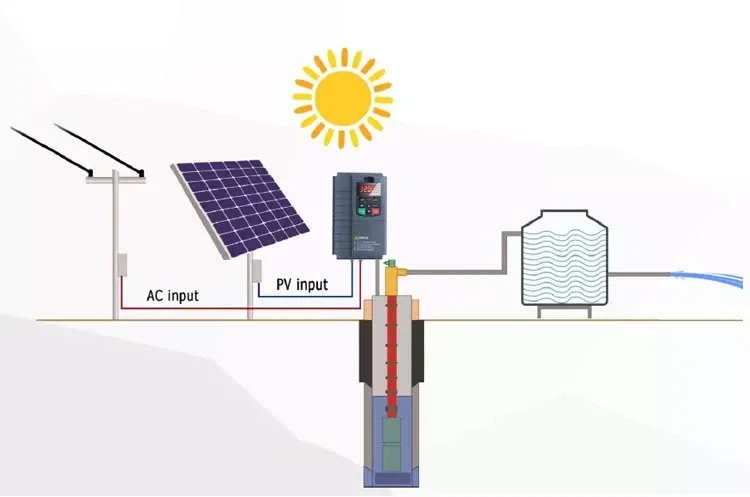
What is a solar pump VFD
A solar pump VFD (Variable Frequency Drive) is a specialized frequency converter that transforms direct current from photovoltaic panels into alternating current of the required frequency and voltage to power a pump motor. Unlike conventional frequency inverters that operate exclusively from AC mains, solar models feature a DC input with a built-in MPPT algorithm for maximum energy harvesting from solar panels.
The key difference from a standard VFD lies in three aspects:
- DC input — direct acceptance of DC power from photovoltaic panels without an external inverter or rectifier
- MPPT algorithm (Maximum Power Point Tracking) — automatic search for the maximum power point of the solar array
- Dual power supply — ability to operate from both solar panels and the electrical grid (hybrid AC/DC mode)
The system operates simply: solar panels generate DC power, which feeds into the converter's DC bus, the built-in inverter creates three-phase voltage at the required frequency, and the motor drives the pump. The entire system works without batteries — the pump delivers water when the sun shines.
How it works: MPPT and dual power supply
The heart of any solar pump inverter is the MPPT (Maximum Power Point Tracking) algorithm. Photovoltaic panels generate varying voltage and current depending on solar irradiance, temperature, and angle of incidence. The panel's I-V curve has one point where the product of voltage and current (i.e., power) is maximum — this is the MPP.
The MPPT algorithm continuously analyzes solar array parameters and adapts the converter's operating point. For example, the Veichi SI23 series achieves MPPT efficiency of 99.9%, meaning near-zero losses in energy harvesting. In practice, even under partial cloud cover, the converter automatically finds the optimal operating mode.
In addition to MPPT, solar VFDs support CVT (Constant Voltage Tracking) mode — useful for stable lighting conditions.
Dual power supply (hybrid mode) — one of the most important features. The converter automatically switches between power sources:
- During sunny conditions — powered by PV panels (free energy)
- In cloudy weather — combined mode (partial PV + partial grid)
- At night or during power outages — full grid power (or shutdown if no grid is available)
- Switching occurs automatically without stopping the pump.
Advantages of solar pump inverters
Compared to traditional water supply systems, solar VFDs offer significant advantages:
Zero fuel cost — unlike diesel generators, solar energy is free after the initial investment. For a farm with a 7.5 kW pump, this saves UAH 50,000-80,000 per year on electricity alone
No batteries required — the pump runs directly from panels. Water accumulates in a tank, which itself serves as an energy "battery"
Minimal maintenance — no moving parts (except the pump itself), no fuel, no oil. Panel lifespan: 25+ years, inverter: 10-15 years
Scalability — need more capacity? Add more panels
Environmental — zero CO2 emissions, no noise
Quick ROI — typical payback period for agricultural use is 2-3 years
Energy independence — critically important for Ukraine, where power outages have become reality
Applications in Ukraine
Ukraine has excellent conditions for solar pumping systems: 1,700 to 2,200 sunshine hours per year.
Agricultural irrigation — the largest segment. Wheat, corn, and sunflower fields in southern and central regions require irrigation precisely during sunny months when panel output peaks.
Livestock watering — water supply for cattle farms, pig complexes, poultry farms.
Fish farms and aquaculture — water circulation in ponds, aeration.
Residential water supply — private homes and villages with artesian wells.
Drip irrigation systems — the solar pump inverter regulates pressure in the drip system.
Landscape and fountain systems — parks, municipal facilities, private estates.
Industrial water supply in remote locations — construction sites, quarries.
How to choose a solar pump VFD
- Step 1: Determine pump power and motor type. Check the pump nameplate: power in kW and motor type (asynchronous, synchronous, permanent magnet).
- Step 2: Select supply voltage. For residential pumps up to 2.2 kW — single-phase 220V. For industrial from 3 kW — three-phase 380V.
- Step 3: Calculate the solar panel array. Rule of thumb: total panel capacity should be 1.3-1.5 times the VFD power rating.
- Step 4: Check DC voltage range. For example, 250-750 VDC (Veichi SI23) or 280-778 VDC (Schneider ATV320 Solar).
- Step 5: Evaluate protection features. Dry run protection, jam protection, overflow detection, automatic sleep mode.
- Step 6: Consider communication needs. The Veichi SI23 series supports cloud monitoring via GPRS/Wi-Fi/GPS for remote pump control from a smartphone.
Series comparison: Veichi SI23 vs Schneider Electric Altivar 320 Solar
| Parameter | Veichi SI23 | Schneider Altivar 320 Solar |
| Power range | 1.5 — 200 kW | 0.37 — 15 kW |
| Supply voltage | 1x220V, 3x380V | 1x220V, 3x220V, 3x380V |
| DC input (380V models) | 250 — 750 VDC | 280 — 778 VDC |
| MPPT efficiency | 99.9% | Auto MPPT |
| Motor types | Async, Sync, PM, SynRM | Async, Sync, PM |
| Built-in PLC | Yes | No (ATVLogic macros) |
| Functional safety (STO/SLS) | No | Yes (STO, SLS, SS1, SMS, GDL) |
| Communication | RS485/Modbus, GPRS, Wi-Fi, GPS | Modbus RJ45, CANopen, opt. EtherNet/IP |
| IoT monitoring | Yes (cloud platform) | No |
| Protection rating | IP20 | IP20 |
| Price range | UAH 12,994 — 138,840 | UAH 14,279 — 84,416 |
| Best for | Large agricultural, industrial | Small-medium residential, commercial |
Veichi SI23 — the optimal choice for large-scale projects up to 200 kW. Built-in PLC and IoT monitoring enable fully automated systems with remote control.
Schneider Electric Altivar 320 Solar — a premium solution for small and medium systems with built-in safety functions STO, SLS, SS1. See detailed specs on the ATV320 product page.
Installation and commissioning
Typical connection scheme:
- Solar panel array — series-parallel connection for required voltage and power
- DC disconnect switch — mandatory safety element
- Solar pump VFD — installed in a protected location (IP20 requires cabinet or shelter)
- Motor cable — from converter to motor (shielded recommended)
- Pump — borehole, surface, or submersible
- Grounding is mandatory. Panel frames, converter housing, and motor must be properly grounded.
First startup includes: auto-detection of solar array parameters, MPPT/CVT configuration, minimum frequency setting, dry-run sensor calibration, and PV-to-grid switchover test.
Detailed instructions are available on product pages: Veichi SI23 and Schneider ATV320 Solar.
Where to buy a solar pump inverter in Ukraine
- Both series — Veichi SI23 and Schneider Electric Altivar 320 Solar — are available for order on chastotnik.ua with delivery across Ukraine.
- Technical consultation — we help select the right converter and calculate panel array
- Full range — from 0.37 to 200 kW
- Warranty — official manufacturer warranty
- Delivery — Nova Poshta, Ukrposhta, door-to-door delivery
- Browse the full catalog of hybrid solar VFDs in the hybrid frequency inverters section.