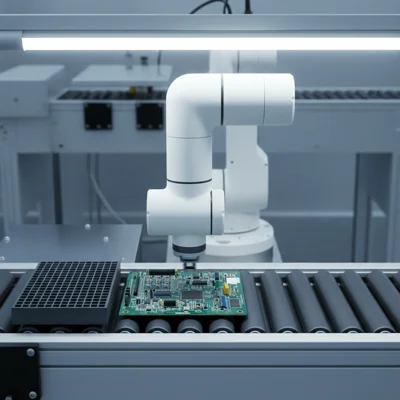
SCARA robot — 4-axis arm for precision assembly
SCARA (Selective Compliance Assembly Robot Arm) is an industrial 4-axis robot with a horizontal arm configuration. Two rotary axes are parallel (J1, J2), the third is a linear vertical axis (Z), the fourth rotates the tool flange (Roll). Vertical stiffness resembles a column, while X-Y plane compliance behaves like a flexible lever. Hence the name: selective compliance.
Quality SCARA repeatability is ±0.01-0.02 mm; a pick-and-place cycle (25-300-25 mm, ANSI/RIA standard) runs in 0.3-0.5 s — 3-5 times faster than a 6-axis on typical assembly work. At chastotnik.ua we stock the Veichi VCSH series — 8 models from 207 155 UAH, the cheapest 4-axis SCARA in Ukraine's B2B segment.
Below: how it works physically, why SCARA wins at electronics assembly, and which to pick for your line — Veichi, Epson, Mitsubishi or Yamaha.
How SCARA works — what selective compliance means
SCARA is built around a pair of parallel rotary axes. J1 is the shoulder joint at the base. J2 is the elbow, on the second link. Both rotate in the horizontal plane, so all torques close on a rigid vertical column. Payload and side impacts are absorbed by the frame, not the drives.
Four axes — enough for 80% of tasks
- J1 (shoulder): shoulder link rotation, working range ±130°, servo 400-1500 W.
- J2 (elbow): elbow link rotation, ±145°, Harmonic Drive or cycloidal gearbox.
- Z (vertical): linear axis, 150-400 mm stroke, ball screw with servo drive.
- Roll (flange rotation): ±360°, stepper or servo motor, for gripper orientation.
Why not a fifth axis? Because flat parts (PCBs, SIM trays, USB connectors) don't need a tilted tool — all operations run top-down. Adding a fifth axis would add 20-30% lever mass, cost speed and precision. Manufacturers skip it on purpose.
Why SCARA is stiff in Z and compliant in-plane
During assembly (say, pressing a connector into a PCB) the Z-axis force reaches 50-150 N. The Z column passes this into the base without bending — gearboxes stay happy. Meanwhile a small X-Y error (±0.1 mm) won't break the part: the robot nudges the component into its slot even if the flange misses on the first attempt. That's selective compliance — rigidity where precision is needed, compliance where tolerance is needed.
SCARA vs 6-axis vs Delta — which to buy
Short answer: SCARA for flat assembly, 6-axis for 3D handling and welding, Delta for ultra-fast sorting of light parts. The numbers:
| Criterion | SCARA | 6-axis | Delta |
|---|---|---|---|
| Axes | 4 | 6 | 4 (parallel links) |
| Cycle time | 0.3-0.5 s | 1.5-3 s | 0.2-0.3 s |
| Repeatability | ±0.01-0.02 mm | ±0.03-0.05 mm | ±0.05-0.1 mm |
| Payload | 1-25 kg | 3-2300 kg | 1-8 kg |
| Workspace | Cylinder | Sphere | Cone from above |
| Price from | 300 000 UAH | 500 000 UAH | 600 000 UAH |
| Best for | Assembly, pick&place | Welding, machining, 3D | Packaging, sorting |
Buy 6-axis instead of SCARA when you need tool tilt (welding torch, paint nozzle) or obstacle avoidance. Our Veichi VCR 6-axis units start at 402 802 UAH, comparable pricing to the same-brand SCARA.
Buy Delta when cycle < 0.3 s and object mass < 1 kg (chocolates, blister-packed tablets, apple color sorting).
Veichi VCSH series — 8 models in stock
Chastotnik.ua currently stocks 8 VCSH SKUs. This is the only Veichi SCARA line with official service support in Ukraine. All models use Veichi SD700 servo drives, Harmonic Drive gearboxes on the main axes, and the VC-Robot controller with EtherCAT.
| Model | Payload | Reach | Z stroke | Repeat. | Price, UAH |
|---|---|---|---|---|---|
| VCSH030-400 | 3 kg | 400 mm | 150 mm | ±0.01 mm | 207 155 |
| VCSH030-500 | 3 kg | 500 mm | 150 mm | ±0.01 mm | 207 155 |
| VCSH030-600 | 3 kg | 600 mm | 200 mm | ±0.01 mm | 207 155 |
| VCSH100-800 | 10 kg | 800 mm | 300 mm | ±0.02 mm | 287 716 |
| VCSH100-900 | 10 kg | 900 mm | 300 mm | ±0.02 mm | 287 716 |
| VCSH100-1000 | 10 kg | 1000 mm | 400 mm | ±0.02 mm | 287 716 |
| VCSH200-1200 | 20 kg | 1200 mm | 400 mm | ±0.03 mm | 448 836 |
| VCSH500-1200 | 50 kg | 1200 mm | 400 mm | ±0.05 mm | 563 922 |
Typical order config: VCSH100-800 with an SMC pneumatic gripper (extra ~15 000 UAH) plus Modbus TCP to the line PLC. This combo runs on LED-lamp and power-bank assembly lines — we shipped similar rigs to Brovary and Vinnytsia throughout 2025.
Competing SCARA brands in Ukraine
If budget allows 500k+ UAH per unit and you want a brand with decades of local service presence — here are the Veichi alternatives.
| Brand | Series | Payload | Reach | Price from, UAH |
|---|---|---|---|---|
| Veichi | VCSH | 3-50 kg | 400-1200 mm | 207 155 |
| Epson | G / T-series | 2.5-20 kg | 350-1000 mm | 600 000 |
| Mitsubishi | RH-3 / 6 / 20 | 3-20 kg | 350-1000 mm | 750 000 |
| Yamaha | YK-XE | 3-12 kg | 350-900 mm | 650 000 |
| Omron | i4 / eCobra | 6-20 kg | 400-1200 mm | 720 000 |
Epson is the fastest (0.29 s cycle on G6). Mitsubishi is the toughest, MTBF 80 000 hours, but spares arrive in 6-8 weeks. Yamaha leads in semiconductors — 60% of Taiwanese fab SCARAs are theirs. Veichi VCSH loses on cycle (we measure 0.38-0.42 s on VCSH030), but wins on price and lead time — 10-14 days from Kyiv stock.
Typical SCARA applications
Below are the real fields where SCARA delivers the best ROI. The list is pulled from Ukrainian integrator cases, 2023-2025.
- Mobile phone and electronics assembly. SIM tray insertion, USB-C connector pressing, chip pre-solder positioning. 0.4 s cycle, up to 7200 operations per 8-hour shift. SCARA replaces human conveyor work here — fingers don't survive 3000+ identical motions per hour.
- Sealant and adhesive dispensing. On car windshields, EV batteries, phone shells. The robot holds the nozzle perpendicular to the surface, linear speed 300-500 mm/s, bead thickness error ±0.2 mm. Pairs with Nordson or Graco pneumatic/piston dispensers.
- Pick-and-place in pharma packaging. Ampoule blister sorting, 4+4+4 box kitting, DataMatrix serialization. SCARA works in an ISO 7 laminar box, wipes clean with alcohol, sheds no particles. Typical model — VCSH030-500 with vacuum gripper.
- PCB testing (ICT/FCT). Probes test points, holds 2-5 N pressure, reads signals via Keysight or Teradyne testers. Repeatability ±0.01 mm is critical here — test-point spacing is 0.5-1 mm.
- Screw driving. On appliance shells, servers, automotive modules. An electric screwdriver head mounts on the flange, torque 0.1-5 Nm, encoder feedback. One SCARA handles 15-20 fastening points in 10-12 s.
- Labeling/tagging in food. Sticker placement on bottles, cans, sausage casings. Conveyor speed 60-120 pc/min, SCARA grabs from the magazine and applies at ±0.3 mm accuracy. In meat plants we pair VCSH100-800 with a washdown zone — IP65 protection handles disinfection.
All these tasks need the right servo drive on auxiliary axes (conveyor, indexing table) and a PLC with an EtherCAT master. Without proper automation a SCARA is an expensive toy.
How to pick a SCARA — 6 steps
- Weigh the object together with the gripper. Not "component weighs 80 g" but "component + vacuum gripper + pneumatic valve". Often it's already 1.2-1.5 kg. Pick a model with 30-40% margin over max payload.
- Measure max reach to the work point. SCARA workspace is a cylinder of radius R (reach) and height Z. If the part sits at 950 mm, VCSH100-800 won't reach — you need VCSH100-1000.
- Set repeatability from process requirements. USB-C connector pressing needs ±0.02 mm. Label placement — ±0.3 mm is fine. Don't pay for precision your operation won't use.
- Calculate cycle and line takt. If the conveyor runs 120 pc/min, you have 0.5 s per operation. That must cover: robot approach, pickup, move, place, retract. VCSH030 can hold 0.5 s takt, VCSH500 cannot (0.8-1.0 s).
- Pick the brand by service, not badge. If your plant is in Dnipro, look at engineer response time and spare parts availability in Kyiv. Veichi stocks in Brovary, Mitsubishi in Kyiv, but a replacement gearbox from Germany takes 6 weeks.
- Add machine vision if parts arrive unordered. Cognex In-Sight 2800 or Keyence CV-X are the standard SCARA pairings. Integration via Ethernet/IP or TCP/IP, cost 180-300k UAH with optics and lighting.
SCARA integration into a production line
A typical SCARA cell in our shop looks like this: VCSH100-800 in the center, left — a belt conveyor driven by a Veichi AC310 VFD 2.2 kW (soft start/stop, encoder sync), right — a rotary table with a stepper drive, above — a Cognex camera. Everything runs under a Delta DVP-28SV2 PLC with EtherCAT module. HMI — a Veichi HMI-K104 10.1" touchscreen, operator selects recipes with 50+ parameters.
- Protocols: EtherCAT — between robot controller and servos (1 ms cycle). Modbus TCP — between robot and line PLC (10-50 ms, enough). Profinet — if the line is Siemens-based.
- Safety: category 2 light curtain (Pilz, Sick) at the zone entry, e-stop on the panel, interlocked door switch.
- Sensors:inductive and optical proximity sensors on the conveyor — part position detection before the work zone. Typically 3-5 per cell.
Full build from scratch — mechanics, electrics, programming, commissioning — runs 6-10 weeks. For typical tasks (pick-and-place, screw driving) our engineers deliver a turnkey project in 3-4 weeks.
Operation and maintenance
Harmonic Drive gearbox life on the main axes is 25 000-40 000 hours to replacement. That's 10-15 years of 2-shift operation. Gearbox grease change — every 5 000 hours or 2 years, whichever comes first, roughly 80-120 g per axis, special lubricant (Harmonic Grease SK-2).
Repeatability calibration — once a year, and mandatory after any major repair. Procedure: laser tracker (Leica AT960 or FARO Vantage) or factory calibration rig, 15-30 minutes per robot. After a year on VCSH100 we saw positioning drift of 0.03-0.05 mm — calibration brought it back to the spec ±0.02 mm.
Environment: standard SCARA rating is IP40 (dust, no water). Food and pharma lines go IP54 or IP65 — Veichi VCSH adds this as an option for +18-25% on price. Ambient temperature +5...+45 °C, humidity up to 90% non-condensing.
Basic quarterly inspection: visual belt check (if present), base bolt torque (120-160 Nm for VCSH100), flange dust cleaning, pneumatic pressure verification. 30-40 minutes of technician time, nothing fancy.
Frequently Asked Questions
What is SCARA in simple terms?
It's a 4-axis industrial robot built on the principle "stiff down, compliant sideways." It moves small parts fast and precisely in a horizontal plane — ideal for electronics assembly, packaging, and testing. Unlike a 6-axis, it can't tilt its tool, but it's 2-3x faster on standard pick-and-place work.
How does SCARA differ from a 6-axis robot?
SCARA has 4 axes and works in a cylindrical envelope — fast, accurate, no tool tilt. A 6-axis has 6 axes, works in a sphere — can angle a torch, nozzle or gripper however you want, but slower. SCARA is for flat assembly; 6-axis is for welding, machining, palletizing, and 3D handling.
How much does a SCARA cost in Ukraine?
From 207 155 UAH for Veichi VCSH030-400 (3 kg / 400 mm reach). Mid-range 280-450k UAH (VCSH100 and VCSH200). European and Japanese brands (Epson, Mitsubishi, Yamaha) start at 600-750k UAH. Budget another 15-25% for gripper, 10-15% for commissioning.
What repeatability does SCARA have?
Small models (3-5 kg payload) — ±0.01 mm. Mid models (10-20 kg) — ±0.02-0.03 mm. Heavy models (50+ kg) — ±0.05 mm. That's 3-5x tighter than a typical 6-axis and 5-10x tighter than Delta. Enough precision for USB connector seating, press-fitting and ICT probing.
When is SCARA NOT the right fit?
For welding (you need torch tilt — go 6-axis), for palletizing 20+ kg crates above 1.5 m (reach and Z are too short — pick a palletizer or a heavy 6-axis), for painting complex surfaces (tilt again), for tight-space work with obstacle avoidance (cylindrical envelope won't let you).
Bottom line — which SCARA to buy in 2026
If you're assembling electronics, packing pharma, or running screw driving — SCARA gives you a 2-3x faster cycle at the same money as a 6-axis. Our budget line Veichi VCSH (207-564k UAH) covers 80% of Ukrainian tasks — 8 models on stock, 10-14 day delivery. For demanding lines (semiconductors, premium auto) go Epson or Mitsubishi, but budget 600k+ UAH and 8-12 week lead times. Don't forget the vision camera (+200k UAH), servo drives on auxiliary axes, and a proper PLC with EtherCAT. Questions on a specific project — ping our engineers, we'll size the config in 1-2 business days.