Motor rotation speed — how to choose the right one
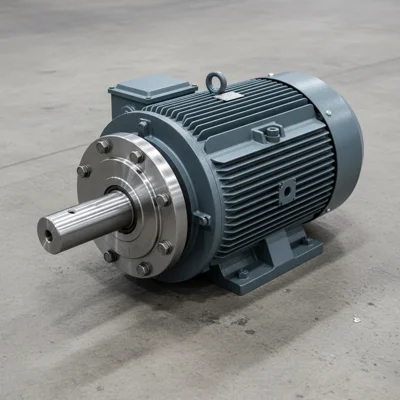
750, 1000, 1500, or 3000 rpm — these are the four standard speeds of induction motors at 50 Hz. The right choice depends on the driven machine. Get the speed wrong and you either spend extra on a gearbox, accelerate wear, or the equipment simply does not work correctly.
What determines speed: poles and frequency
An induction motor speed depends on two things: supply frequency (50 Hz in Ukraine) and the number of pole pairs. The formula is simple:
n = 60 × f / p
where n is synchronous speed (rpm), f is frequency (Hz), p is the number of pole pairs.
| Pole count | Pole pairs | Synchronous speed | Actual speed (with slip) |
|---|---|---|---|
| 2 | 1 | 3000 rpm | 2850–2950 rpm |
| 4 | 2 | 1500 rpm | 1420–1470 rpm |
| 6 | 3 | 1000 rpm | 950–980 rpm |
| 8 | 4 | 750 rpm | 710–735 rpm |
Slip — the difference between synchronous and actual speed — is necessary for induction motor operation: no slip means no induced voltage, no induced voltage means no torque. Typical slip is 2–5%.
3000 rpm (2-pole): when and why
The fastest standard motor. Compact at the same power rating.
- Centrifugal pumps — most run at ~2900 rpm
- High-pressure fans — ID fans, forced-draft fans
- Grinding machines
- Woodworking — table saws, routers
Downsides: higher noise, heavier bearing load, lower torque at same power. Not recommended for hard-starting loads (compressors, conveyors).
1500 rpm (4-pole): the gold standard
Roughly 60–70% of all industrial motors are 4-pole. The most versatile speed.
- Conveyors and material handling
- Compressors — reciprocating and screw
- Mixers and agitators
- Pumps — submersible, borehole, some centrifugal
- Fans — duct, roof, low-pressure centrifugal
If unsure — start with 1500 rpm. AIR and WEG W22 at 1500 rpm have the widest range available.
1000 rpm (6-pole): low-speed machinery
For applications where speed must be low and torque high. Larger frame at same power, more expensive.
- Slow-speed agitators
- Large-diameter fans — axial, direct drive
- Mills and crushers
- Roller tables, turntables
750 rpm (8-pole): rare breed
Eight-pole motors are uncommon. Large, expensive, lower efficiency.
- Slow conveyors without gearbox
- Cranes and hoists
- Special pumps
In most cases a 4-pole motor with a gearbox is cheaper.
Need a non-standard speed? Use a VFD
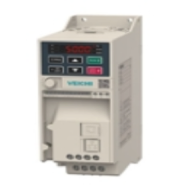
A variable frequency drive removes the standard-speed constraint. With a VFD a 4-pole motor runs at any speed from 0 to 1500 rpm and even above.
Speed comparison table
| Parameter | 2-pole | 4-pole | 6-pole | 8-pole |
|---|---|---|---|---|
| Speed | ~2900 | ~1450 | ~960 | ~720 |
| Torque (at 7.5 kW) | 25 N·m | 50 N·m | 75 N·m | 100 N·m |
| Frame (at 7.5 kW) | 132S | 132M | 160M | 160L |
| Efficiency (IE3) | ~90% | ~91% | ~89% | ~87% |
| Noise | High | Medium | Low | Low |
| Price | Lowest | Standard | +20–30% | +30–50% |
Frequently Asked Questions
How to find the speed if the nameplate is gone?
Count pole pairs via stator slots or measure speed with a tachometer. Frame size and power can also determine pole count using the AIR table.
Can I replace a motor with a different speed?
Only if the driven machine allows it. Swapping a 4-pole for a 2-pole doubles the speed — this can destroy a gearbox. Always check with the equipment manufacturer.
What is "slip"?
The difference between synchronous and actual shaft speed. For a 4-pole motor: 1500 synchronous, ~1450 actual. Slip is 50 rpm (3.3%). Higher load means higher slip.
Is a dual-speed motor worth it?
Dual-speed motors exist but are expensive. A 4-pole motor with a VFD is usually cheaper and gives smooth adjustment across the full range.
Which speed for a pump?
Surface centrifugal — 3000 rpm. Borehole — 3000 or 1500. Gear and screw — 1500. When in doubt — check the pump datasheet.
Summary
For most applications 4-pole (1500 rpm) is the right pick. 2-pole for pumps and high-speed machines. 6 and 8 poles for special slow-speed duties. With a VFD one 4-pole motor covers all four. Browse WEG and AIR catalogs for selection.