Industrial APCS Start-up & Commissioning Services
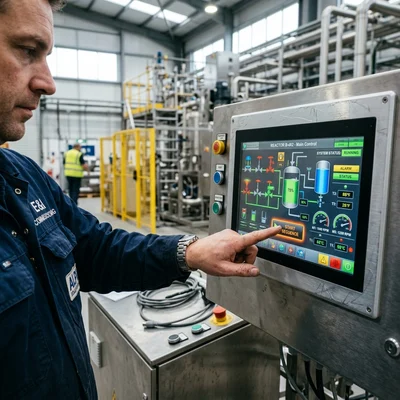
Expert APCS commissioning represents the final and most critical phase of implementing modern industrial automation systems before initiating full-scale commercial operation. Performing comprehensive start-up and commissioning works allows engineering teams to identify and rectify design or installation errors, validate emergency interlocks and safety loops, and optimize machinery to achieve its nominal efficiency. Our certified automation engineers execute deep automation testing, integrate field instrumentation and industrial networks, calibrate variable frequency drives (VFDs) and programmable logic controllers (PLCs), and conduct complete HMI startup tasks to deliver a fully functional, safe, and transparent operator environment.
On-site Commissioning Stages: Step-by-Step Procedure
Commissioning procedures are executed in strict accordance with international standards, industrial safety regulations, and equipment manufacturer guidelines. Every stage of the process is documented, requiring formal intermediate reports and bilateral acceptance certificates to ensure maximum reliability and transparency.
- Pre-commissioning Audit and Cold Testing: This stage begins immediately after the completion of mechanical and electrical installations. Our specialists perform comprehensive visual inspections of control cabinets and power distribution boards, conduct insulation resistance checks (meggering) of cables, and measure grounding loop impedance. Direct point-to-point electrical checks are performed on all power and control lines. In dry run testing (cold tests), mechanical units, pumps, and pneumatic actuators are operated without process medium to verify proper motor rotation directions, valve stroke limits, and mechanical clearances.
- Signal Loop Verification and Network Checks (Loop Checks): Every discrete and analog channel connecting field devices (sensors, transmitters, valves, actuators) to the PLC input/output (I/O) modules undergoes individual point-to-point loop testing. This verifies that electrical inputs correctly register in the controller software and that control outputs actuate the physical devices. In parallel, industrial communication networks (such as Modbus TCP/RTU, Profinet, EtherCAT, and CANopen) are audited to eliminate transmission errors and configure optimal data exchange rates between distributed I/O blocks.
- Parameter Scaling and Sensor Calibration: Field service engineers configure and calibrate all primary measurement instruments. For analog loops using standard 4-20 mA current signals or 0-10 V voltage lines, precise parameter scaling is configured inside the PLC software environment. For example, a physical range of 0 to 10 bar on a pressure transmitter is mapped to a 4-20 mA signal while compensating for sensor mounting offsets and zero-point drift. VFD parameters are also configured, including acceleration/deceleration ramps, motor nameplate data, and current/torque limits.
- Wet Commissioning and Dynamic Tuning (Hot Testing): These tests are conducted on live, operational systems with actual process fluids, raw materials, and utility supplies. The primary goal is to perform dynamic tuning of closed-loop controllers, specifically tuning proportional, integral, and derivative (PID) coefficients for temperature, pressure, flow, and level control loops. By analyzing step response curves, our engineers optimize these parameters to prevent oscillations, minimize settling times, and maintain target setpoints under varying load conditions. Safety interlocks and emergency shutdown (ESD) systems are fully validated.
- Site Acceptance Testing (SAT Testing): The final phase of system validation at the customer's facility (Site Acceptance Testing). The entire automation infrastructure is tested under continuous nominal operating load, typically for 24 to 72 hours of uninterrupted production. SCADA system stability, alarm archiving, historical data logging, and database operations are verified. All operation modes (manual, automatic, emergency, and maintenance) are tested. A comprehensive SAT certificate is signed upon successful completion, signaling formal handover to the client.
Technical Testing and Parameter Reference Table
To standardize quality control during the commissioning process, our engineers utilize a rigorous checklist and parameter matrix. Below is a typical checklist showing typical industrial testing operations, methodologies, and expected outcomes.
| Commissioning Checkpoint / Testing Phase | Methodology & Measurement Instruments | Technical Norms & Expected Target Outcome |
|---|---|---|
| Electrical Safety & Insulation Audit | Testing insulation resistance using a calibrated megohmmeter at 500V/1000V DC; checking grounding loop continuity. | Insulation resistance for signal lines >= 0.5 MOhm; power circuits >= 1.0 MOhm. Secure control panel grounding connection. |
| Analog Signal Calibration (4-20 mA) | Simulating signals using a process calibrator at 4 mA (0%), 12 mA (50%), and 20 mA (100%); checking values inside the PLC. | HMI display error does not exceed 0.1% of the full measuring scale. Zero-point drift completely eliminated. |
| Analog Voltage Loop Testing (0-10 V) | Applying stable reference voltages with a precision power supply; monitoring potential drop on long cable runs. | Voltage drop compensation active. Clean signal path free from high-frequency electromagnetic interference (EMI). |
| Functional Point-to-Point Loop Check | Actuating field limit switches, pressure sensors, and pushbuttons; validating corresponding I/O variables in PLC. | 100% correlation between physical wire terminals, I/O card channels, and internal PLC database tags. |
| Safety Interlock & Emergency Stop (ESD) | Triggering emergency stop pushbuttons and safety sensors; verifying control relay de-energization. | Instantaneous power shutdown to critical actuators, transitioning the entire system to a fail-safe state. ESD override active. |
| Dynamic PID Controller Tuning | Analyzing system response to setpoint changes; applying mathematical models to calculate optimal gain, integral, and derivative times. | Minimum settling time, overshoot restricted below 10%, zero steady-state error, and zero auto-oscillations across full load range. |
| Final FAT / SAT Handover Validation | Executing the approved SAT protocol under load; verifying historian archiving, automated reporting, and alarms. | Trouble-free, continuous operation under load. Handover of finalized electrical schematics, PLC code backups, and manuals. |
Value-Added Engineering Services
Beyond standard loop checks and basic signal calibration, our team delivers comprehensive integration support. We customize Human-Machine Interface (HMI) screens to optimize operator ergonomics, presenting intuitive process mimics, dynamic trend displays, active alarm banners, and step-by-step diagnostic prompts. This helps control room operators react swiftly and accurately to process fluctuations, reducing human error.
Another key engineering service is integration with factory-level systems such as MES (Manufacturing Execution Systems) or ERP platforms. We set up data collectors to monitor key performance indicators (KPIs), track utility consumption, and log equipment runtimes to support predictive maintenance schedules. Our team resolves compatibility issues between legacy machinery and new automation systems by developing custom communication interfaces and hardware gateways.
To ensure long-term operational success, we conduct detailed on-site training sessions for the plant's maintenance technicians and operators. Our training curriculum covers safe system operation, alarm response protocols, controller diagnostics (understanding LED indicator codes and system messages), and database backup/restore procedures, empowering your team to handle routine maintenance independently.
Order Professional Commissioning Services
Our company deploys mobile engineering teams equipped with high-precision calibration instruments and certified by leading global automation brands. We guarantee strict adherence to project deadlines, compliance with local safety regulations, and premium service quality. To request a customized commercial proposal, discuss an upcoming commissioning project, or consult on upgrading an legacy automation system, please contact our engineering division via our official Contacts page.