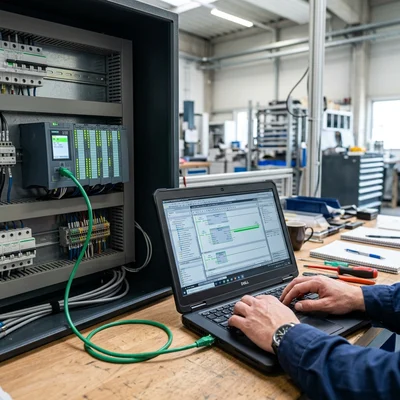
Industrial PLC Programming & SCADA System Development for APCS
Services that include professional plc programming and comprehensive design of automated process control systems form the backbone of modern industry. Chastotnik.ua engineers perform complex controller programming, configuration of network interfaces, and complete scada development for central data acquisition and dispatching of industrial sites. We provide reliable integration of field equipment via the industry-standard Modbus RTU protocol on the physical RS-485 layer, as well as high-speed Ethernet-level industrial buses such as Profinet and EtherCAT. All logic algorithms are developed in professional engineering environments, including the open platform CoDeSys, TIA Portal, Step 7, ISPSoft, and GX Works, in strict accordance with the requirements of international industrial standards.
Methodology and Architecture of PLC Software Development
Writing software for industrial controllers requires strict adherence to requirements for fault tolerance, deterministic cycle scan time, and prevention of runtime crashes. We design software based on the international IEC 61131-3 standard, selecting the optimal language for each class of tasks. For complex mathematical calculations, array processing, and signal filtering algorithms, Structured Text is utilized. To build the core sequential control logic and handle discrete I/O interlocks, graphical languages like Ladder Diagram and Function Block Diagram are preferred. Independent cyclic processes with clearly defined state steps and transitions are implemented using Sequential Function Chart. This structured approach not only guarantees real-time execution reliability but also simplifies subsequent diagnostics, maintenance, and future system modifications by the plant engineering staff.
Detailed Software Development and Commissioning Process
Creating a highly reliable industrial automation system is a rigorous engineering process consisting of several mandatory stages:
- Technical Requirements Analysis and Register Map Design: At the initial stage, our engineers carefully analyze the technological process and compile a complete list of discrete and analog I/O points. We design the Modbus register map or Profinet hardware configuration to govern the exchange between the PLC, variable frequency drives, HMI panels, and SCADA. This includes defining 16-bit holding registers and bitwise coils to avoid data collision and ensure robust integration of multi-brand hardware into a single network loop.
- Hardware Configuration and PLC Architecture Selection: Based on I/O count and performance requirements, we select the central processing unit, digital/analog input/output expansion modules, and communication modules. We work with Siemens S7-1200/1500, Delta DVP/AS, Veichi VC, INVT, and Schneider Electric Modicon platforms. At this stage, the hardware Watchdog Timer is configured, and the target program scan cycle is set, typically not exceeding 10 to 20 milliseconds for highly dynamic applications.
- IEC 61131-3 Compliant Coding: Logic code development is carried out inside professional software suites. We create dedicated Function Blocks to control VFDs, solenoid valves, pumps, and other actuators. Safety algorithms such as pump dry-run protection, motor overload detection, short-circuit interlocks, and emergency stop sequences are implemented. The code is carefully organized into logical Program Organization Units with comprehensive inline comments to facilitate future diagnostics.
- Mathematical Modeling and Software Emulation: Before dispatching engineers to the site, the developed software undergoes thorough testing in emulation mode. Utilizing integrated simulators and process simulation software, our engineers model the technological loops, mimic sensor feedbacks, and validate interlock behavior under extreme and abnormal conditions. This allows us to eliminate up to 95% of logical bugs at the development stage, drastically reducing on-site commissioning time.
- HMI Design and Integration: Parallel to the PLC coding, we design intuitive graphical user interfaces for operator panels such as Weintek, Kinco, Delta DOP, and Siemens Comfort. The HMI screens visualize real-time process parameters, generate dynamic trend charts, and implement structured Alarm handling with historical event logging. Communication between the HMI and the PLC is configured via Modbus TCP or Profinet for low latency display and setpoint input.
- SCADA System Design and Deployment: For the supervisory level, a full-featured SCADA system is developed. This includes designing animated process mimic screens, setting up SQL databases for long-term historical data archiving, designing shift/daily production reports, and integrating the system with corporate IT networks using OPC UA. SCADA allows operators to supervise the entire plant from a single control desk.
- On-site Commissioning and Field Testing: Our engineering team arrives at the customer's industrial facility for final setup. This stage includes checking cable routing, verifying motor rotation directions, calibrating analog sensors, and verifying grounding integrity. Dry runs are executed, followed by real-load tuning. Particular attention is given to the precise tuning of PID controller parameters for temperature, pressure, or flow loop stabilization.
Comparative Analysis of Industrial Automation Architectures
To choose the correct system configuration, it is critical to understand the technical capabilities and application boundaries of various communication protocols. Below is a detailed comparison of solutions used in PLC and SCADA system designs:
| Comparison Metric | Modbus RTU / TCP Based Solutions | Profinet Based Solutions | EtherCAT Based Solutions |
|---|---|---|---|
| Data Transmission Speed | Low to medium. Sequential polling using Master-Slave. Suitable for systems with response times above 100 milliseconds. | High. Operates in real-time, providing critical data transfer in milliseconds for dynamic assembly lines. | Extremely high. Processing telegrams on-the-fly ensures sub-millisecond synchronization for multi-axis servo systems. |
| Physical Network Layer | Shielded twisted pair for RS-485 or standard Category 5e Ethernet cable for Modbus TCP. | Industrial Category 5e Ethernet cable or higher with enhanced protection against electromagnetic noise. | Industrial Category 5e Ethernet cable, supporting ring, star, or line topologies without active network switches. |
| Maximum Bus Length | Up to 1200 meters for RS-485 without repeaters at 19.2 kbps, up to 100 meters between TCP nodes. | Up to 100 meters between active network switches. | Up to 100 meters between neighboring devices, total bus length is virtually unlimited. |
| HMI & SCADA Integration | Direct register polling via Modbus maps. Requires manual register address configuration in each device. | Easy integration via device names and GSDML file variable imports. Highly resilient against communication dropouts. | Integration via OPC UA servers or specialized PLC communication boards. Best suited for high-speed motion control. |
| Diagnostics & Logging | Basic diagnostics. CRC checksum checks and Modbus exception error codes. | Deep real-time diagnostic capabilities covering individual physical ports and I/O module health. | Instant physical cable break detection with precision down to the exact port and node. |
Integration of Drives and Sensors into a Unified Automation Loop
In most industrial systems, the PLC acts as the brain while variable frequency drives and soft starters act as the muscles. When connecting them, we pay utmost attention to protecting communication buses from electromagnetic interference. Motor power cables must be shielded, and RS-485 communication cables are routed away from power lines with shielding grounded at a single point and 120 Ohm end-of-line termination resistors installed. We configure comprehensive drive parameter mapping via the PLC, including start/stop commands, speed references, acceleration/deceleration ramps, and readouts of active fault codes. All analog signals from pressure, temperature, or flow transmitters pass through software low-pass filters in the PLC to suppress high-frequency electrical noise before entering the PID loop. This engineering practice guarantees stable process control under harsh industrial environments.
Ordering Professional PLC & SCADA Programming Services
If your enterprise requires modernization of legacy control panels, software development for a new production line, integration of frequency converters into a single control network, or the deployment of a SCADA control room, reach out to the Chastotnik.ua engineering center. Our specialists possess licensed development tools, professional diagnostic instruments, and extensive hands-on experience in executing complex industrial projects. For technical consultation, project requirements discussion, and cost estimation, visit our Contacts page and submit an inquiry or call our engineering team directly.